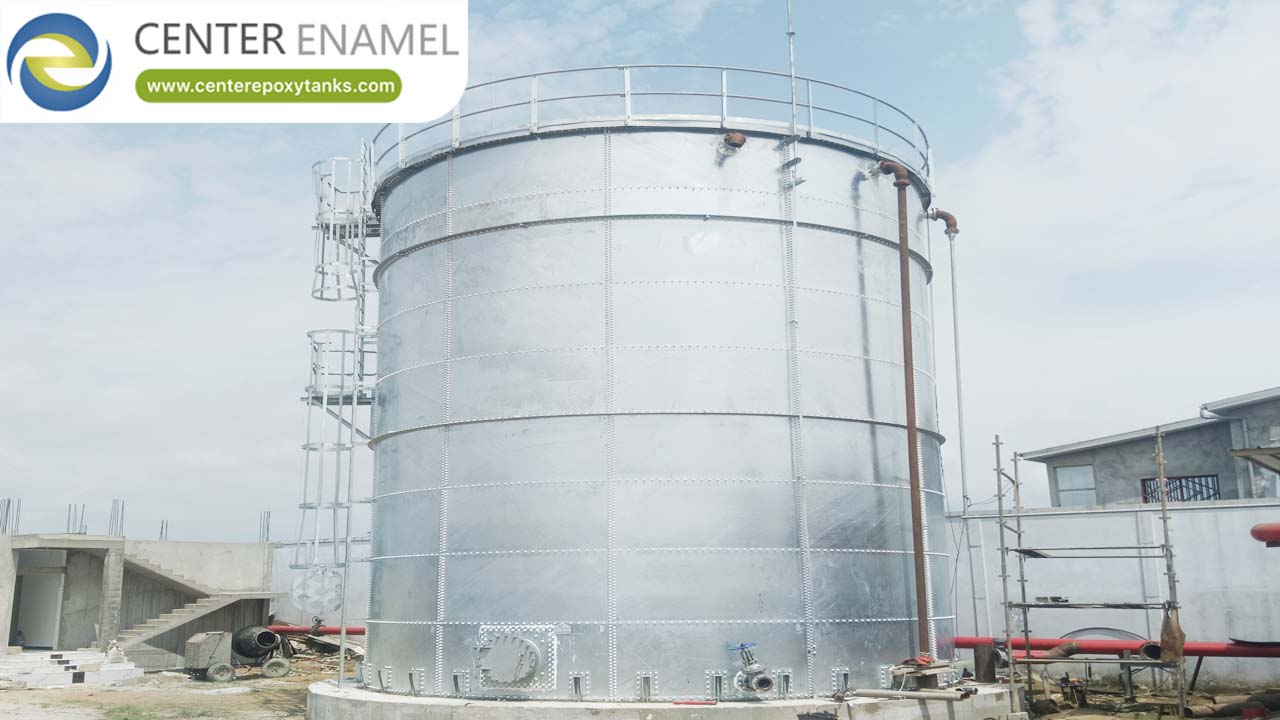
Galvanized Steel Silos for Wheat Storage: Industrial Best Practices
For wheat production, storage is not merely about containment; it is about preservation. Wheat is a living biological commodity that requires precise control over moisture, temperature, and aeration to maintain its grade, nutritional value, and market price.
Center Enamel (Shijiazhuang Zhengzhong Technology Co., Ltd.) specializes in the design and fabrication of galvanized steel silos that provide an airtight, moisture-resistant environment, far superior to traditional concrete or bag storage.
Why Galvanized Steel is the Gold Standard for Wheat
The transition from traditional storage methods to galvanized steel is driven by the need for efficiency and quality control. Unlike concrete, which is porous and susceptible to cracking, galvanized steel offers:
Superior Moisture Control: High-grade galvanized steel prevents external humidity from penetrating the structure, protecting wheat from mold, mycotoxins, and clumping.
Pest & Rodent Resistance: The smooth, sealed surface of a steel silo eliminates cracks and crevices where pests thrive, ensuring a hermetic-like environment that protects inventory without over-reliance on chemical fumigation.
Thermal Regulation: Steel has lower thermal mass than concrete, meaning it does not "store" heat as long. When integrated with aeration systems, steel silos cool down faster, preventing the "hot spots" that lead to grain spoilage.
Long-Term Durability: The galvanized coating acts as a sacrificial anode, preventing oxidation and rust, providing a structural life cycle of 20–30+ years with minimal maintenance.
Technical Comparison: Wheat Storage Solutions
Feature | Galvanized Steel Silo | Concrete Silo | Bag Storage |
Moisture Resistance | High (Hermetic Sealing) | Low (Porosity issues) | Very Low (Tearing risk) |
Maintenance | Low (Bolt/Panel check) | High (Cracking/Patching) | Constant (Replacement) |
Installation Speed | Fast (Modular/Bolted) | Very Slow (Pour-in-place) | N/A |
Pest Control | Excellent (Sealed) | Moderate (Cracks harbor pests) | Poor (Easy entry) |
Expansion Capability | Easy (Modular units) | Impossible (Static) | High Land Usage |
Key Features of Industrial Wheat Silos
To ensure optimal wheat preservation, modern steel silos from Center Enamel integrate several advanced systems:
Automated Aeration Systems: Regulated airflow moves through the grain bulk to maintain consistent temperature and moisture profiles.
Temperature Monitoring: Integrated digital sensors detect early-stage temperature rises, allowing for preemptive ventilation adjustments.
Advanced Discharge Design: Hopper-bottom or flat-bottom configurations with sweep augers ensure "first-in, first-out" inventory management, preventing old grain stagnation.
Weather-Proof Coating: Specialized high-gauge galvanized coatings are tested for extreme environmental conditions, from high-humidity coastal zones to arid, high-temperature regions.
Frequently Asked Questions (FAQ)
1. How does a galvanized steel silo prevent moisture damage to wheat?
The silo uses a multi-layered sealing design at all joints and connections, preventing rainwater ingress. Furthermore, the steel wall allows for faster heat dissipation, which, when paired with an aeration system, keeps the moisture equilibrium stable and prevents condensation.
2. Can I expand my storage capacity in the future?
Yes. Galvanized steel silos are modular. Unlike concrete structures, you can easily install additional silos or upgrade your existing configuration as your wheat yields increase, providing greater scalability for your facility.
3. How long does the galvanized coating last?
Under normal environmental conditions, high-quality galvanized steel silos can last for 20–30 years. The zinc coating creates a "sacrificial" layer that protects the base steel from oxidation, significantly outlasting the functional life of traditional storage methods.
4. Is a steel silo easier to clean than a concrete one?
Yes. Steel silos feature smooth interior walls with fewer seams or porous surfaces. This makes them significantly easier to clean and disinfect between grain rotations, reducing the risk of cross-contamination from old residues or pests.
5. What do I need to prepare for a silo foundation?
Steel silos are significantly lighter than concrete ones, which reduces the structural requirements for the foundation. However, they still require a professional geotechnical evaluation to ensure the load-bearing capacity matches the total weight of the wheat at maximum capacity.


