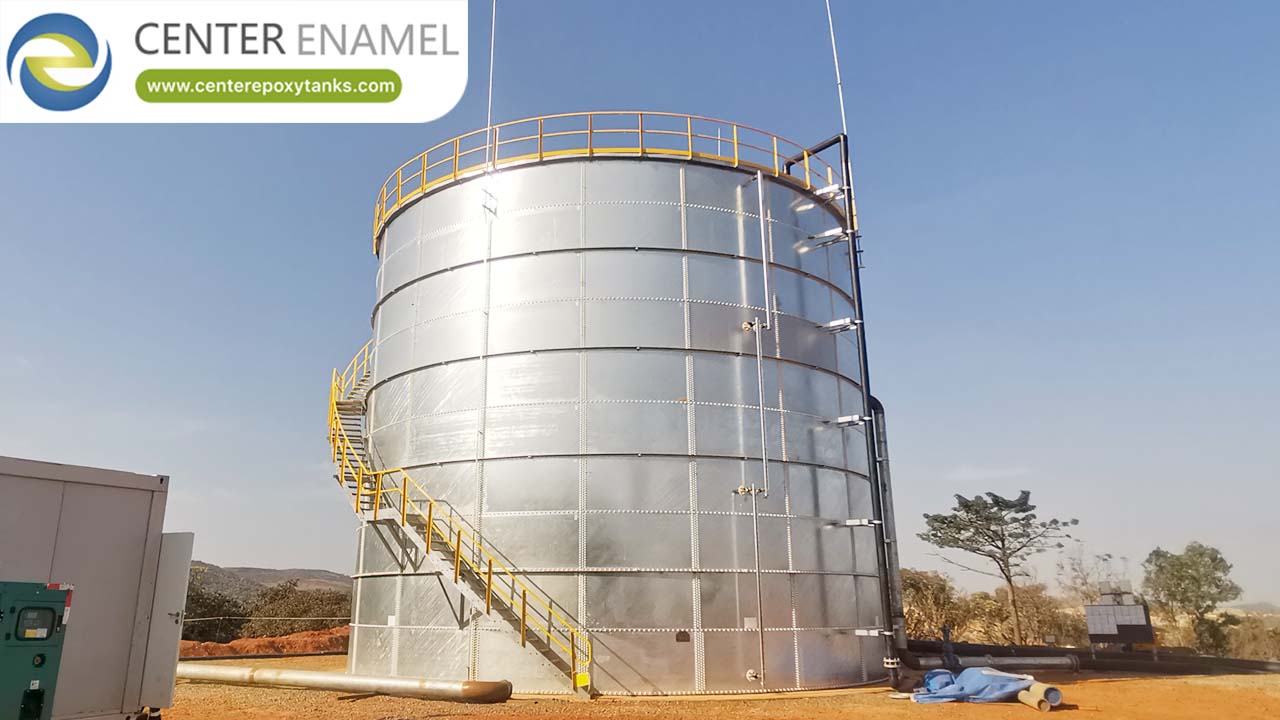
Galvanized Steel Harvested Rainwater Tank Manufacturer: Engineering & Procurement Guide
For large-scale agricultural, municipal, and industrial rainwater harvesting, the containment vessel must offer a balance of structural resilience, rapid deployment, and cost-efficiency. Galvanized bolted steel tanks have become the industry standard for these applications, providing a robust alternative to expensive concrete basins or short-lived plastic reservoirs. By leveraging China’s sophisticated manufacturing base, project planners can source high-precision, modular storage solutions that meet international benchmarks while optimizing capital expenditure.
1. Metallurgical Science: The Galvanization Process
The reliability of a galvanized tank rests entirely on the quality of its protective barrier. Unlike standard field-painted tanks, a high-quality galvanized panel undergoes a rigorous thermal manufacturing process.
Hot-Dip Galvanization (The Fused Alloy Barrier)
● The Process: Precision-punched carbon steel sheets are pickled (acid-cleaned) and submerged into a bath of molten zinc at temperatures between 440°C and 460°C.
● The Result: This reaction creates an inseparable metallurgical bond consisting of zinc-iron alloy layers shielded by a pure zinc exterior.
● Coating Standards: Elite manufacturers enforce standards such as ISO 1461 or ASTM A123, ensuring coating weights often exceeding 610 g/m² (approx. 85 microns).
● Cathodic Protection: The zinc layer acts as a sacrificial anode. If the panel is scratched during assembly, the surrounding zinc will corrode preferentially to the steel, effectively "self-healing" the breach and preventing rust creep.
2. Engineering Architecture: Modular Bolted Panels
Galvanized tanks are engineered as "kits" that minimize on-site logistics and installation risk.
Structural Integrity & Design Codes
● Code Compliance: Modern Chinese manufacturers design to AWWA D103 (the international standard for bolted steel tanks) and ASCE 7 (for wind and seismic load resilience).
● Clear-Span Support: For rainwater harvesting, these tanks are often paired with specialized lightweight roofs designed to handle local snow and wind loads without internal support columns, ensuring the entire volume is available for water storage.
● Gasket & Sealing Matrix: The panel seams are the critical failure points in low-quality tanks. Superior manufacturers utilize high-performance synthetic elastomeric gaskets (such as EPDM or Viton) that accommodate thermal expansion and contraction without losing structural tightness.
3. Comparative Performance Matrix
When evaluating storage technology, consider the total lifecycle value.
Performance Vector | Galvanized Bolted Steel | Poured-in-Place Concrete | Plastic/Polymer Tanks |
Installation Speed | Fast (Modular/No curing) | Very Slow (Curing required) | Moderate |
Structural Integrity | High (High-tensile steel) | High (But prone to cracks) | Low (Degrades over time) |
Scalability | High (Modular expansion) | None (Permanent size) | None |
Maintenance | Low (Minimal patching) | High (Crack injection) | Very High (Repair difficult) |
Initial Cost | Economical | High (Infrastructure intensive) | Varies (High for large sizes) |
4. Procurement Vetting Matrix
Sourcing from China requires distinguishing between specialized industrial fabricators and general metal-working shops. Use this checklist to qualify your partner:
● Certification Adherence: Does the manufacturer hold ISO 9001 (Quality) and ISO 14001 (Environmental) certifications? Are their panels tested to meet NSF/ANSI 61 if the harvested water is intended for potable use?
● Factory Transparency: Ask for video documentation of the galvanization bath. Are the panels fully submerged or spray-painted? (True hot-dip is essential).
● Third-Party Inspection (TPI): A reliable manufacturer will welcome a TPI agent (e.g., SGS, Bureau Veritas) to the factory to witness the coating thickness tests and tensile strength verification before shipping.
● Logistics & Assembly Support: Do they provide "Top-Down" jacking installation systems? This methodology allows the tank to be built starting from the roof down, drastically reducing the need for high-risk scaffolding or heavy cranes.
Frequently Asked Questions (FAQ)
Q: Are galvanized tanks safe for drinking water (potable harvesting)?
A: Yes, provided the tank is equipped with an NSF/ANSI 61-certified internal liner. The liner prevents the water from coming into direct contact with the galvanized steel, ensuring the water remains safe for human or animal consumption while protecting the steel from potential corrosive agents in the rainwater.
Q: How do these tanks perform in coastal/humid environments?
A: In high-salinity or high-humidity environments, pure galvanization may face accelerated oxidation. If your project is near the coast, specify optional powder coating or a heavier-gauge galvanization class to extend the design life beyond 30 years.
Q: Can these tanks be relocated?
A: One of the greatest advantages of the bolted design is the ability to deconstruct, transport, and re-erect the tank at a different site. This is a critical factor for agricultural projects that may change their irrigation layout over time.


