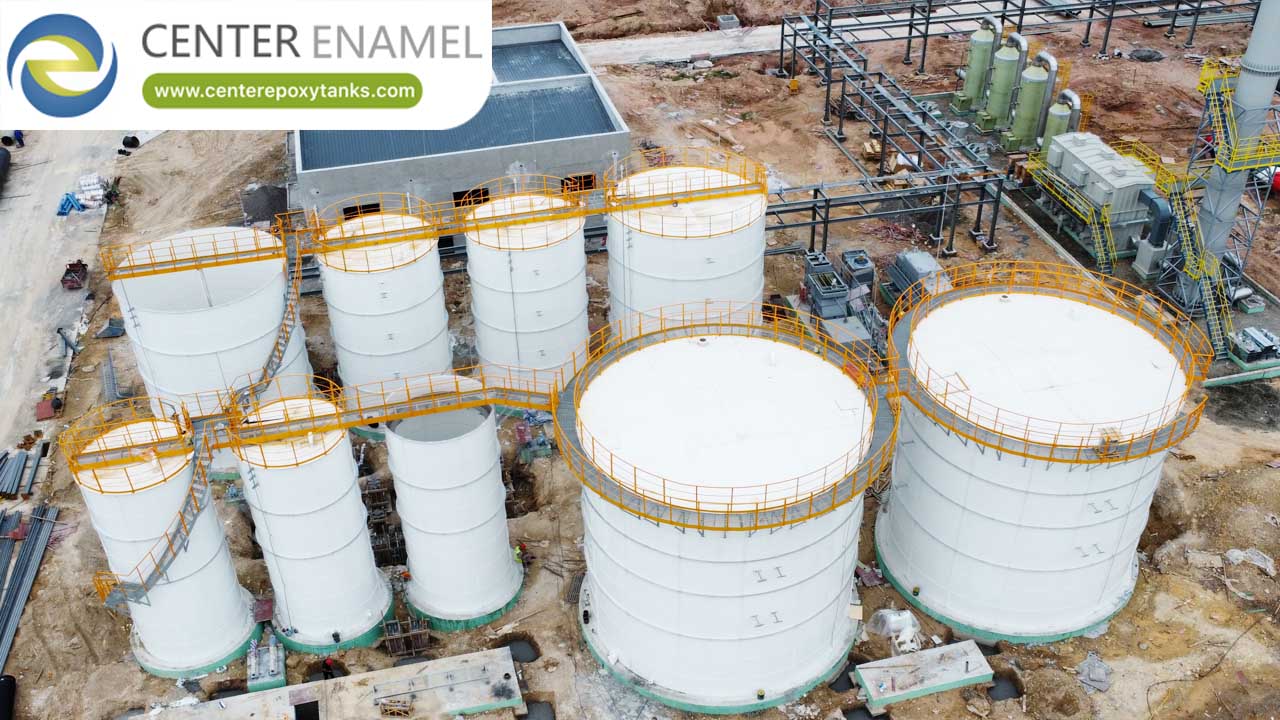
The Strategic Importance of Reliable Effluent Containment
In modern industrial processing, an Effluent Treatment Plant (ETP) is more than a utility—it is a critical compliance and sustainability asset. The efficiency of your treatment process relies on the reliability of your storage infrastructure. When managing complex wastewater streams containing varying pH levels, high salt concentrations, and abrasive particulates, the containment vessel must offer more than just capacity; it must provide an impenetrable barrier against degradation.
Center Enamel engineers Fusion Bonded Epoxy (FBE) Tanks to act as the gold standard for effluent containment, bridging the gap between high-strength structural engineering and chemical-resistant polymer science.
Why FBE Technology is the Industry Standard
Unlike traditional concrete or field-welded steel tanks, FBE tanks utilize a factory-controlled thermal fusion process. This ensures that the epoxy coating is not just a surface application, but a molecularly bonded layer that becomes part of the tank’s structural identity.
Comparative Storage Performance
Feature | Center Enamel FBE Tanks | Concrete Tanks | Conventional Welded Steel |
Corrosion Defense | Superior (Inert Barrier) | Low (Acid/Salt erosion) | Low (Requires painting) |
Construction Speed | Fast (Modular) | Slow (Weeks of curing) | Moderate |
Maintenance | Minimal (Non-porous) | High (Cracking/Sealing) | High (Paint repair) |
Contamination Control | Excellent | Low (Porous) | Moderate |
Lifecycle ROI | High | Moderate | Moderate |
Core Advantages for Effluent Treatment Operations
1. Superior Chemical & Corrosion Resistance
Effluents are rarely stable. The FBE layer acts as a monolithic barrier, preventing the underlying steel from ever contacting the aggressive chemicals, acids, or alkalis within the wastewater. This inertness is the primary driver for extended asset lifespan in harsh chemical environments.
2. High-Performance Structural Integrity
Engineered for industrial loads, our FBE tanks provide the tensile strength required to handle large fluid volumes and the dynamic stresses of aeration and mixing systems. This robustness is essential for meeting international safety regulations and mitigating the risk of catastrophic leakages.
3. Total Cost of Ownership (TCO) Optimization
While the upfront investment for FBE technology is a premium compared to basic steel, the lifecycle analysis tells a different story. By eliminating the need for recurring internal coating repairs, surface rust removal, and structural sealing, FBE tanks dramatically reduce your facility's ongoing operational and maintenance budget.
4. Modular Efficiency & Fast-Track Deployment
Our bolted panel design allows for rapid assembly, even in brownfield sites with limited space. Because components are fabricated in a controlled factory environment, site disruption is minimized, allowing your plant to reach operational capacity faster.
Lifecycle Sustainability: The Center Enamel Commitment
Choosing a manufacturer for effluent containment is a decision that impacts your facility for decades. Center Enamel provides an end-to-end partnership that includes:
Customization: We tailor the tank geometry, ports, and internal configurations to match your specific treatment process—whether it’s equalization, aeration, or final clarification.
Quality Assurance: Every panel undergoes rigorous testing to ensure coating continuity and structural soundness before it ever leaves our facility.
Compliance Support: Our tanks are engineered to help you meet stringent environmental discharge standards and local building codes, providing the certification documentation required for regulatory audits.
Frequently Asked Questions (FAQ)
Q: Can FBE tanks handle the sludge buildup common in ETPs?
A: Yes. The surface of our FBE coating is ultra-smooth and non-porous. This significantly reduces the tendency for sludge to adhere to the tank walls, making the cleaning process easier and more efficient during scheduled shutdowns.
Q: Are FBE tanks suitable for high-temperature effluent?
A: Our FBE formulations are engineered to withstand the thermal ranges typically encountered in industrial effluent streams. We can conduct a technical analysis of your effluent temperature profile to ensure the coating specification is perfectly matched to your application.
Q: What is the benefit of "Factory-Applied" over "Field-Applied" coatings?
A: Factory-controlled thermal fusion is vastly superior to field-applied paints or resins. It eliminates human error, weather-related inconsistencies, and poor surface preparation, resulting in a uniform, high-density barrier that field coatings cannot achieve.
Are you currently in the planning phase for a new Effluent Treatment Plant, or are you looking to replace an aging storage vessel? [Contact the Center Enamel engineering team] today to request a technical proposal, capacity analysis, or project consultation.
Expert Follow-Up Question: Would you like me to develop a specific "TCO vs. ROI" calculator template that your sales team can share with prospective clients to help them justify the investment in FBE tanks over cheaper, lower-quality alternatives?


