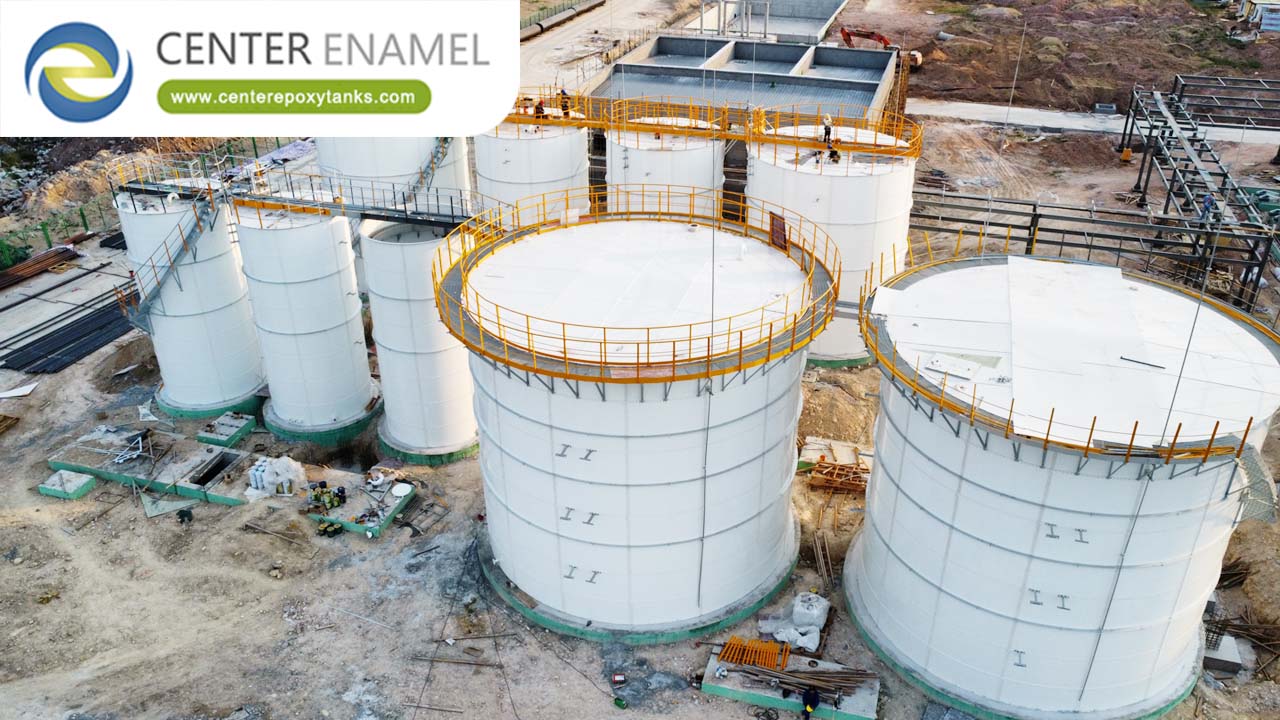
Fusion Bonded Epoxy (FBE) Coating Technology: The Science of High-Performance Containment
How does the molecular cross-linking of Fusion Bonded Epoxy (FBE) create a high-adhesion, non-porous barrier that outperforms traditional liquid epoxies in aggressive industrial environments? In the search for long-term corrosion defense, FBE technology represents a significant leap from "paint" to "performance coating." Unlike liquid-applied systems that rely on solvent evaporation, FBE is a thermochemical process that results in a monolithic polymer shell fused directly to the steel substrate.
Shijiazhuang Zhengzhong Technology Co., Ltd (Center Enamel) utilizes premium FBE Coating Technology to deliver high-integrity bolted steel tanks for fire protection, wastewater, and industrial storage to over 100 countries.
1. The Thermochemical Process: From Powder to Polymer
FBE is a "dry" coating process. The technology relies on a heat-activated chemical reaction to achieve its superior properties:
● Surface Preparation: The steel substrate is grit-blasted to a Near-White Metal finish (SSPC-SP10/NACE No. 2), creating an anchor profile that maximizes mechanical bonding.
● Electrostatic Application: Epoxy powder particles are electrostatically charged and sprayed onto the steel. This ensures a uniform coating thickness, even on edges and bolt holes, where liquid paints often thin out.
● The Fusion Phase: The coated steel is heated to approximately 200°C. At this temperature, the powder melts, flows, and undergoes a chemical cross-linking reaction. The result is a high-density, high-molecular-weight polymer chain that is chemically bonded to the metal.
2. Engineering Advantages of FBE Technology
For 2026 infrastructure projects, FBE is selected for its specific mechanical and chemical benchmarks:
● Superior Adhesion: FBE achieves an adhesion strength typically exceeding 20 MPa, making it virtually impossible to delaminate under normal operational stresses.
● Flexibility and Impact Resistance: Unlike glass coatings which are brittle, FBE is "ductile." It can withstand the mechanical vibrations of pumps and the thermal expansion of the tank shell without cracking.
● Holiday-Free Integrity: Because it is applied as a powder in a controlled factory environment, FBE is less prone to "holidays" (microscopic pinholes). Every Center Enamel panel is verified using 1100V-1500V high-voltage testing.
● Chemical Resilience: FBE provides an excellent barrier against H2S, CO2, and a wide range of industrial salts and hydrocarbons.
3. Comparison: FBE vs. Traditional Liquid Epoxy Paints
Feature | Liquid Applied Epoxy Paint | Center Enamel FBE Technology |
Application Method | Brush/Spray (Solvent-based) | Electrostatic (Powder-based) |
Curing Process | Air Dry / Solvent Evaporation | Heat Fusion (Cross-linking) |
Coating Uniformity | Variable (Thin on edges) | Absolute Precision |
VOC Emissions | High (Solvent evaporation) | Zero (Eco-friendly powder) |
Design Life | 5–10 Years | 30+ Years |
4. Strategic Application in Fire Water and Industrial Reserves
Center Enamel’s FBE tanks are the global standard for "ready-state" infrastructure:
● Fire Protection (NFPA 22): FBE’s resistance to stagnant water corrosion makes it the ideal choice for fire water reserves. Recent projects, such as our 12,261 m3 project in India and the 268 m3 project in Panama (2024), demonstrate the scale and reliability of our FBE solutions.
● Municipal Wastewater: Used as equalization tanks and aeration basins where the coating must resist biogenic sulfuric acid.
● Agricultural Water Storage: Providing a sustainable, non-leaching barrier for high-volume irrigation reserves.
5. Why Partner with Center Enamel?
As a global leader in factory-coated bolted tanks, Center Enamel combines 30 years of manufacturing excellence with advanced polymer science.
● Automated Production: Our 150,000 m2 facility ensures every panel is precision-coated to the exact micron specifications required for your project.
● Quality Assurance: We adhere to AWWA D103-19 and ISO 28765 standards, ensuring that our FBE technology meets the world's most stringent containment codes.
● Global Logistics: Our modular FBE panels are flat-packed for efficient international shipping, reducing the "landed cost" and carbon footprint of your project.


