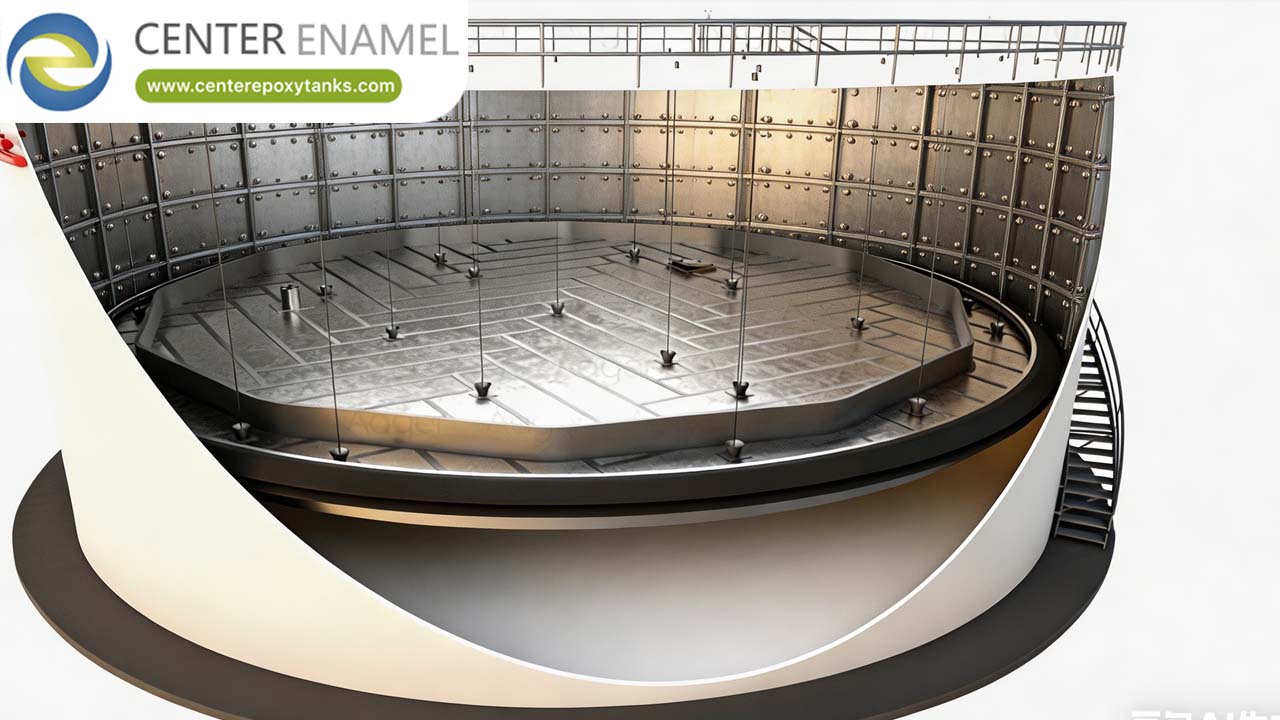
Floating Roofs For Vertical Oil Storage Tank: Engineering Safety, Compliance, and Emission Control
In the petroleum and petrochemical industries, vertical cylindrical aboveground storage tanks serve as critical nodes for crude oil, refined products, and volatile chemical reserves. Storing volatile hydrocarbons introduces severe operational challenges, most notably evaporative product losses and the accumulation of hazardous fugitive emissions.
When volatile organic compounds (VOCs) escape into the atmosphere, facilities face financial losses, environmental regulatory penalties, and heightened safety risks. To mitigate these hazards, modern industrial storage infrastructure relies on floating roofs for vertical oil storage tanks. By moving up and down synchronously with the liquid surface, these roofs eliminate internal vapor spaces (ullage), providing a robust defense against evaporation and explosion risks.
Governing Standards: API 650 Annex C and Annex H
The design, fabrication, and operation of floating roofs are strictly regulated by the American Petroleum Institute (API) to ensure structural resilience and environmental stewardship:
API 650 Annex C (External Floating Roofs - EFRs): Governs roofs that float directly on the liquid surface and are exposed directly to ambient atmospheric conditions. Annex C mandates strict buoyancy criteria—requiring the roof to remain afloat even if two adjacent pontoon compartments are breached—alongside comprehensive drainage and rim seal requirements.
API 650 Annex H (Internal Floating Roofs - IFRs): Regulates floating decks installed inside permanent fixed-roof or dome-roof tanks. Because the outer fixed roof protects the deck from wind, rain, and snow loading, IFR design focuses intensively on vapor space ventilation, low-density non-reactive materials (such as aluminum alloys), and tight rim sealing.
API 653 (Inspection, Repair, and Reconstruction): Serves as the definitive lifecycle standard for evaluating, repairing, and modifying existing floating roof assets in service.
Technical Performance Matrix: External vs. Internal Floating Roofs
Technical Parameter | External Floating Roof (EFR) | Internal Floating Roof (IFR) | Fixed Roof (No Floating Deck) |
API Regulatory Framework | API 650 Annex C | API 650 Annex H | API 650 Basic Standard |
Environmental Exposure | Exposed directly to wind, rain, snow, and solar radiation | Protected inside a fixed cone or dome roof structure | Fully enclosed static structure with a large internal vapor headspace |
Vapor Loss & VOC Control | Highly effective at cutting emissions; requires robust primary/secondary seals | Maximum VOC retention by eliminating ullage beneath the fixed roof | High continuous breathing and working losses |
Drainage System Requirements | Complex flexible hoses or articulated drain pipes to clear rainwater | Minimal or none required due to fixed-roof weather protection | Standard roof slope drainage; no internal deck drainage needed |
Critical Engineering Components for Optimal Performance
To guarantee safe, continuous operation over decades, floating roof systems incorporate specialized sub-assemblies:
Rim Seal Systems: The annular space between the outer perimeter of the floating deck and the inner tank shell is secured using primary and secondary seals (such as mechanical shoe seals or liquid-mounted wiper seals). These seals minimize rim-space vapor leakage.
Net Buoyancy Force (Fb): The floating deck must maintain positive upward buoyancy under all operating and weather conditions, factoring in the dead weight of the steel structure, seal weight, and design rain loads.
Anti-Rotation and Guiding Systems: Vertical guide poles and anti-rotation devices prevent the roof from twisting or binding as it travels up and down with liquid level fluctuations.
Vapor Vents and Bleeder Vents: Strategically positioned vents (compliant with API 650 Appendix H) ensure proper air movement and prevent explosive gas accumulations during initial filling or emptying cycles.
Frequently Asked Questions (FAQ)
Q: What is the primary purpose of a floating roof on a vertical oil storage tank?
A: Floating roofs eliminate the vapor-air space (ullage) between the liquid surface and the tank roof. By resting directly on the stored oil, they drastically reduce evaporative product losses, minimize volatile organic compound (VOC) emissions, and lower fire and explosion hazards.
Q: What is the difference between API 650 Annex C and Annex H?
A: API 650 Annex C governs External Floating Roofs (EFRs) that are directly exposed to the atmosphere, requiring specialized rain drainage and weather-resistant pontoon designs. Annex H governs Internal Floating Roofs (IFRs) operating inside a fixed or domed roof structure, focusing on vapor space containment and internal ventilation.
Q: How do floating roofs handle rainwater accumulation?
A: External floating roofs utilize engineered drainage systems—such as articulated pipes or flexible heavy-duty hoses routed through the tank center—to safely discharge accumulated rainwater out of the tank without pooling on the deck. Internal floating roofs generally do not require complex drainage because the fixed outer roof shields them from precipitation.
Q: Do floating roof tanks require Pressure Safety Valves (PSVs)?
A: Under normal operating conditions, floating roof tanks do not require standalone PSVs because the floating deck itself acts as a natural pressure-relieving mechanism by rising and falling with liquid movements. Instead, they rely on properly sized rim vents and leg-actuated relief vents conforming to API 650 guidelines.


