Floating Roofs for Oil Field Storage Tanks: Technical Engineering & Procurement Guide
In oil field operations, the storage of volatile crude oil and petroleum products presents two critical challenges: economic loss through evaporation and the safety risks associated with flammable vapor accumulation. Floating roofs act as a critical control measure by eliminating the vapor space between the liquid surface and the tank roof. By rising and falling with the liquid level, these roofs effectively suppress Volatile Organic Compound (VOC) emissions, preserve product quality, and significantly reduce fire risks, all while ensuring compliance with international environmental standards like API 650.
1. Classification: IFR vs. EFR
Refinery and field storage design is governed primarily by API 650 (Welded Tanks for Oil Storage), which classifies floating roofs into two distinct operational categories based on the tank's environment.
Internal Floating Roofs (IFR)
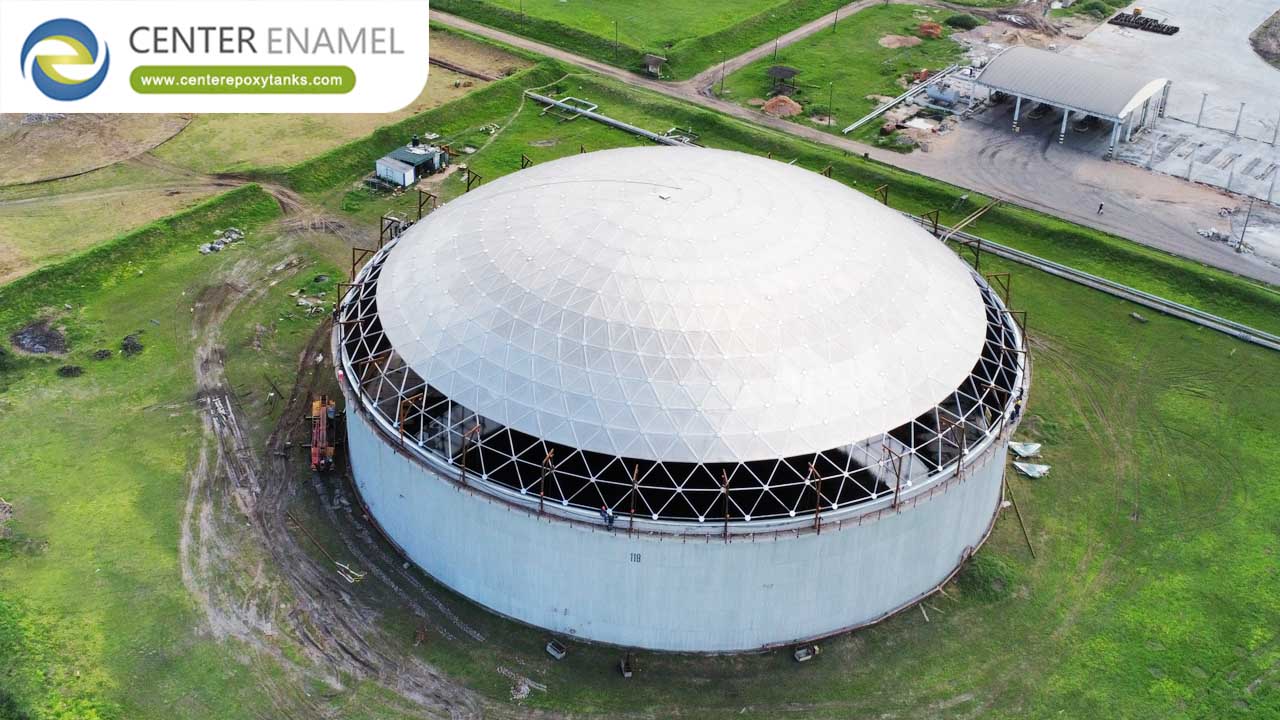
An IFR is installed within a tank that possesses a permanent fixed roof (often a cone roof or geodesic dome).
● Primary Function: The fixed roof provides environmental protection (shielding against rain and snow), while the internal floating roof traps vapors beneath it.
● Best Application: Aviation fuel, jet fuel, and lighter crude fractions where water contamination must be strictly prevented.
External Floating Roofs (EFR)
An EFR is installed in an open-top cylindrical tank, meaning the roof is directly exposed to the elements.
● Primary Function: Designed for heavy-duty, high-capacity crude oil storage in remote terminals.
● Best Application: Massive crude oil storage tanks where internal column support is structurally impractical.
Comparative Matrix for Procurement
Feature | Internal Floating Roof (IFR) | External Floating Roof (EFR) |
Environmental Exposure | Sheltered by fixed roof | Exposed (Rain/Snow/UV) |
Maintenance Needs | Low (No weather-related damage) | High (Requires rain drainage management) |
Typical Material | Aluminum / Stainless Steel | Welded Carbon Steel |
Operational Risk | Minimal | Moderate (Risk of sinking if drains clog) |
2. Emissions Control & Thermodynamic Physics
The primary driver for floating roof adoption is environmental compliance. The "vapor space" in a fixed-roof tank allows lighter hydrocarbons to evaporate, resulting in significant product loss.
Refineries and terminal operators utilize the EPA AP-42 methodology to model total emissions (LT) from floating roof tanks. The calculation is segmented into three primary loss mechanisms:
Engineering Optimization: By utilizing high-efficiency secondary rim seals and low-emissivity deck coatings, operators can achieve VOC emission reduction efficiencies exceeding 98% compared to fixed-roof atmospheric storage.
3. Critical Mechanical Components
A floating roof is only as effective as the mechanical components that integrate it with the tank shell:
● Rim Seal Systems: The "living edge" of the roof.
○ Primary Seal: Usually a metallic shoe seal that exerts mechanical pressure against the tank wall.
○ Secondary Seal: A wiper or rim-mounted seal providing a redundant barrier and acting as a weather shield to keep debris out of the primary seal.
● Drainage Systems (EFR Only): Because EFRs are open to the sky, rainwater accumulates on the roof. An articulated drainage pipe or flexible hose system is required to transport water off the roof and out of the tank without allowing hydrocarbon leakage.
● Anti-Rotation Systems: Guide poles are critical to ensure the roof does not rotate or tilt due to wind shear or liquid turbulence, which could result in a mechanical bind or "hanging" of the roof.
Frequently Asked Questions (FAQ)
Q: Can a floating roof be retrofitted into a fixed-roof tank?
A: Yes. This is a common upgrade for older tanks. By installing an internal floating roof (IFR) into an existing fixed-roof tank, operators can drastically reduce VOC emissions without the massive capital expenditure of building new tanks.
Q: What is the risk of a floating roof "sinking"?
A: This is primarily a concern for External Floating Roofs (EFR). If the primary roof drains clog during a heavy rainstorm, water weight can overcome the buoyancy of the roof. Modern EFR designs include emergency drain-slots on the pontoons that allow water to bypass the roof and enter the product, preventing the catastrophic sinking of the structure.
Q: Why do we need guide poles?
A: Guide poles prevent the roof from rotating (keeping it concentric with the tank shell) and provide a controlled path for the roof to rise and fall. Furthermore, they function as sampling ports for lab technicians to test product density without opening the tank to the atmosphere.
What is the specific diameter and product type of the storage tanks you are currently looking to equip with floating roofs?


