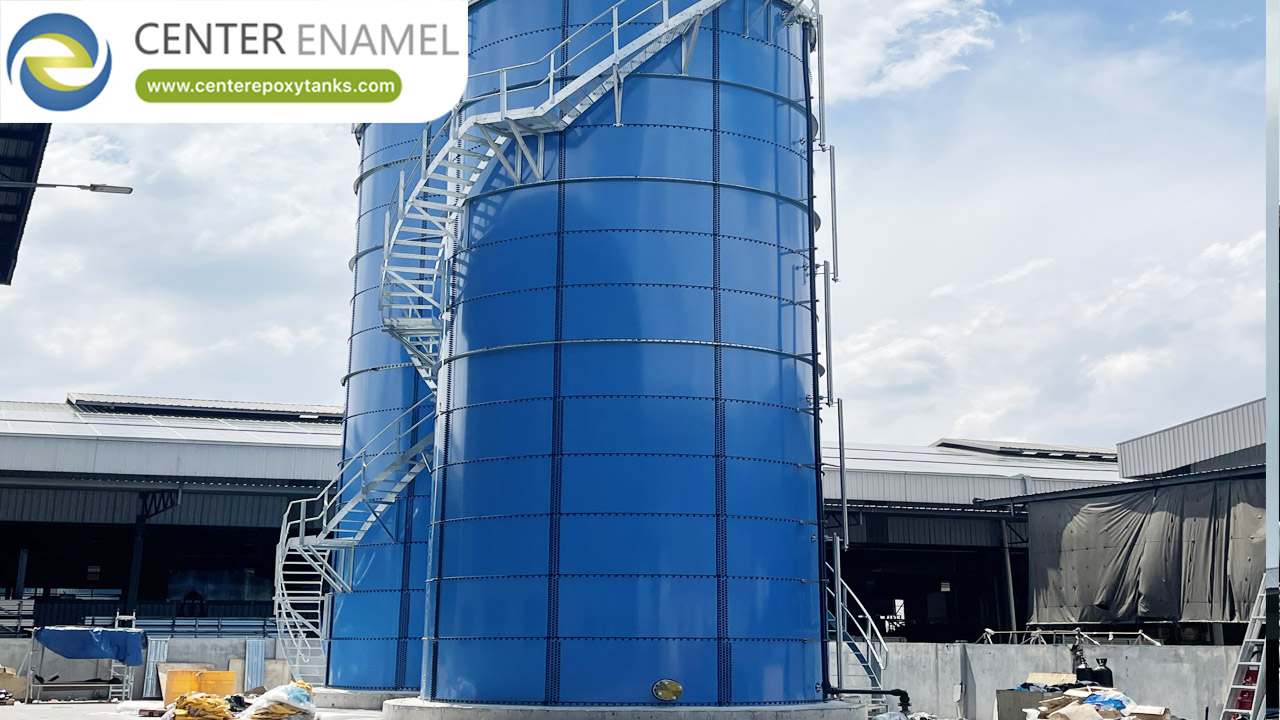
Fire Water Storage Tank: Complete Information Guide
A fire water tank is sized to deliver a calculated flow for a required duration, not to hold a round number. Everything else follows from that: the construction type, the foundation, the appurtenances, the inspection regime and the supplier you pick. Buy the volume and the code compliance, and the rest follows.
Introduction
A fire water storage tank is a large vessel of water that exists for the worst day at a plant. Everything else in the system depends on there being water available at a rate the pump can deliver. The tank is the one component that cannot be improvised on the day, which is why it is designed years in advance and installed before the system around it.
This guide is written for the owner or project manager meeting the subject for the first time. It explains what the tank does, the construction types and their trade-offs, which standards apply, how the sizing works, what installation and inspection involve, and what to look for when choosing a supplier.
The standards referred to throughout are NFPA 22 for the tank and its appurtenances, NFPA 13 for the sprinkler demand, NFPA 20 for the pump, and AWWA D103 for a bolted steel tank. NFPA 22 is a design standard, not a certification.
What a fire water storage tank does in the system
The tank's job is to be a reliable source of water at the right rate. A gravity tank on a tower delivers water by static head alone. A suction tank at ground level feeds a fire pump that adds the pressure the system needs. A break tank is a third case: it isolates the pump from the public supply and is sized for the pump, not the building.
The distinction matters commercially as well as technically. Where the public supply is dependable and can meet the required flow and pressure on its own, a tank may not be needed. Where it cannot, or where the insurer or the authority requires an independent supply, a tank becomes part of the design rather than an option.
The second job is continuity. A full tank is a reserve that does not depend on the public main, a power supply or an open valve. NFPA 22 Chapter 4 carries the general requirements for the tank, including that the supply restore the drawn volume within a defined refill time and that the tank be kept at its fire service level.
Construction types and their trade-offs
NFPA 22 accepts several tank constructions, each with its own chapter, and each trades something. A factory-coated bolted steel tank, built to AWWA D103 under Chapter 6, arrives as coated panels and is assembled on site with factory-controlled coating quality. A welded carbon steel tank, under Chapter 5 with AWWA D100, arrives as plate and is welded on site.
A pressure tank is covered by Chapter 7 where the fire protection system uses one, and a fiberglass-reinforced plastic tank is covered by Chapter 11 for smaller or corrosion-sensitive duties. Other constructions exist under the standard as well. The route that suits a given project is chosen before the drawings start, because it fixes the coating plan, the transport, the erection method and the inspection basis.
The trade for the bolted route is a large number of panels to deliver, erect and seal; the trade for the welded route is field-applied coating whose quality depends on weather and surface preparation. Neither is universally better, which is why the selection is a design decision rather than a default.
The standards that govern the tank
Four standards matter, and they divide cleanly by what each one governs. NFPA 22, Standard for Water Tanks for Private Fire Protection, covers the tank and its appurtenances: the general requirements in Chapter 4, the foundations and anchorage in Chapter 12, the pipe connections and fittings in Chapter 14, the acceptance testing in Chapter 17 and the inspection and maintenance in Chapter 18.
NFPA 13 governs the sprinkler system the tank serves and is the source of the design flow and duration the tank is sized against. NFPA 20 governs the stationary fire pump and its installation, including the suction arrangement the tank has to work with. AWWA D103 is the construction standard a bolted tank is designed to, and AWWA D100 and AWWA D102 cover welded tanks and their coating.
After installation the tank's life is governed by NFPA 25, whose Chapter 9 covers water tanks. NFPA 22 Chapter 18 points the owner's inspection programme to NFPA 25, so the maintenance manual should be written against it from the start.
Material and coating choices
For a steel tank the coating choice is the durability decision. Glass-fused-to-steel is a vitreous enamel fused to the steel at high temperature in the factory. It is inert against most stored waters and does not need a recoating cycle, but because it is fused rather than painted it is difficult to repair in the field when damaged.
Fusion-bonded epoxy is a powder coating electrostatically applied and cured to the steel in the factory. It has good chemical resistance against a wide range of waters and is more forgiving of field repair than fused glass. Hot-dip galvanizing puts a zinc sacrificial layer on the steel, which protects as long as the zinc lasts.
For a standby fire water tank specifically, two features of the duty change the priorities. The tank sits mostly full and mostly idle, so the coating has to survive long periods of no flow, and the vapor space above the water line sees the most variation in temperature and moisture. Whichever system is chosen, the specification should say how it is verified: surface preparation, film thickness and holiday detection, measured against the named standard.
Sizing at a glance
The sizing is a chain of numbers, and it is worth being able to follow it even if the calculation is not yours. The design flow comes from the sprinkler or standpipe design, and on a combined system the demands are added rather than compared. The duration comes from the same system standard and the occupancy hazard classification. Multiply the two and you have the required volume of water.
Then subtract what cannot be delivered. The water below the vortex plate on a suction tank cannot be drawn without cavitating the fire pump, and the operating band below the fire service level is not deliverable either. What remains is the net capacity, and the tank holds that plus the unusable volume, which is why a tank quoted at a nominal volume may deliver a smaller usable volume to the system.
If more than one tank is needed, the split does not divide evenly, because each tank carries its own unusable volume. And if the public supply is credited with part of the duty, the refill requirement has to be demonstrated, not assumed. These are the points where a quotation stops being straightforward.
Installation and commissioning
The tank is installed before the system around it, and the installation is a coordinated operation rather than a tank delivery. The foundation has to be built and accepted first, under Chapter 12, and the tank is then erected, grouted and filled.
Commissioning catches the last errors, and Chapter 17 sets the acceptance test requirements. The tank is filled and inspected for leakage, the coating and connections verified against the approved drawings, and the piping, valves and instrumentation confirmed in the installed condition. A written acceptance record closes the install and is kept by the authority and the owner.
Two things carry on after commissioning. The maintenance programme, which Chapter 18 points to NFPA 25, should exist as a written document from day one rather than being assembled later. And the monitoring - the level and condition instrumentation on the tank - has to be proven during commissioning, not discovered to be wrong a year later.
Inspection and maintenance over the service life
The tank's condition changes over its life in ways that are not visible from outside, which is why the inspection regime is set by the standard rather than left to the owner's discretion. Chapter 18 requires tanks to be inspected, tested and maintained in accordance with NFPA 25, which addresses water tanks in its Chapter 9.
For a steel tank the practical items move with the water. The interior coating is inspected from inside, and the internal interval depends on whether the interior has a protective coating or cathodic protection. The external inspection covers the coating, roof, vents, overflow, supports and any heating system.
Two conditions drive the frequency. A standby tank sits full, so the interior surface is in permanent contact with water, which is why the interior coating matters more than on a tank drained regularly. Where the stored water is aggressive, cathodic protection becomes part of the programme.
Choosing a supplier
Choosing a supplier is a technical decision under commercial pressure. The technical question is whether they can build the tank to the standard for its type and show the records. The commercial question is price, and the order decides what you get.
· Ask for the drawings and the calculations, not the brochure. A supplier who cannot show the shell and roof calculations, the anchorage detail and the appurtenance schedule has not shown you the tank.
· Ask for the coating evidence and the standard it is measured against: surface preparation, film thickness and holiday detection, with panel-level traceability.
· Ask for the erection method and the site resources it needs, because the difference between a short and a long erection is your schedule.
· Ask for references on comparable tanks in comparable duties, and who is accountable when something goes wrong on site.
Treat a certification claim as a question rather than an answer. NFPA 22 and AWWA D103 are standards, not product approvals, so ask which document and clause is being satisfied, and verify any third-party listing against the listing body's own records.
Fire Water Storage Tank Construction Types Compared
Type | NFPA 22 Chapter | Construction Standard | Principal Trade-off |
Welded carbon steel | Chapter 5 | AWWA D100, with AWWA D102 coating | Coating applied in the field; schedule depends on weather |
Factory-coated bolted steel | Chapter 6 | AWWA D103 | More panels to deliver and erect; coating applied under factory control |
Pressure tank | Chapter 7 | ASME BPVC where applicable | Used where the system calls for a pressure vessel |
Fiberglass-reinforced plastic | Chapter 11 | FRP-specific design | Smaller volumes; corrosion-resistant and light |
Procurement Decision Sequence For A Fire Water Tank
Step | Question | Output | Who Decides |
1 | Is a tank required; does the public supply meet flow and pressure alone? | Design basis and supply assessment | Fire engineer with authority |
2 | What flow, for how long? | Design flow, duration, hazard class | Fire engineer, NFPA 13 |
3 | Net and gross capacity to order? | Net with datum, gross, unusable separate | Design engineer, NFPA 22 Ch.4 |
4 | Which construction route? | Bolted AWWA D103 or welded AWWA D100 | Design engineer with supplier |
5 | Which coating system? | Coating, preparation, thickness, holiday test | Tank supplier, AWWA D103/D102 |
6 | Foundation, anchorage, site interface? | Foundation, anchorage, access, drainage | Engineer of record |
7 | What is received and maintained? | Acceptance record, coatings, NFPA 25 manual | Contractor, owner, authority |
8 | Which supplier demonstrates all? | Drawings, calculations, coating, method | Procurement with engineer |
About Center Enamel
Center Enamel (Shijiazhuang Zhengzhong Technology Co., Ltd.) designs and fabricates bolted steel storage tanks, welded steel tanks, fusion-bonded epoxy tanks, galvanized tanks, stainless steel vessels, pressure vessels, aluminum geodesic dome roofs and floating roofs. The company has more than 30 years of production experience and has supplied equipment to projects in more than 100 countries. Aluminum geodesic dome roofs are designed and fabricated to API 650 Appendix G, AWWA D108, the Aluminum Design Manual, ASCE 7 and IBC, and the company developed and exported a 72 m diameter aluminum dome roof in 2023. Engineering, fabrication, coating, quality control and site service are handled as one scope, which is why the drawings, the calculation basis and the delivered hardware can be reconciled against each other.
Frequently Asked Questions
What is a fire water storage tank?
A vessel that holds a calculated volume of water for a fire protection system. It supplies that water to a fire pump, which then delivers it to the sprinklers or standpipes, and it exists so the water is available independently of the public supply. NFPA 22 sets the requirements: the general provisions in Chapter 4, the pipe connections and fittings in Chapter 14, and the requirement that the tank be kept at its fire service level and that the drawn volume be restored within the allowed refill time.
How does a fire water tank connect to a sprinkler system?
Through the fire pump. The tank is the suction source, the pump takes water from it and adds the pressure the system needs, and the tank's discharge pipe is specified by NFPA 22 Chapter 14: sized by tank capacity, with an anti-vortex arrangement at the outlet and a valve set that isolates and protects the connection. The pump itself is governed by NFPA 20, so the two packages have to be coordinated rather than bought separately, and the discharge size has to match the pump demand.
What is the difference between a fire water tank and a potable water tank?
The purpose and the consequence differ. A potable tank holds drinking water, so the requirements are about the material the water contacts and the health-effect listing that applies to the specific product used. A fire water tank holds water for a fire pump and is rarely, if ever, used for drinking, so the requirements are about structural integrity, deliverable volume, appurtenance and inspection access. The coating question also reverses: potable duty favours a surface that will not leach, and fire duty favours a surface that will survive standing water and a humid vapor space for decades.
Which standards apply to a fire water storage tank?
NFPA 22 governs the tank and its appurtenances: Chapter 4 for general requirements, Chapter 12 for foundations and anchorage, Chapter 14 for the pipe connections and fittings, Chapter 17 for acceptance testing and Chapter 18 for lifetime inspection. NFPA 13 governs the sprinkler design that produces the demand, NFPA 20 the fire pump, NFPA 25 the inspection programme after handover (water tanks are addressed in NFPA 25 Chapter 9), and AWWA D103 the construction of a factory-coated bolted steel tank. Which apply in your jurisdiction depends on the code the authority has adopted.
How long does a fire water tank last?
NFPA 22 does not set a service life. It sets an inspection regime, and the tank lasts as long as its coating, its joints, its anchorage and its appurtenances last, which is why the inspection and maintenance programme matters more than any published figure. Chapter 18 sends the lifetime inspection to NFPA 25, and the internal inspection interval for a steel tank depends on whether the interior has protective coating or cathodic protection. A tank that is inspected and maintained as designed outlasts one that is bought on a price comparison and then ignored.
Can a fire water tank be used for other water on site?
Yes, but only within defined limits. Connections for uses other than fire protection have to be approved and the piping has to be entirely separate from the fire-service pipework, extending to an elevation inside the tank above the required fire protection volume. In practice that means the fire reserve stays at the bottom of the tank and cannot be drawn down for process or service use, which is the whole point of the arrangement. If a site wants to draw from the tank for other reasons, that connection elevation is a design decision with a code consequence attached to it.
What maintenance does a fire water tank need?
A written programme, and Chapter 18 makes the case for having one from handover: NFPA 25 is where the requirements live, and it handles water tanks in its Chapter 9. In practice that means routine level and condition checks, the external inspection of the coating, roof, vents, overflow and supports, periodic valve operation and testing, the heating system where there is one, and the internal inspection on the interval NFPA 25 sets for the tank type and its coating condition. The manual written against NFPA 25 should be handed over with the tank, not written later.
A fire water tank is a simple purchase with a complicated life. On the day it is signed for, it is a steel vessel holding a volume of water. On the day it matters, it is the thing the whole fire protection system was designed around, and it will only work if it was sized, anchored, coated and maintained properly.
None of those four things is difficult. Each is a decision, and each is much cheaper to get right before the tank is built than after. The sizing follows from the sprinkler design, the coating from the stored water and the duty, the anchorage from the site.
If you want the tank side of that settled, send us the duty, the stored water, the site constraints and the governing code edition, and we will return the volume basis, the construction route, the coating system with its verification method, and the documentation the contract should require.
Talk To Our Engineering Team
Send the duty, the volume basis, the governing code and the site constraints, and our engineering team will come back with a specification that a supplier can price and a reviewer can approve. We will also tell you plainly when a different tank type or a different scope is the better answer.


