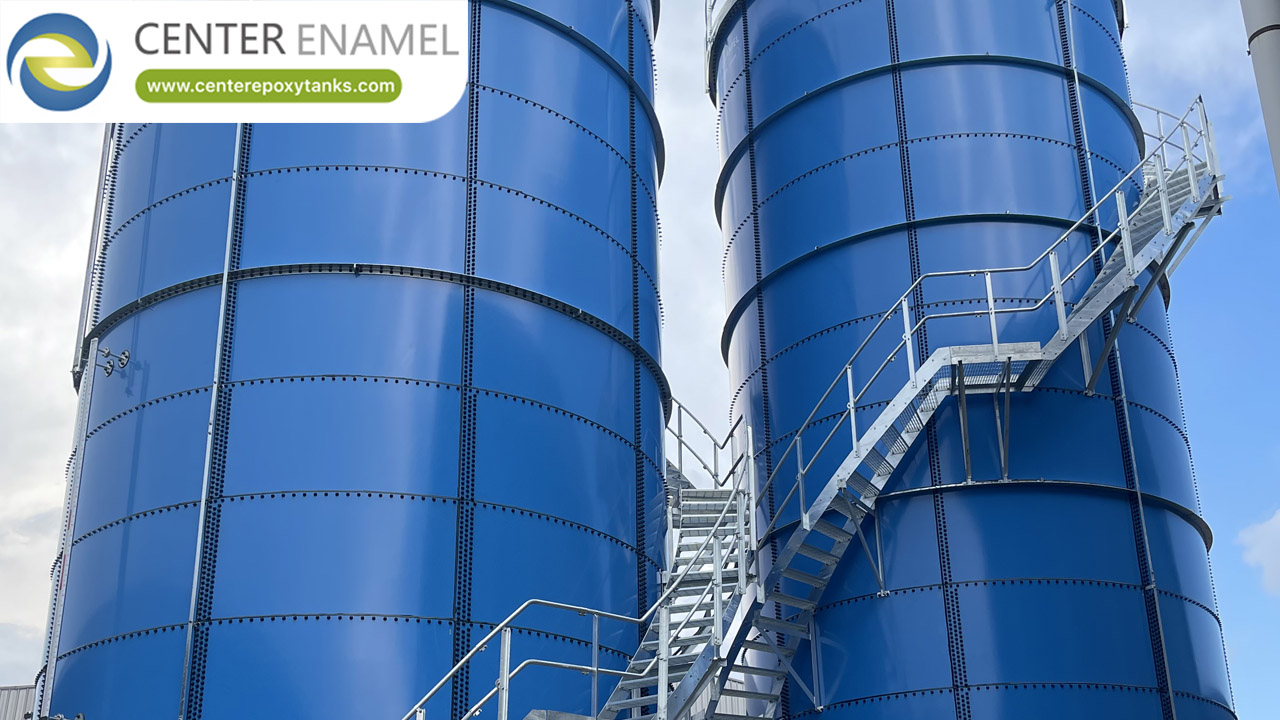
Fire Protection Water Tank Types Compared: GFS, Epoxy, Galvanized And Welded
For a standby fire water tank the coating choice is decided by what happens when nothing happens: long immersion, a humid vapor space, no flow to wash the surface, and an inspection regime that finds what the coating did. Glass-fused-to-steel resists a poorly controlled atmosphere best, epoxy is the most forgiving to repair, galvanized protects until the zinc is gone, and a welded shell removes the joint system.
Introduction
A fire water tank is a very unusual vessel. It holds a volume of water that will rarely be disturbed, that sits in one condition for years at a time, and that has to be trusted on the one occasion it matters. Most storage tanks see a cycle of filling and emptying every day or every week. A standby fire water tank sees none of that.
This article compares the four steel routes available to a fire protection tank: glass-fused-to-steel, fusion-bonded epoxy, hot-dip galvanized, and welded carbon steel, on the properties a standby duty actually stresses.
The standards referenced are NFPA 22 for the tank and its appurtenances, AWWA D103 for a factory-coated bolted carbon steel tank with its Section 12 coating provisions, AWWA D100 with AWWA D102 for the welded route, ISO 28765 for vitreous enamel coatings, SSPC-SP 10 and SSPC-SP 6 for preparation, SSPC-PA 2 for film thickness and ASTM D5162 for holiday detection.
What makes a fire tank different from a process tank
The reason a fire water tank behaves differently from a process tank is written into the way it is used. A process tank is cycled, so its interior is regularly wetted and dried. A standby fire water tank is filled and left: the interior stays in permanent contact with the same water, and the vapor space alternates between condensation and drying.
Three consequences follow. The vapor space above the water line is the most aggressive part of the tank, because that is where the coating sees both water and oxygen. The immersed coating sees a constant chemical load with no movement to relieve it. And the joints see nothing at all most of the time, so a joint problem is found by inspection.
There is also a regulatory layer on top of the physical one. NFPA 22 Chapter 6 covers factory-coated bolted carbon steel tanks and routes their construction to AWWA D103, while Chapter 5 covers welded carbon steel tanks with AWWA D100 and AWWA D102. Where the water is corrosive, Clause 6.3 allows cathodic protection under AWWA D104 or AWWA D106.
Glass-fused-to-steel construction
Glass-fused-to-steel is a vitreous enamel fused to the steel at high temperature in the factory. It is not a film laid on the metal; it is a glass layer chemically bonded to it, and it is about as inert as a coating gets. Its strength in a standby tank comes from that inertness.
Its weakness is repair. Because the coating is fused rather than sprayed, a damaged area cannot simply be painted over in the field, and through-thickness damage in the immersed zone has to be dealt with under a written repair procedure. On a tank handled during erection and inspected over decades, it is worth asking the supplier what their repair procedure covers.
Verification also has a specific standard. ISO 28765 covers vitreous and porcelain enamels for bolted steel tanks, setting out the coating classes, the thickness expectations and the test requirements. Where the specification says glass-fused-to-steel, it should also say which class is required.
Fusion-bonded epoxy lined steel
Fusion-bonded epoxy is a powder coating applied electrostatically and cured to the steel in the factory. It has good resistance to a wide range of stored waters, and because it is a polymer film rather than a fused glass, damaged areas can be prepared and recoated in the field using a documented repair procedure.
That repairability is the practical advantage in a standby tank, where damage comes from handling during erection and from occasional mechanical contact over a long life. It is also why the coating specification has to be specific about the repair system, because a generic field repair will not bond reliably to a contaminated epoxy surface.
Two properties are worth weighing against the standby duty. It is a permeable film, so the resistance of the system depends on film quality and thickness rather than on the inertness of the material. And it is affected by temperature, so the specification should state the service temperature range the coating has to perform in.
Hot-dip galvanized steel
Hot-dip galvanizing is a different mechanism entirely. The zinc is not a barrier coating that fails and lets the steel go; it is a sacrificial layer that corrodes in preference to the steel underneath, so the steel is protected for as long as the zinc lasts. That is valuable where the stored water is aggressive enough to attack a paint film.
The trade is time and water chemistry. Zinc is consumed, so the protection is finite and its rate depends on the water: temperature, pH, and the species that consume zinc. The vapor space is where galvanizing is most exposed. Where a galvanised tank is specified, the inspection has to look at zinc condition and rate of consumption, not only at whether the surface looks sound.
Galvanizing also constrains the rest of the tank. Fittings, bolts and appurtenances have to be compatible, dissimilar metals have to be avoided or isolated, and the tank cannot be painted over in the field without a specific compatible system. For a tank built entirely to AWWA D103 with a galvanised coating under Section 12, that consistency is available.
Welded carbon steel
Welded carbon steel is the odd one out, because it removes the joint system rather than improving it. There is a continuous welded shell with no bolted joints to seal and no gaskets to inspect, which is an advantage wherever joint integrity is the concern and wherever the tank is inspected internally and the seams have to be looked at.
The cost of that advantage is that the tank no longer arrives finished. Under Clause 5.6.1 the interior surfaces in immersion and in the vapor phase zone have to be near-white blasted to SSPC-SP 10 and painted to AWWA D102 after the shell is erected, and 5.6.2 requires exterior surfaces and dry interior surfaces to be commercial blasted to SSPC-SP 6 and coated to the same standard. The coating quality on a welded tank is a function of site conditions, and so is the schedule.
For a very large capacity, or where a seamless internal surface is wanted for cleanability, the welded route has a real case. Where the schedule is tight or the site climate is uncertain, the factory-applied routes remove a variable the welded route cannot remove.
Comparison on coating durability in a standby atmosphere
Set against the standby duty, the durability ranking is not simply a ranking of coating quality. It is a ranking of how each coating behaves in a poorly controlled atmosphere over a long period, and how much of that can be corrected.
· Glass-fused-to-steel: the most inert against standing water and a humid vapor space, with no recoating cycle expected. The constraint is repair.
· Fusion-bonded epoxy: good resistance across a wide range of waters and the most practical to repair. The constraint is that the film carries the protection.
· Hot-dip galvanized: sacrificial protection that continues while the zinc lasts, which is the right answer where the water is aggressive. The constraint is that the protection is finite.
· Welded carbon steel: no joint system to fail, and a continuous internal surface to inspect. The constraint is that the coating is applied on site.
None of these is a free choice, because the construction standard and the coating have to be consistent with each other and with the tank type: Chapter 6 with AWWA D103 for a bolted tank, Chapter 5 with AWWA D102 for a welded one.
Comparison on repair and re-inspection consequences
The consequence of the coating choice shows up in the inspection regime, and that is where a standby tank differs most from a process tank. Chapter 18 of NFPA 22 sends the lifetime inspection to NFPA 25, and the internal inspection interval is longer where the interior is protected.
· Glass-fused-to-steel: an intact fused coating gives the inspector very little to find, so the inspection verifies that the coating is still continuous. Repair is the exception case, and it needs a written procedure in advance.
· Fusion-bonded epoxy: the inspection looks for the same continuity, plus the condition of any previous repair, and the record of those repairs makes the next one faster.
· Hot-dip galvanized: the inspection assesses remaining zinc rather than coating integrity, so the water chemistry and temperature are part of the assessment, and the result is a rate of consumption.
· Welded carbon steel: the internal inspection examines welds and the coating over them, and Clause 5.6.4 already anticipates this, requiring weld seams and damaged primer to be blast-cleaned and primed.
The practical point for a specifier is that the repair regime has to be agreed before the tank is delivered rather than after the first defect is found. The repair only works if the procedure was written down in advance, with the surface preparation, the compatible material and the cure requirements stated, and with Clause 6.6.3.1's requirement that damaged coating be repaired to the manufacturer's instructions.
Comparison on capital and lifecycle cost
Lifecycle cost for a fire water tank is not the same calculation as for a process tank, because the operating costs are close to zero and the whole of the cost sits in the first purchase and in the inspection regime over the service life. That makes the comparison narrower and, in some ways, easier.
· First cost: the coating system, the construction route and the erection method drive this. A factory-coated bolted tank has a higher material cost per unit of coating quality and a lower site cost.
· Inspection cost: this moves most between options, because the interval depends on the interior protection and on whether a previous repair has to be assessed.
· Repair and remedial work: the frequency follows the coating system, and a system needing a written repair procedure applied in the field carries a different cost profile from one that rarely needs it.
· Site and schedule cost: a bolted tank needs delivery access, laydown space and a crane position; a welded tank needs a working area, a welding operation and site coating.
· End of life: a bolted tank can be dismantled and relocated; a welded tank has no second use.
The useful conclusion is not that one option is cheapest. It is that the coating system, the erection method and the inspection regime have to be compared together, because that is where the differences are.
Four-Way Comparison Of Steel Fire Water Tank Construction
Criterion | Glass-Fused-To-Steel | Fusion-Bonded Epoxy | Hot-Dip Galvanized | Welded Carbon Steel |
Governing standard | NFPA 22 Chapter 6 with AWWA D103 Section 12 | NFPA 22 Chapter 6 with AWWA D103 Section 12 | NFPA 22 Chapter 6 with AWWA D103 Section 12 | NFPA 22 Chapter 5 with AWWA D100 and AWWA D102 |
Where the coating is applied | Factory, fused to the steel at high temperature | Factory, powder applied and cured to the steel | Factory, zinc applied and reacted with the steel | On site, after the shell is erected and welded |
Mechanism | Inert glass layer bonded to the steel | Permeable polymer film, resistance depends on thickness and preparation | Sacrificial layer that corrodes in preference to the steel | As epoxy, with the surface prepared on site |
Behaviour in standing water and a humid vapor space | Strongest, with no recoating cycle expected in service | Good across a wide range of waters, subject to film integrity | Protective while zinc remains, and consumptive rather than renewable | As epoxy, with the same film dependence |
Joint system | Field bolted and sealed under Clause 6.1.3.5 | Field bolted and sealed under Clause 6.1.3.5 | Field bolted and sealed under Clause 6.1.3.5 | No bolted joints; continuous welded shell |
Field repair after damage | Requires a written repair procedure | Most forgiving, using a compatible repair system | Zinc supplementation or replacement rather than recoating | Welding and recoating, with preparation under Clause 5.6.4 |
Inspection focus | Coating continuity and mechanical damage | Coating continuity and the condition of previous repairs | Remaining zinc and its rate of consumption | Welds, coating over welds, and site coating condition |
Principal constraint | Repair is difficult, not impossible | Film thickness, preparation and cure must be right | Finite and consumptive protection, sensitive to water chemistry | Coating quality and schedule depend on site conditions |
Lifecycle Cost Drivers For A Standby Fire Water Tank
Cost Driver | What Changes It Between The Four Routes | How It Is Controlled | Who Should Decide |
Purchase price | The coating system, the plate thickness and the construction route | Specification of the coating system to a named standard and edition, with the verification method stated | Procurement with the engineer of record |
Erection and site cost | Factory-applied coating against site-applied coating, and assembly against welding | Erection method and site resources stated in the enquiry, including delivery route and laydown area | Contractor and site logistics lead |
Internal inspection frequency | The interior protection and whether a previous repair has to be assessed | Coating system and the inspection interval agreed under NFPA 25 before the tank is delivered | Owner with the engineer of record |
Remedial and repair work | How often damage occurs and how easily it can be repaired | A written repair procedure issued at handover, with surface preparation, compatible material and cure requirements, per Clause 6.6.3.1 | Supplier and owner jointly |
Site climate exposure | Whether coating application depends on site weather | Coating route fixed at the design stage rather than at the site | Design engineer with the tank supplier |
End of life | Whether the shell can be dismantled and relocated | Construction route fixed at the design stage | Owner |
Project Reference
A delivered fire water installation in a galvanized steel tank, completed in 2025, with 652 m3 of total storage volume. The reference is published here for the construction-route comparison only: the record documents the coating system, but it does not state the governing standard for the project or the water chemistry, so it is not presented as an NFPA 22 compliance example and no conclusion about zinc performance is drawn from it.
Location | Service | Total Storage Volume | Year |
Not recorded | Fire water service | 652 m3 total storage volume | 2025 |
About Center Enamel
Center Enamel (Shijiazhuang Zhengzhong Technology Co., Ltd.) designs and fabricates bolted steel storage tanks, welded steel tanks, fusion-bonded epoxy tanks, galvanized tanks, stainless steel vessels, pressure vessels, aluminum geodesic dome roofs and floating roofs. The company has more than 30 years of production experience and has supplied equipment to projects in more than 100 countries. Aluminum geodesic dome roofs are designed and fabricated to API 650 Appendix G, AWWA D108, the Aluminum Design Manual, ASCE 7 and IBC, and the company developed and exported a 72 m diameter aluminum dome roof in 2023. Engineering, fabrication, coating, quality control and site service are handled as one scope, which is why the drawings, the calculation basis and the delivered hardware can be reconciled against each other.
Frequently Asked Questions
Which tank type is best for fire protection water?
Which tank type is best for fire protection water?There is no single answer, because the duty decides it. For a standby tank that is almost always full and almost never disturbed, glass-fused-to-steel is usually the strongest answer on durability, because a fused inert coating tolerates standing water and a humid vapor space without a recoating cycle. Fusion-bonded epoxy is usually the strongest answer on repairability. Hot-dip galvanized is usually the strongest answer where the stored water is aggressive enough to attack a paint film. Welded carbon steel is usually the strongest answer where a continuous internal surface matters or the capacity is very large. All four are acceptable under NFPA 22, each in its own chapter.
How do GFS and epoxy tanks compare for fire protection duty?
How do GFS and epoxy tanks compare for fire protection duty?Both are factory applied, both are permitted for a bolted tank under NFPA 22 Clause 6.1.3.3 by way of AWWA D103, and both give a coherent tank with field-bolted joints sealed under 6.1.3.5. The difference is in the coating and in what happens after damage. Glass-fused-to-steel is inert against standing water and a humid vapor space and does not need a recoating cycle, but because it is fused it cannot simply be patched in the field. Fusion-bonded epoxy has good chemical resistance across a wide range of waters and is more forgiving of a documented field repair, but it is a permeable film whose performance depends on thickness and preparation.
Do galvanized tanks need repainting for fire protection service?
Do galvanized tanks need repainting for fire protection service?A hot-dip galvanized tank is not normally recoated as part of a routine inspection cycle, because the zinc protects sacrificially and the question is how much zinc remains rather than whether a film is still intact. The inspection requirement is different from the other coating systems: it assesses zinc condition and, where the water chemistry and temperature are known, the rate at which the zinc is being consumed. Where an owner does choose to coat or recoat a galvanized surface for appearance or for a specific exposure, that is a field coating job to the exterior coating provisions of AWWA D102, not a maintenance step.
Is a welded steel tank better than a bolted tank for fire water?
Is a welded steel tank better than a bolted tank for fire water?Neither is better in general; they answer different problems. A bolted tank arrives as factory-coated panels, so the coating quality is under plant control and the site work is assembly. A welded tank has a continuous shell with no bolted joints to seal and no gaskets to inspect, which is a real advantage for internal inspection and for very large capacity, but under Clause 5.6.1 and 5.6.2 its coating is applied on site and the schedule depends on weather and on achieving the specified preparation. Choose on capacity, site conditions and programme, then on the coating.
Which construction is easiest to repair after inspection?
Which construction is easiest to repair after inspection?A bolted tank with a fusion-bonded epoxy coating, because the repair procedure is a surface preparation and an application of compatible material rather than a fused or sacrificial system. A glass-fused-to-steel tank is repairable but needs a written procedure, because the coating is fused rather than painted. A galvanized tank is repaired by replacing or supplementing the zinc, which is a different kind of work. A welded tank can be welded and recoated, and Clause 5.6.4 already anticipates the blast cleaning and priming of weld seams and damaged primer after construction, but the work is heavier. Access arrangements, not the coating, decide how easy any of it is.
How long does each coating last in a standby fire tank?
How long does each coating last in a standby fire tank?That is not a figure any of the standards gives you, and any supplier who offers one without conditions is quoting a condition they have not stated. What the standards do is set the inspection regime: NFPA 22 Chapter 18 sends lifetime inspection to NFPA 25, and the internal inspection interval for a steel tank depends on whether the interior is protected by a coating or by cathodic protection, because that determines how much there is to find. The answer for any individual tank comes from its own inspection history and its own water chemistry, not from a catalogue.
Which option carries the lowest lifecycle cost?
Which option carries the lowest lifecycle cost?It depends on the inspection regime and the site, not on the purchase price alone, and it is worth comparing the coating system, the erection method and the inspection interval together. The cost lines that differ most between the four options are the erection and site cost, which favours the factory-coated bolted route, and the inspection and repair cost, which depends on the interior protection and on the documented repair procedure. A tank that is cheap to buy and expensive to inspect or to repair is not the cheaper tank over its life.
The four steel routes available to a fire protection tank are all acceptable under NFPA 22, and the difference between them is not whether one works and another does not. It is how each behaves in the conditions a standby tank creates: standing water, a humid vapor space, no flow, and a long interval between inspections.
Glass-fused-to-steel is the most chemically resistant and the least forgiving to repair. Fusion-bonded epoxy is the most repairable and depends on its film being right. Hot-dip galvanizing protects until the zinc is consumed and asks for a different inspection. A welded shell removes the joint system and puts the coating on site.
Send us the stored water, its temperature, the duty cycle and the inspection regime you are signed up to, and we will return the coating system, the construction route and the verification method that fit, with the trade-offs written out rather than implied.
Talk To Our Engineering Team
Send the duty, the volume basis, the governing code and the site constraints, and our engineering team will come back with a specification that a supplier can price and a reviewer can approve. We will also tell you plainly when a different tank type or a different scope is the better answer.