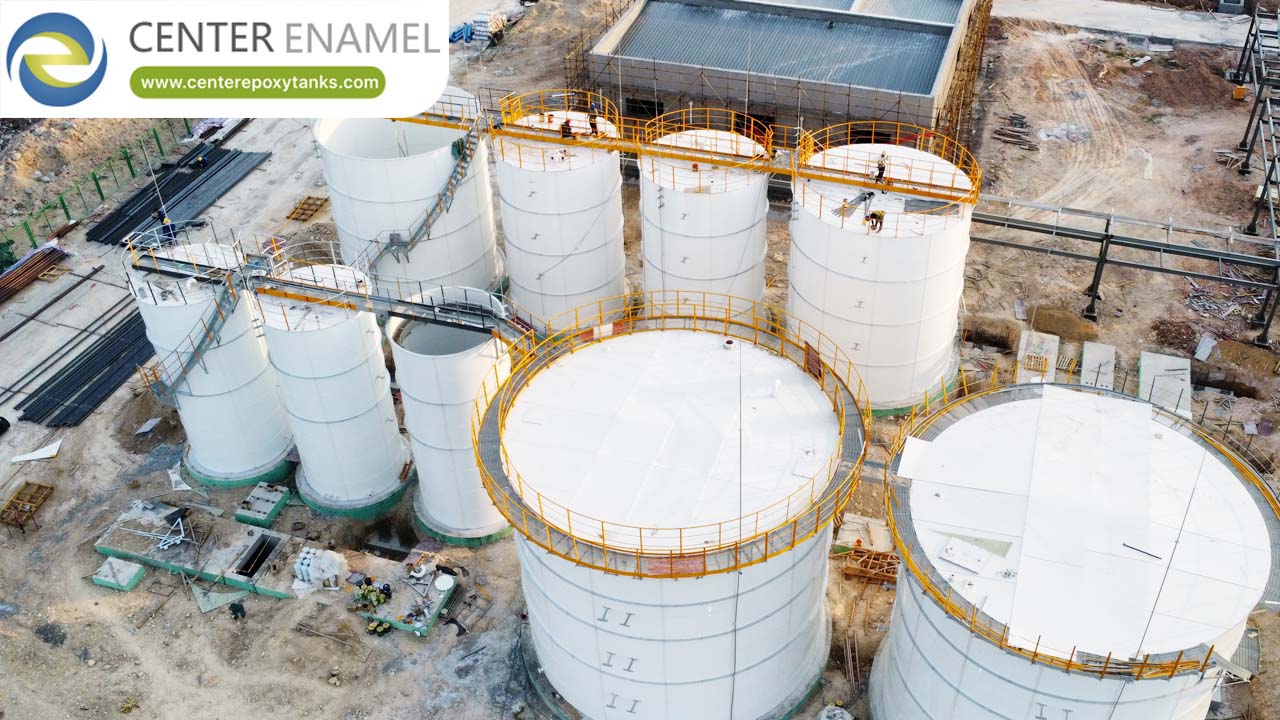
FBE Tanks for Sewage Treatment Plants: Engineering Superior Durability and Wastewater Containment
In municipal and industrial wastewater management, infrastructure reliability is critical to public health and environmental safety. Sewage treatment plants handle aggressive fluids, biological sludges, and corrosive byproducts—including hydrogen sulfide (H2S), methane, and various cleaning chemicals—that rapidly degrade standard materials. Protecting primary clarifiers, aeration basins, and sludge holding tanks requires advanced containment engineering.
The premier modular solution deployed across modern wastewater facilities is the Fusion-Bonded Epoxy (FBE) tank. Engineered by fusing a thermosetting epoxy powder onto high-tensile steel plates at elevated temperatures, FBE tanks create an impenetrable, chemically inert barrier designed to withstand the harsh environments of sewage treatment.
Core Engineering Principles and the FBE Coating Process
The structural and protective superiority of FBE tanks stems from advanced metallurgical bonding and factory-controlled manufacturing:
Electrostatic Application and Thermal Fusing: Unlike liquid paints that rely on simple air-drying or curing, FBE powder is electrostatically sprayed onto shot-blasted, precision-punched steel panels. The coated plates are then baked in a high-temperature thermal oven, causing the epoxy resin to melt, flow, and chemically cross-link into a uniform, continuous polymer matrix.
Unrivaled Adhesion and Flexibility: The fusion-bonding process creates a molecular-level bond between the epoxy and the carbon steel substrate. This results in exceptional peel strength and impact resistance, ensuring the coating flexes with the steel panels during thermal expansion or seismic events without cracking or flaking.
Smooth, Non-Porous Hygiene: The glass-like, non-porous finish of an FBE coating prevents microbial adhesion and biofilm accumulation, making internal tank walls exceptionally easy to clean and sanitize during routine maintenance cycles.
Primary Applications in Sewage Treatment Infrastructure
FBE tanks support critical stages of the municipal and industrial wastewater treatment cycle:
Primary and Secondary Clarifiers: Holding raw or chemically treated sewage while suspended solids settle out of the liquid stream.
Sludge Storage and Digestion Tanks: Containing dense biological sludges prior to dewatering, stabilization, or anaerobic digestion.
Chemical Treatment and Neutralization Basins: Storing coagulants, flocculants, and pH-adjustment chemicals safely without risking wall degradation.
Data Table: Comprehensive Comparison of Sewage Tank Technologies
Technical Parameter | Fusion-Bonded Epoxy (FBE) Bolted Tanks | Cast-in-Place Concrete Basins | Traditional Field-Painted Steel Tanks |
Coating Application & Quality | Factory-controlled thermal fusion ensuring uniform thickness and zero pinholes | Relies on manual concrete finishing and field-applied coatings | Field-applied liquid paint vulnerable to weather delays and human error |
Corrosion Defense in Wastewater | Superior resistance to sewage chemicals, moisture, and H2S gas | Vulnerable to concrete spalling, rebar corrosion, and acid attack | High susceptibility to blistering, peeling, and rust over time |
Installation Speed | Rapid modular bolting completed in weeks without curing delays | Slow civil construction requiring weeks of concrete framing and curing | Complex field welding and multi-coat painting staging |
Asset Service Life | 30 to 40+ years with minimal maintenance overhead | 30 to 50 years (prone to micro-cracking and joint leaks) | 15 to 25 years before intensive recoating is required |
Frequently Asked Questions (FAQ)
Q: What is an FBE tank in sewage treatment applications?
A: An FBE (Fusion-Bonded Epoxy) tank is a modular steel storage vessel whose interior and exterior panels are coated with a thermoset epoxy powder heat-fused to the metal, providing exceptional resistance to corrosive wastewater and sewage chemicals.
Q: How do FBE tanks resist hydrogen sulfide (H2S) corrosion in wastewater plants?
A: The chemically cross-linked epoxy barrier is completely inert to hydrogen sulfide gas and sulfuric acid formations commonly found in the headspace of sewage tanks, preventing the rust and degradation that destroys unprotected steel.
Q: Why are bolted FBE tanks preferred over concrete basins for sewage plants?
A: Bolted FBE tanks offer significantly faster installation times, predictable factory quality control, lower lifecycle maintenance costs, and the flexibility to expand or relocate the tank as the treatment plant's capacity grows.
Q: Can FBE tanks be customized for specific wastewater treatment capacities?
A: Yes. Because they utilize a modular panel design, FBE tanks can be engineered in a wide range of diameters and heights to meet the exact volume and footprint requirements of any municipal or industrial sewage facility.


