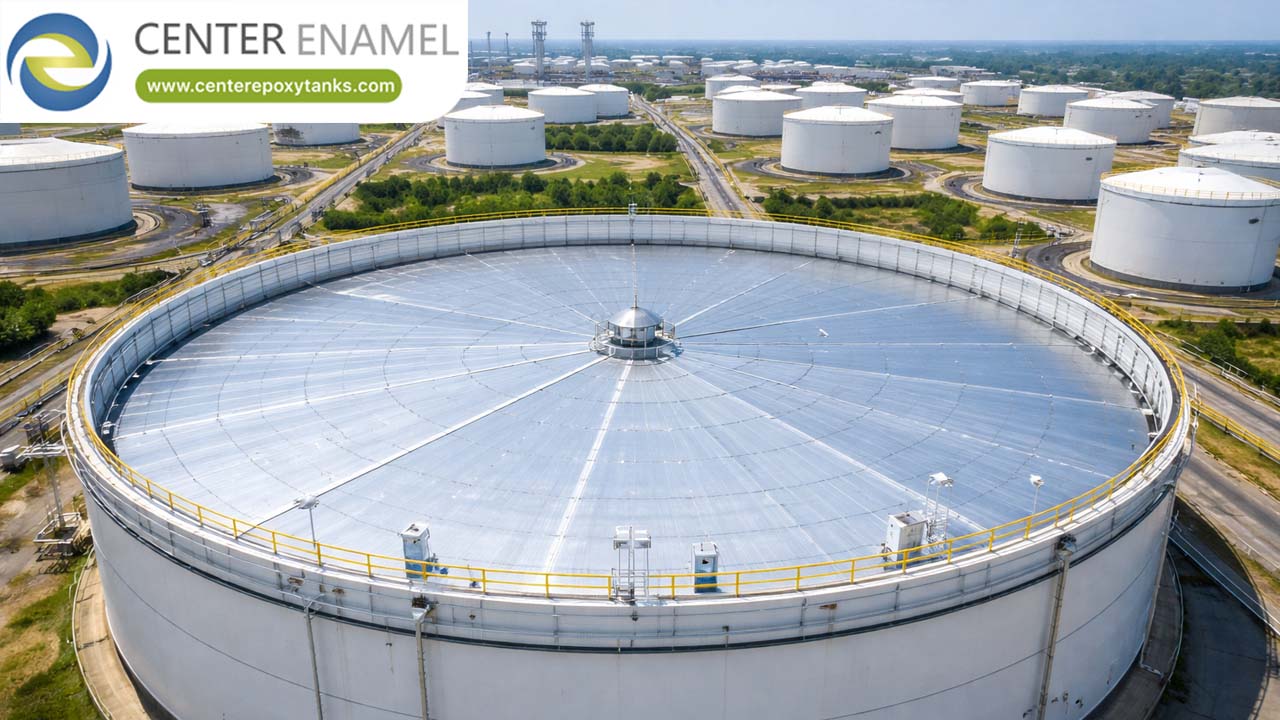
External I-Beam Roofs for Bolted Tanks: Engineering & Design Guide
In the design of industrial bolted tanks, the roof structure is a critical determinant of long-term maintenance costs and operational hygiene. An External I-Beam Roof (often referred to as an "External Rafter" design) shifts the load-bearing framework from the tank’s interior to its exterior. This architectural shift creates a clean, unobstructed interior space while ensuring the structural steel remains isolated from the potentially corrosive headspace vapors of the stored liquid.
1. The Engineering Logic: Why External Support?
Standard tank roofs often rely on internal columns or truss structures that create "dead zones" where sediment can accumulate or where corrosive vapors concentrate. The External I-Beam design resolves these issues through a radial arrangement of structural steel beams mounted on the tank’s top angle.
Key Structural Benefits:
● 100% Unobstructed Internal Volume: By moving the I-beams outside, the entire internal diameter remains clear. This is vital for industrial applications requiring top-mounted mixers, scrapers, or level sensors.
● Corrosion Mitigation: Structural members are removed from the headspace (the area between the liquid surface and the roof). This is essential for wastewater, biogas, or chemical storage where hydrogen sulfide (H2S) and other gases aggressively corrode internal steel supports.
● Simplified Maintenance: Because the roof structure is external, visual inspections of the beams and connections can be performed without entering the tank, significantly improving workplace safety and reducing downtime.
2. Technical Specifications & Material Standards
For EPC contractors and municipal engineers, the following specifications serve as the baseline for high-performance external I-beam roof systems:
Specification Component | Industry Standard |
Design Standard | AWWA D103-09 / Eurocode 3 / API 650 |
Support Material | High-strength Carbon Steel (Q235B / Q345B) |
Corrosion Protection | Hot-Dip Galvanized (ISO 1461) or Fusion Bonded Epoxy |
Load Capacity | Custom engineered (Snow/Wind/Seismic) up to 2.0 kN/m² |
Assembly | Bolted radial connection to top-rim |
3. Structural Comparison: External I-Beam vs. Alternative Designs
When selecting a roof system, consider the trade-offs between load-bearing requirements and internal accessibility.
● External I-Beam Roofs: The premier choice for heavy-duty requirements (e.g., high snow loads, heavy top-mounted equipment). They offer the highest structural rigidity for mid-to-large diameter tanks.
● Aluminum Geodesic Domes: An excellent alternative for very large spans or corrosive environments where minimizing roof weight is the priority. However, they are generally higher in capital cost compared to steel I-beam structures.
● Internal Rafter/Column Roofs: Lower initial cost but significantly higher lifecycle costs due to internal corrosion and the presence of structural obstacles that complicate cleaning and equipment operation.
4. Frequently Asked Questions (FAQ)
Q: Does the external beam design affect the aesthetic of the tank?
A: Yes, the external I-beams create a distinct industrial profile. While this does not impact the operational capacity, it is a visible structural feature. If a "flush" appearance is required, an aluminum dome is often the preferred aesthetic alternative.
Q: Can external I-beam roofs be retrofitted?
A: Yes. Most bolted tank manufacturers offer modular roof kits designed for reinforcement. If a client needs to upgrade their current tank’s load-bearing capacity (e.g., to support new mixing equipment), a new I-beam array can often be installed onto the existing top ring.
Q: How are these roofs sealed against leakage?
A: The roof panels are typically attached to the external framework using high-grade, UV-resistant gaskets and stainless steel fasteners. The connection at the tank shell is secured with a secondary sealant, ensuring an airtight seal that prevents rainwater ingress and vapor escape.
The External I-Beam Roof system represents the optimal balance between structural strength, maintenance ease, and process hygiene. For facilities managing wastewater, sludge, or complex chemical mixtures, removing the structural supports from the internal environment is a proactive strategy to extend the tank’s service life and ensure 100% operational reliability.
Are you currently specifying roof requirements for a new bolted tank project, and would you like to review the structural load calculations for your specific wind and snow exposure zones?


