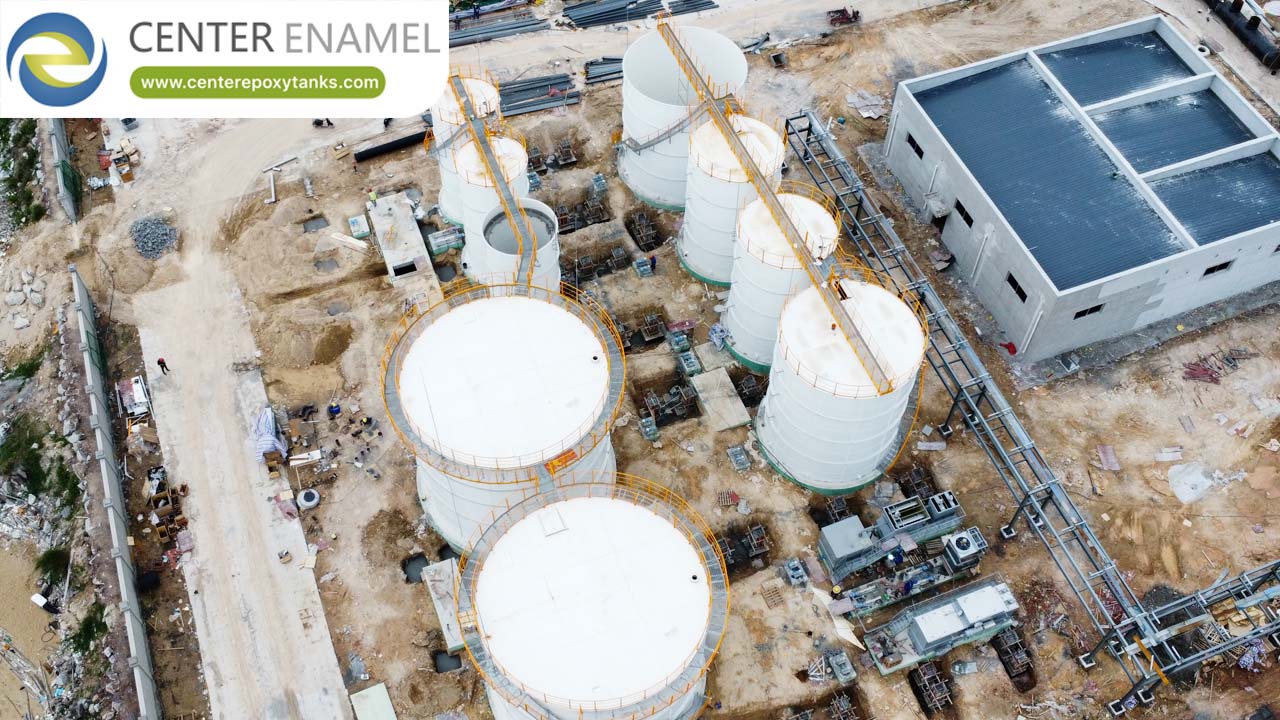
Expert China Epoxy Coated Tanks Manufacturer
In the 2026 global infrastructure landscape, the demand for resilient, modular storage has moved beyond simple containment toward Resource Recovery and Zero-Leak Infrastructure. As a premier Expert China Epoxy Coated Tanks Manufacturer, Center Enamel (Shijiazhuang Zhengzhong Technology Co., Ltd) has redefined the standard for Fusion Bonded Epoxy (FBE) technology. By integrating three decades of metallurgical research with factory-controlled polymer application, Center Enamel provides EPC contractors with a high-durability alternative to traditional concrete or welded steel.
1. Technical Authority: The FBE Fusion Process
Leadership in 2026 is defined by factory-controlled precision. Unlike on-site coatings, Center Enamel’s FBE tanks are meticulously fabricated in a controlled environment to ensure absolute uniformity and adhesion.
● Surface Pre-treatment: Steel surfaces undergo automated grit blasting to a Near-White Metal finish (SSPC-SP10) to create a permanent mechanical bond.
● Thermal Fusion Bonding: Specialized epoxy resin powder is electrostatically applied to pre-heated steel (180 C to 230 C).
● Molecular Integrity: The heat causes the powder to melt and chemically cross-link into a solid, non-porous polymer film.
● The Result: An impenetrable barrier that prevents rust, chemical degradation, and leaks even under the most aggressive industrial conditions.
2. Performance Matrix: Engineered for Global Standards
Center Enamel’s tanks are engineered to handle the dynamic stresses of 2026's industrial requirements.
FBE Tank Technical Specifications
Technical Feature | Engineering Specification | Strategic Operational Value |
Coating Material | High-Density FBE | 0% porosity; high impact and abrasion resistance. |
pH Tolerance | pH 3 – pH 11 | Suitable for raw sewage, organic slurries, and chemicals. |
Design Standard | AWWA D103-09 | Verified structural integrity for high-rate global projects. |
Compliance | NFPA 22 / NSF 61 | Certified for fire protection and potable water storage. |
Design Life | 30+ Years | Predictable ROI with minimal maintenance expenditure. |
3. Strategic Applications: Focus on Recovery & Resilience
As part of the 2026 Global Circular Economy, Center Enamel emphasizes the importance of recovery over mere treatment.
Biogas & Energy Recovery
In high-growth markets like the Philippines, the priority is maximizing biogas recovery. Center Enamel’s FBE tanks serve as primary reactors in CSTR and UASB systems, capturing methane (CH4) and preventing the release of H2S and CO2. The smooth, non-porous surface reduces "caking" of agricultural slurries and food waste digestate.
Municipal & Industrial Wastewater
Our tanks are the standard for secondary treatment, including aeration, equalization, and sludge thickening. The FBE barrier is chemically inert to the microbial-induced corrosion found in municipal sewage.
Potable Water & Rainwater Recovery
With NSF/ANSI 61 certification, our tanks provide hygienic storage for municipal drinking water and rainwater harvesting in regions from Singapore to Timor-Leste.
4. Why Partner with the Expert China Manufacturer?
Center Enamel’s leading position is solidified by a unique blend of technological prowess and an unwavering commitment to client success:
● Three Decades of Expertise: Over 30 years dedicated to bolted tank technology across 100+ countries.
● Advanced Manufacturing: A 150,000 square meter facility with fully automated production lines ensuring precision and efficiency.
● Global Supply Resilience: Modular bolted designs are high-density packed, reducing international freight costs by up to 40%.
● Custom Engineering: Bespoke solutions for specific process requirements, including agitation systems and temperature control.
5. Technical FAQ
Q: Why choose FBE over traditional welded steel for sewage storage?
A: Welded tanks require on-site painting, which is prone to pinholes and weather-related failures. Factory-applied FBE provides a molecularly bonded, holiday-free barrier that installs 60% faster and requires zero maintenance for decades.
Q: Can FBE tanks handle the aggressive H2S found in biogas systems?
A: Yes. The inert nature of the thermoset polymer prevents the sulfuric acid byproducts of biogas from degrading the steel structure, making it ideal for recovery-focused projects.
Q: What certifications ensure the quality of China-manufactured FBE tanks?
A: Center Enamel tanks comply with AWWA D103-09, ISO 9001, API 650, and EN 1090, ensuring they meet the same rigorous engineering audits as Western alternatives.


