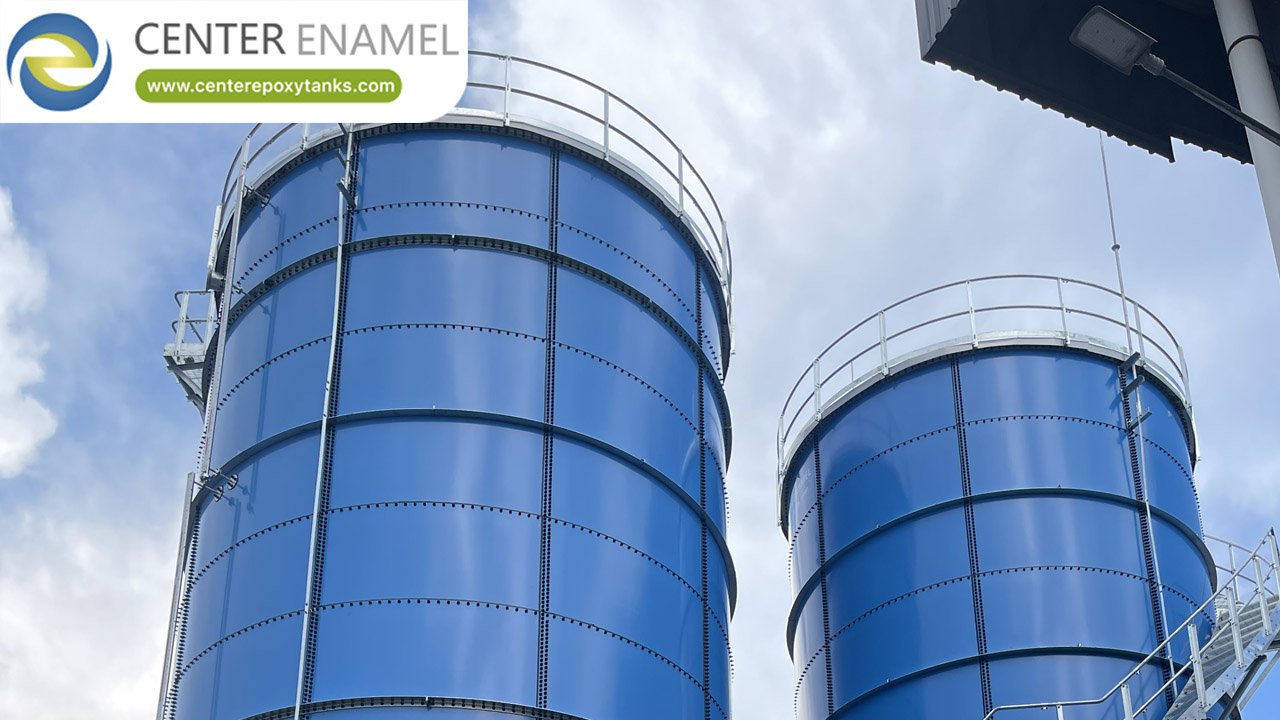
Epoxy Coated Tanks: The Resilient Backbone of Wastewater Treatment
In the infrastructure world, few environments are as chemically and microbiologically hostile as a wastewater treatment plant. From raw sewage and volatile sludge to aerobic/anaerobic reaction vessels, containment systems must endure relentless corrosion, heavy structural loads, and strict compliance mandates.
Center Enamel provides the engineered solution. By utilizing high-strength steel panels protected by a robust, factory-applied Fusion Bonded Epoxy (FBE) coating, we deliver containment systems uniquely capable of resisting biogenic corrosion, pH fluctuations, and the abrasion inherent in the treatment process.
The Engineering Advantage: Defense Against Biogenic Corrosion
The primary failure mechanism in wastewater infrastructure is biogenic corrosion—where biological activity produces sulfuric acid ($H_2SO_4$) in the tank's vapor space. Conventional paint systems and concrete struggle to survive this.
Why FBE Outperforms Traditional Materials
Feature | Center Enamel FBE Bolted Tank | Traditional Concrete Tank | Welded Carbon Steel Tank |
H2S/Acid Resistance | Superior (Inert FBE) | Low (Acid erosion) | Low (Rapid rusting) |
Construction Time | Fast (Modular/Bolted) | Very Slow (Pour/Cure) | Moderate |
Surface Smoothness | High (Non-stick) | Low (Porosity/Scaling) | Moderate |
Scalability | High (Add ring panels) | None (Permanent) | Low |
Maintenance Needs | Minimal | High (Repair/Sealing) | High (Paint/Sandblast) |
Fusion Bonded Excellence: Unlike field-applied paints, our FBE is electrostatically applied and thermally cured, creating a molecular bond to the steel. This barrier prevents acid from ever touching the structural steel.
Edge Integrity: Our process ensures uniform coverage at critical panel edges and bolt holes, preventing the "thin-film" failures common in conventional tanks.
Versatility Across the Treatment Train
Our epoxy-coated tanks are engineered to integrate seamlessly into every stage of the wastewater treatment process:
1. Anaerobic Digestion (AD) & Biogas
Our bolted, sealed construction creates the hermetic, oxygen-free environment required for methane production, while our acid-resistant FBE coating withstands the volatile fatty acids (VFA) produced during initial digestion phases.
2. Clarifiers and Thickeners
Clarifiers require the ability to support heavy rake mechanisms and endure uneven static loads. Our high-grade steel provides the necessary structural integrity, while the smooth, non-porous FBE surface prevents sludge buildup, ensuring efficient mechanical operation.
3. Aeration and Bioreactors
In MBR or activated sludge processes, tank walls face constant abrasion from aeration bubbles and suspended solids. Our FBE coating is chemically inert, resisting both the process chemicals (flocculants/polymers) and the corrosive effects of converted H2S.
Proven Project Footprint
Center Enamel’s epoxy tanks are the foundation of major municipal and industrial projects globally:
Guangdong Huizhou Industrial Park (20 units): Supported complex treatment processes with a total capacity of 12,166 m³, showcasing our high-volume deployment capability.
Inner Mongolia Landfill Leachate Project (4 units): Managed extremely corrosive leachate, proving our FBE technology’s superior chemical resistance in the most aggressive environments, with a total capacity of 11,960 m³.
South Africa Municipal Sewage Project (2 units): Delivered dependable, large-scale containment for urban infrastructure development, totaling 10,132 m³.
Frequently Asked Questions (FAQ)
Q: Why is FBE superior to standard enamel or paint?
A: Standard paints are susceptible to "holiday" defects (micro-voids) and can delaminate under high-humidity or acid-vapor conditions. FBE is thermally fused to the steel, creating a permanent, non-porous barrier that is part of the steel panel itself, not just a surface application.
Q: How does the bolted design handle the weight of sludge?
A: Our bolted panels are precision-engineered to meet specific structural load requirements. The modular design allows us to vary the steel thickness and reinforcement based on the tank's hydrostatic load, ensuring stability even for high-density clarifier sludge.
Q: Can these tanks be expanded after installation?
A: Yes. This is a primary benefit over concrete. Because our system is bolted and modular, facilities can add additional rings of panels in the future if treatment capacity needs to increase, protecting your initial capital investment.
Are you looking to replace failing concrete infrastructure or optimize your new facility's lifecycle costs? [Contact the Center Enamel engineering team] today to receive a technical proposal and feasibility analysis for your wastewater treatment project.


