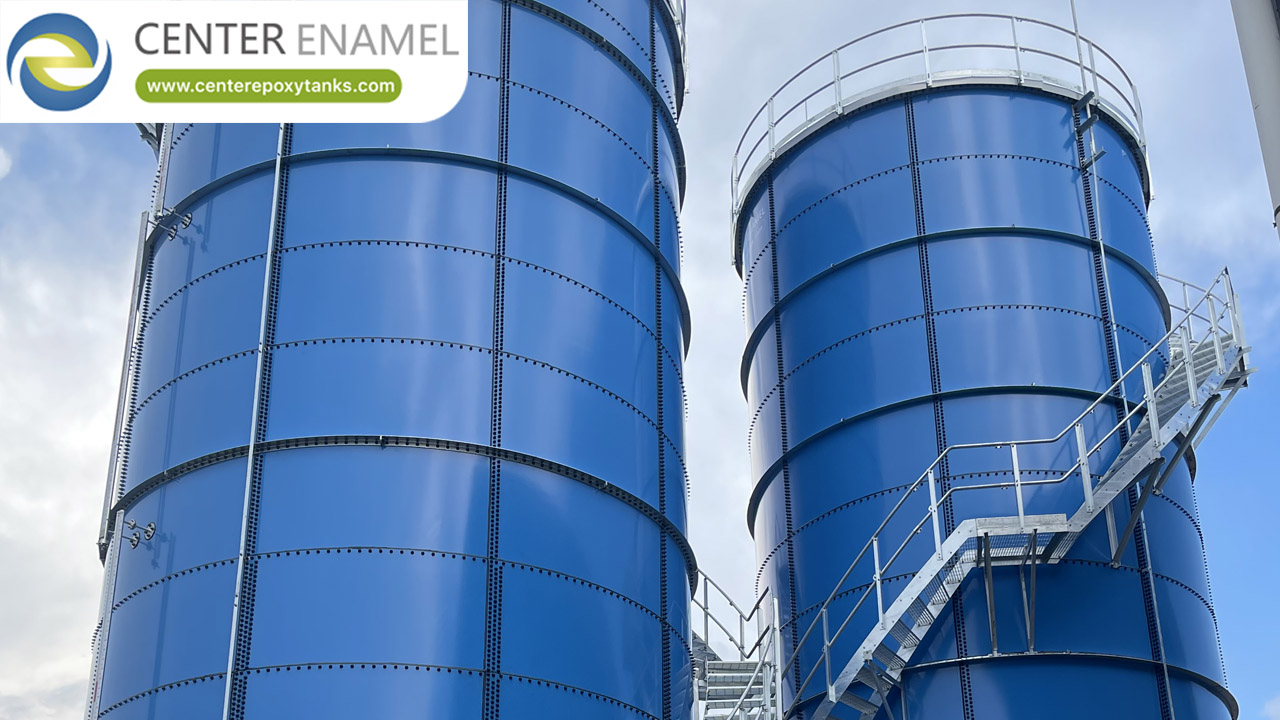
Epoxy Coated Tanks for Landfill Leachate Storage: A Technical Overview
Landfill leachate is one of the most chemically aggressive substances in industrial waste management. Composed of organic contaminants, heavy metals, ammonia, and fluctuating pH levels, it requires storage solutions that prioritize absolute chemical inertness and structural integrity. Factory-applied Fusion Bonded Epoxy (FBE) bolted steel tanks are the modern industrial standard for leachate containment, providing a superior balance of chemical resistance, modular scalability, and long-term durability.
The Engineering Challenge: Why Leachate Requires Specialized Containment
Standard industrial tanks often fail in leachate applications because they cannot handle the unique "cocktail" of corrosive elements found in landfill runoff.
Corrosion Risk: Leachate often fluctuates between acidic and alkaline, rapidly degrading standard carbon steel and concrete.
Permeability: Concrete is porous; over time, leachate can infiltrate the material, causing structural decay of internal rebar.
Gas Management: Leachate generates volatile gases (methane/H2S) that require an airtight storage solution to ensure facility safety and regulatory compliance.
The Solution: Fusion Bonded Epoxy (FBE) Technology
Unlike field-applied paints, Fusion Bonded Epoxy (FBE) is a thermoset polymer barrier fused to steel panels in a factory-controlled environment. This creates a monolithic, non-porous shield that isolates the steel from the corrosive leachate.
Performance Matrix: Leachate Storage Solutions
Feature | Epoxy Coated Steel (FBE) | Reinforced Concrete | Field-Welded Steel |
Chemical Tolerance | High (pH 2–13) | Variable (Needs Liners) | Low |
Porousness | Zero (Non-porous) | High | None |
Installation Speed | Fast (Bolted/Modular) | Slow (Pour & Cure) | Moderate |
Maintenance | Low (Smooth Surface) | High (Structural Repair) | High (Paint Cycles) |
Lifecycle ROI | Highest | Moderate | Low |
Key Advantages for Landfill Operators
Chemical Inertness: FBE coatings are rated for extreme pH ranges, ensuring they withstand the complex chemical profile of landfill leachate without degradation.
Asset Agility: As landfill capacity or leachate volume changes, modular FBE tanks can be expanded or relocated—a level of flexibility that concrete or welded structures cannot offer.
Risk Mitigation: The factory-controlled application ensures zero "holidays" (pinholes) in the coating, a common failure point in field-painted tanks that leads to leakage and environmental liability.
Operational Safety: The bolted, modular design eliminates the need for on-site "hot work" (welding), making installation safer and faster in busy landfill environments.
Frequently Asked Questions (FAQ)
Q: Why choose FBE tanks over concrete for landfill leachate?
A: Concrete is porous. Leachate can penetrate the surface, corrode internal rebar, and lead to structural failure. FBE tanks are non-porous, chemically inert, and do not require the massive site labor or long curing times associated with concrete.
Q: Can these tanks handle the gases (H2S/Methane) produced by leachate?
A: Yes. FBE tanks are designed with airtight bolted connections and specialized gaskets, making them ideal for containing leachate while managing volatile organic compounds and gases safely.
Q: How does FBE compare to Glass-Fused-to-Steel (GFS)?
A: Both are excellent high-performance choices. FBE is often preferred for its exceptional impact resistance and competitive upfront cost for large-capacity projects, while providing a smooth, non-stick interior that is easy to clean.
Q: What is the lifespan of an FBE tank in a landfill application?
A: With proper installation and routine visual inspection, FBE tanks typically offer a service life of 20–30+ years, even in the highly aggressive environment of a landfill.
Q: Are field repairs possible if the coating is scratched during operation?
A: Yes. Unlike GFS, which can be difficult to patch, small mechanical nicks in FBE coatings can be easily addressed using field-proven repair kits that restore the chemical barrier integrity on-site.
Are you currently specifying infrastructure for a new landfill project or looking to upgrade your aging leachate containment systems? [Contact our engineering team] today for a technical proposal or a custom capacity analysis tailored to your site’s specific effluent profile.
Expert Follow-Up Question: To best assist with your technical planning, are you currently dealing with highly acidic leachate from a newer landfill, or is the facility managing older, high-ammonia leachate?


