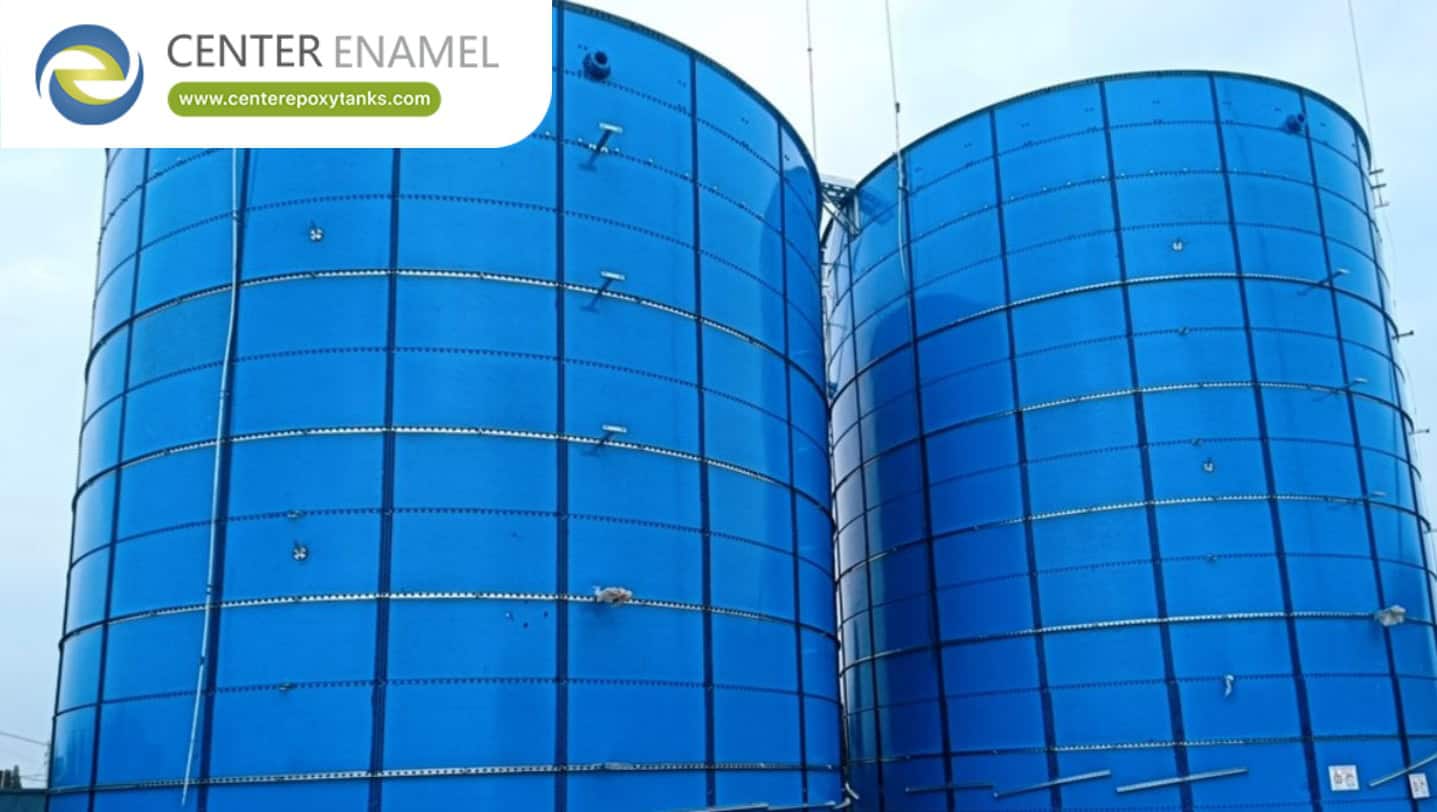
Epoxy Coated Tanks for Brewery Wastewater Treatment: Engineering & Compliance Guide
Brewery wastewater is notoriously difficult to manage due to its high organic load, fluctuating pH levels, and the presence of aggressive cleaning chemicals from Clean-in-Place (CIP) processes. For environmental engineers, selecting the correct storage and treatment vessel is a high-stakes decision. Epoxy-coated bolted steel tanks have become the global standard for Brewery Effluent Treatment Plants (ETP) and anaerobic digesters, offering a superior balance of chemical inertness, structural integrity, and long-term cost-efficiency.
1. The Brewery Effluent Challenge
Brewery waste streams are not standard wastewater; they are nutrient-rich but chemically aggressive environments that accelerate the degradation of traditional materials.
● High Organic Loads: Raw effluent often contains high concentrations of $COD$ (Chemical Oxygen Demand) and $BOD$ (Biochemical Oxygen Demand), which can lead to rapid microbial activity and subsequent acidification.
● pH Fluctuations: Breweries frequently shift between acidic and caustic conditions during cleaning cycles. This pH instability can rapidly erode concrete tank liners and induce stress corrosion cracking in lower-grade steel.
● Temperature Variations: Process effluent is often warm, which accelerates chemical reaction rates, increasing the corrosion pressure on internal tank surfaces.
2. Why Epoxy Coated Bolted Steel?
The manufacturing process for epoxy-coated steel tanks—specifically those using Fusion Bonded Epoxy (FBE)—creates a non-porous, chemically inert barrier that thrives where other materials fail.
● Factory-Controlled Quality: Unlike field-applied coatings (which suffer from humidity and application errors during on-site construction), factory-applied epoxy is cured in a temperature-controlled environment. This guarantees a "holiday-free" (pinhole-free) surface that resists chemical penetration.
● Chemical Inertness: The epoxy layer acts as a sacrificial barrier against the acids, alkalis, and solvents inherent in CIP fluids, ensuring the structural steel remains isolated from the effluent.
● Rapid Modular Assembly: Brewery expansions require agility. Bolted tank technology allows for rapid installation, which can be done in any weather, minimizing downtime for the facility.
3. Material Performance Comparison
When selecting tanks for brewery wastewater, the material choice determines the Total Cost of Ownership (TCO).
Feature | Epoxy Coated Steel | Reinforced Concrete | Stainless Steel |
Chemical Resistance | Excellent (Acid/Alkali) | Poor (Requires lining) | Excellent |
Abrasion Resistance | High | Low | Moderate |
Installation Speed | Rapid (Bolted) | Slow (Poured/Cured) | Moderate |
Lifecycle Cost | Low | High (Constant maintenance) | High (Capital cost) |
Structural Integrity | High (Seismic/Dynamic) | Variable (Crack-prone) | High |
4. Engineering Standards & Compliance
For brewery projects, tanks must adhere to rigorous international standards to ensure environmental compliance and site safety.
● ISO 28765: The international standard for vitreous and porcelain enamel coatings, which often applies to the high-performance standards required for FBE coatings in wastewater.
● NSF/ANSI 61: Critical if the tanks are used for water treatment processes that may be reused within the brewery (e.g., process water recycling).
● Structural Calculations (AWWA D103-09): All designs should be verified by Finite Element Analysis (FEA) to account for the dynamic loads of aeration systems, mixers, and sludge handling equipment.
5. Frequently Asked Questions (FAQ)
Q: Can epoxy coated tanks handle the heat from brewery wastewater?
A: Yes. High-performance industrial epoxy systems are engineered to maintain structural and chemical integrity at temperatures up to $60^circtext{C}$ to $80^circtext{C}$, which covers the majority of brewery effluent applications.
Q: Will the cleaning chemicals (CIP) strip the epoxy coating?
A: Industrial-grade fusion-bonded epoxy is designed specifically for chemical resistance. It is chemically cross-linked during the curing process, making it highly resistant to the caustic soda (NaOH) and nitric/phosphoric acids typically used in brewery CIP cycles.
Q: How do you handle sediment buildup in these tanks?
A: Brewery wastewater contains organic solids that can settle. Our tank designs include sloped floors (cone-down) and properly positioned side-entry manways to facilitate sludge removal. Furthermore, the smooth surface of the epoxy coating discourages bio-fouling and sediment adhesion.
The success of a brewery's wastewater treatment program relies on the reliability of its containment infrastructure. By deploying epoxy-coated bolted steel tanks, brewery operators gain a robust, chemically resistant, and scalable solution that meets modern environmental discharge standards while minimizing long-term maintenance liabilities.
Are you currently sizing tanks for a brewery effluent project, and would you like to review the structural FEA calculations for your specific aeration or agitation equipment requirements?


