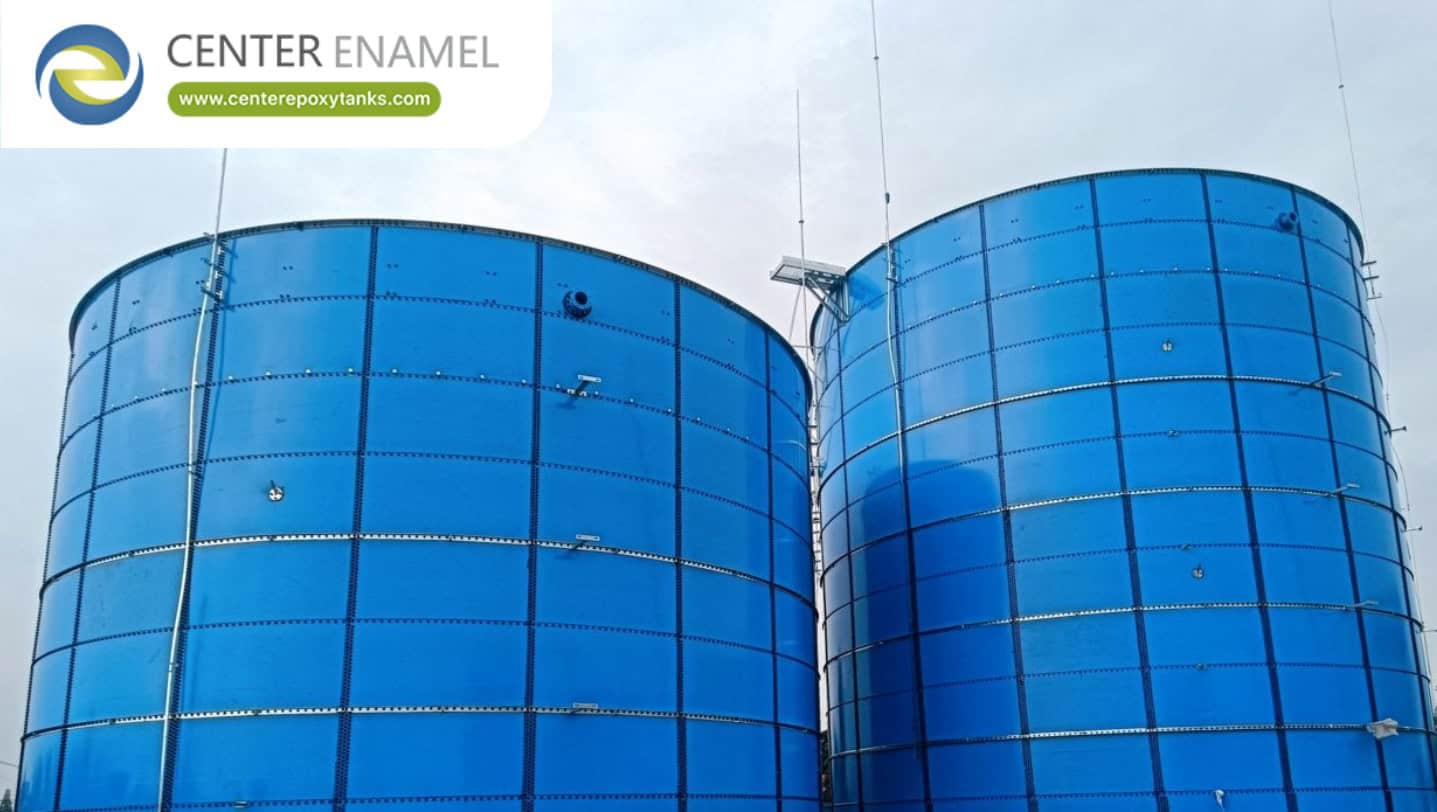
Epoxy Coated Steel Tanks for POME Treatment: Engineering & Procurement Guide
Palm Oil Mill Effluent (POME) represents one of the most challenging wastewater streams in the agricultural industry. Characterized by high Biological Oxygen Demand (BOD), high Chemical Oxygen Demand (COD), high oil/grease content, and significant acidity, POME requires robust containment.
Epoxy-coated bolted steel tanks have become the global standard for POME treatment systems. They provide a chemically inert barrier that resists acid corrosion and prevents the buildup of sludge, while offering the rapid deployment, modularity, and scalability that traditional poured-in-place concrete cannot match. China is currently the dominant global manufacturing hub for these advanced containment systems, offering high-precision factory production for international export.
1. The POME Treatment Challenge
Palm oil processing generates massive volumes of effluent. Because POME is highly degradable, it naturally undergoes anaerobic digestion, producing significant quantities of biogas (methane and hydrogen sulfide) and acidic intermediates.
Why Epoxy-Coated Steel?
Traditional materials fail in POME environments:
Concrete: Porous in nature, concrete is prone to "concrete cancer"—where acidic POME seeps into the structure, corrodes the internal steel reinforcement (rebar), and eventually leads to structural spalling.
Bare/Painted Steel: POME’s acidity and sludge content cause rapid peeling and rust, leading to frequent, expensive maintenance shutdowns.
Epoxy-coated panels are factory-fabricated using high-tensile steel. The epoxy layer is applied via electrostatic spray in a climate-controlled factory, ensuring a uniform, cross-linked polymer barrier that is impervious to the chemical profile of POME.
2. Technical Comparison Matrix
For facility engineers and procurement managers, the choice between materials dictates the facility's long-term OpEx.
Performance Vector | Epoxy Coated Bolted Steel | Cast-in-Place Concrete | Field-Welded Steel |
Chemical Resistance | Excellent (Inert barrier) | Poor (Requires lining) | Low (Needs frequent recoating) |
Installation Speed | Fast (Modular/No curing) | Slow (Weeks for curing) | Moderate (Requires field welding) |
Maintenance | Low (Panel replacement) | High (Crack injection) | High (Sandblasting/repainting) |
Scalability | High (Expandable rings) | Zero (Fixed infrastructure) | Low |
Logistics | Compact (Flat-packed) | Massive (Raw material transport) | High (On-site logistics) |
3. Engineering Specifications for POME Applications
When engaging a manufacturer in China, engineering teams must specify the following technical requirements to ensure the tanks survive the harsh anaerobic conditions of a POME digester:
A. The "High-Voltage Holiday" Benchmark
The coating must be pinhole-free. Specify 100% High-Voltage Spark Testing (also known as Holiday Testing) at 1500V or higher. Any panel that shows a spark during factory testing must be rejected. This is the single most critical quality assurance step for leachate and effluent tanks.
B. Bolt and Gasket Integrity
The seams are the weak points. Specify Grade 8.8 or 10.9 high-strength bolts with self-sealing, chemical-resistant washers. For POME, the gasket material should be Butyl Rubber or specialized EPDM formulations designed to remain flexible and leak-proof even when exposed to fluctuating oil/grease concentrations and organic acids.
C. Headspace Protection
Because anaerobic digestion in POME tanks generates H2S (which creates sulfuric acid when it condenses), the tank roof and the top 1–2 meters of the shell are the most vulnerable. Ensure the manufacturer applies a double-layer or "heavy-duty" epoxy coating thickness specifically for the upper section of the tank.
4. Sourcing Strategy for Chinese Manufacturers
China has industrialized the production of these tanks, transitioning from general steelwork to highly specialized bolted-tank fabrication.
Request Mill Test Reports (MTRs): Always verify the steel grade (e.g., Q235B or Q345R). Do not accept generic "structural steel" without certification.
Audit the Coating Line: Ask for video documentation of the factory's electrostatic spray booth and thermal curing oven. Proper curing is the only way to achieve the required chemical resistance for POME.
Logistics: These tanks are "flat-packed." A single 40ft container can hold thousands of square meters of paneling. Ensure your manufacturer provides a detailed packing list that coordinates with your site erection schedule.
Field Supervision: Most Tier-1 Chinese manufacturers provide "Supervisors" who travel to your site to lead the local installation crew. This is highly recommended to ensure the torqueing of bolts and the integrity of the gasket seal—common failure points in improperly installed tanks.
Frequently Asked Questions (FAQ)
Q: Can we expand the tank capacity later?
A: Yes. This is a primary benefit. If your mill capacity increases, you can jack up the existing epoxy-coated tank and add a new ring of panels at the bottom. This modularity is impossible with concrete or welded steel tanks.
Q: Is the epoxy coating safe from grease and oil buildup?
A: Yes, the coating is extremely "slick." Unlike concrete, which is porous and holds onto grease, the factory-applied epoxy surface makes it difficult for POME solids to adhere. This makes the tanks easier to clean and prevents the "crusting" often seen in older lagoons.
Q: How long can we expect these tanks to last in POME service?
A: With proper maintenance and holiday-test-certified panels, these tanks are designed for a service life of 20 to 30 years in industrial wastewater applications.


