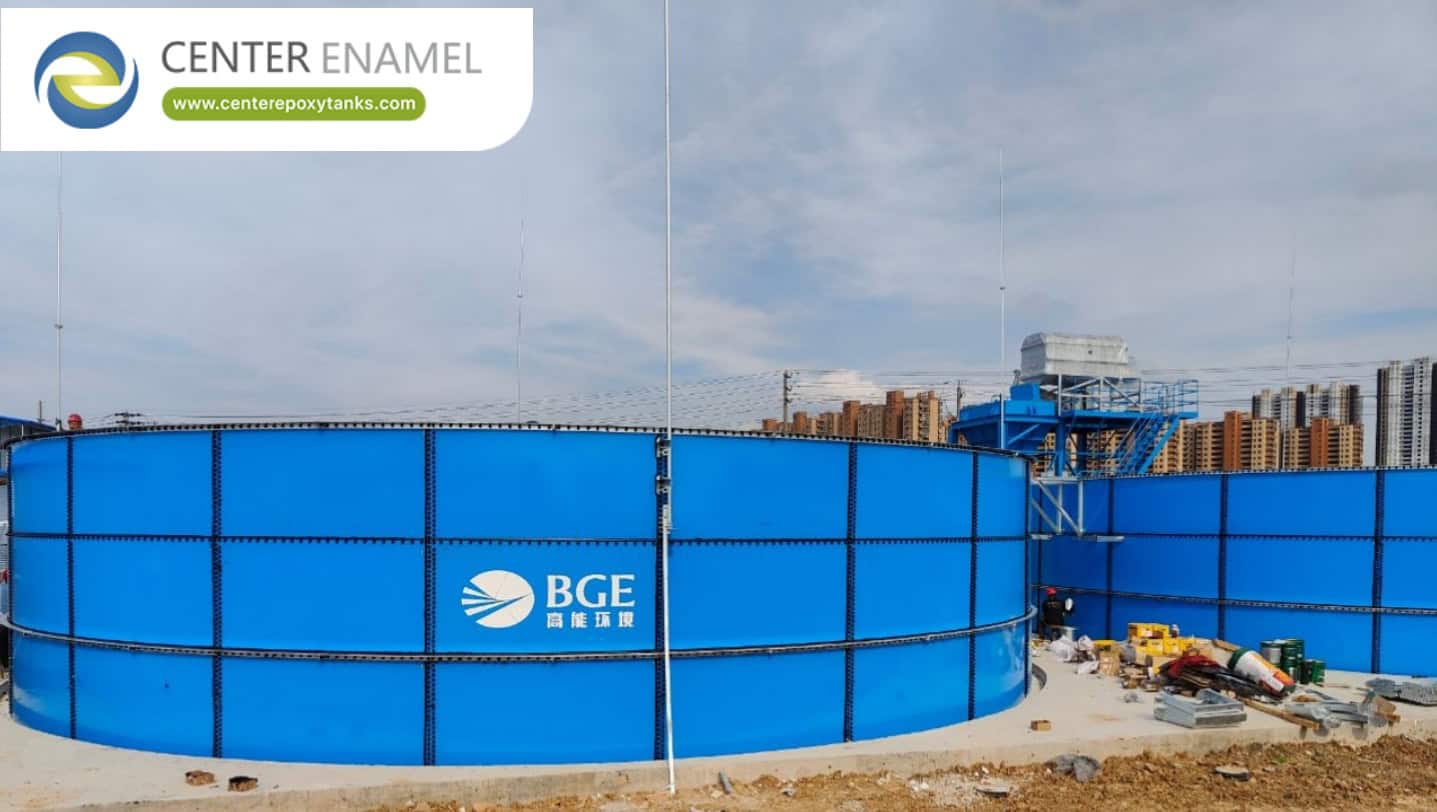
Epoxy-Coated Steel Bolted Tanks: The Industrial Standard for Modular Storage
In today’s fast-paced industrial environment, infrastructure projects demand solutions that combine rapid deployment, long-term durability, and cost-efficiency. Epoxy-Coated Steel Bolted Tanks represent the pinnacle of this balance. By marrying the structural strength of high-grade steel with the chemical inertness of factory-applied epoxy, these tanks provide a versatile storage solution for municipalities, agricultural enterprises, and industrial processing plants.
Center Enamel (Shijiazhuang Zhengzhong Technology Co., Ltd.) has refined the fabrication of these tanks, utilizing precision-engineered panels that arrive ready for assembly, ensuring consistent quality and reduced on-site installation time.
The Advantages of Epoxy-Coated Bolted Design
While welded steel tanks have long been a standard, bolted epoxy-coated tanks are increasingly preferred for their superior lifecycle value and installation flexibility.
1. Factory-Controlled Quality
Unlike welded tanks, where the coating is often applied in the field—vulnerable to weather, humidity, and human error—our epoxy panels are processed in a climate-controlled factory environment. Every panel undergoes abrasive blasting, high-temperature curing, and rigorous "holiday testing" to ensure a flawless, zero-discontinuity surface before it ever reaches your site.
2. Rapid, Modular Assembly
Bolted tanks arrive as a kit of precision-engineered parts. They are assembled using a top-down jacking method or scaffolding, which requires no heavy on-site welding or extensive specialized machinery. This modularity allows for:
Faster Project Timelines: Installation can be completed in a fraction of the time required for traditional construction.
Remote Accessibility: Panels are easily shipped in standard containers, making these tanks ideal for remote industrial sites or locations with limited infrastructure.
3. Superior Corrosion Resistance
The epoxy coating acts as a robust, non-porous barrier. When formulated for specific chemical or water environments, it resists oxidation, acids, and alkalis, protecting the structural steel beneath. This design avoids the "weld decay" often seen in field-welded seams where the coating may be thin or prone to cracking.
Comparison: Bolted Epoxy Tanks vs. Traditional Methods
Feature | Epoxy Bolted Steel | Welded Carbon Steel | Reinforced Concrete |
Installation Speed | Fast (Weeks) | Slow (Months) | Very Slow (Months+) |
Coating Consistency | High (Factory-Applied) | Low (Field-Applied) | N/A |
Site Labor | Minimal (Standard Crew) | High (Certified Welders) | High (Civil Labor) |
Relocatability | Possible | No | No |
Maintenance | Low (Panel Inspection) | High (Repainting/Seams) | High (Crack Repair) |
Applications & Compliance
Center Enamel’s epoxy-coated bolted tanks are engineered to meet global standards including AWWA D103-09 and NSF/ANSI 61 (for potable water). Their versatility makes them suitable for:
Potable Water Storage: Hygienic, non-toxic reservoirs for municipal water supply.
Wastewater Treatment: Resistant to domestic and industrial effluents.
Industrial Process Water: Stable storage for process-intensive industries.
Agricultural Slurry & Digestion: Durable containment for demanding agricultural waste.
Frequently Asked Questions (FAQ)
1. How does the epoxy coating hold up over time?
When applied in our controlled factory environment, the epoxy bond is incredibly strong. It is designed to resist abrasion and chemical degradation for decades. Regular visual inspections are recommended, and any minor damage (like a deep scratch) can be easily repaired with field-touch-up kits, preventing localized corrosion.
2. Can these tanks be used for drinking water?
Yes. When utilizing our NSF/ANSI 61 certified coating systems, the tanks are perfectly safe for potable water. The coating is chemically inert and does not leach into the water, ensuring the highest water quality standards.
3. Are bolted tanks prone to leaking at the seams?
Modern bolted tanks use high-performance, long-lasting gaskets and sealants at every joint. When assembled correctly, they create a hermetic seal that is as reliable as a welded joint, with the added benefit that any minor maintenance can be addressed panel-by-panel rather than via massive structural repairs.
4. How does the cost compare to welded tanks?
While the upfront factory fabrication cost of an epoxy bolted tank might appear comparable or higher than simple steel, the total cost of ownership is significantly lower. You save on on-site labor, field coating costs, and future maintenance, making it a more economical choice over the lifecycle of the tank.
5. Can I expand the tank capacity later?
One of the primary benefits of the bolted modular system is scalability. If your storage needs grow, it is often possible to disassemble the roof and add additional rings of panels to increase height, or relocate the entire structure to a different site if your operational footprint changes.


