Epoxy-Coated Crude Oil Storage Tanks: When FBE Fits
Glass-Fused-to-Steel (GFS) tanks fuse a 820-930°C vitreous enamel to steel, creating an inert, hard (about 6.0 Mohs) liner. For crude oil storage epoxy-coated tanks the question is not 'can glass hold oil' but 'which oil service matches the coating envelope'.
What Is Crude Oil Storage Epoxy-Coated Tanks?
A GFS tank is a bolted steel tank whose panels carry a glass enamel coating fused at 820-930°C. The glass is chemically inert and impermeable; the steel gives strength. Panels bolt together with sealed joints, so the tank arrives flat-packed and assembles quickly.
How Does It Work?
Steel plates are cleaned, sprayed with enamel frit, and fired so the glass bonds to the metal. The result resists corrosion from the stored liquid and survives abrasion better than bare steel. For oil service the lining must suit the product: edible oils are compatible with food-grade glass; aggressive crude streams are not the primary GFS market.
Key Types, Components, and Features
· GFS for edible oil:food-grade glass lining, inert, no taste transfer — suits cooking and vegetable oils.
· GFS boiler feedwater:resists oxygen and thermal-side corrosion in deaerated water.
· Epoxy-coated (FBE) alternative:fusion-bonded epoxy for petroleum-adjacent and higher-pH streams.
· ISO 28765 enamel:vitreous-enamel steel built to the enamel standard for liquid service.
Applications
· Edible / cooking / vegetable oil storage (GFS, food grade)
· Boiler feedwater and process water (GFS)
· Palm-oil wastewater and petroleum wastewater (epoxy-coated)
· Non-flammable, lower-vapor oil-adjacent liquids
Technical Considerations
· Standards:ISO 28765 for vitreous-enamel steel; AWWA D103-09 for bolted construction; NSF/ANSI 61 or LFGB for potable/food contact.
· Hardness:about 6.0 Mohs — hard, but quartz abrasives are harder; manage wear mechanically, do not rely on the lining to win a hardness contest.
· pH envelope:standard GFS covers pH 3-11; special formulations reach 1-14 — confirm before specifying aggressive service.
· Bolting:Grade 8.8 bolts with sealed gaskets; holiday-tested at 1500 V for coating integrity.
· Honest limit:GFS is not the default for flammable crude or gasoline; those favor floating-roof steel or coated steel by fire code.
Key Engineering Parameters
Design Parameter | Typical Value / Range | Why It Matters |
Firing temperature | 820-930 °C | Glass-to-steel fusion |
Coating thickness | 0.25-0.45 mm / side | Corrosion barrier |
Hardness | ~6.0 Mohs | Abrasion resistance |
Adhesion | ~3450 N/cm² | Lining integrity |
Holiday test | 1500 V, 100% | Coating defect check |
pH envelope | 3-11 std; 1-14 special | Chemical compatibility |
Bolts | Grade 8.8, sealed | Joint integrity |
Standards | ISO 28765; AWWA D103-09 | Code compliance |
Food contact | LFGB / NSF optional | Edible-oil suitability |
Project Case Study
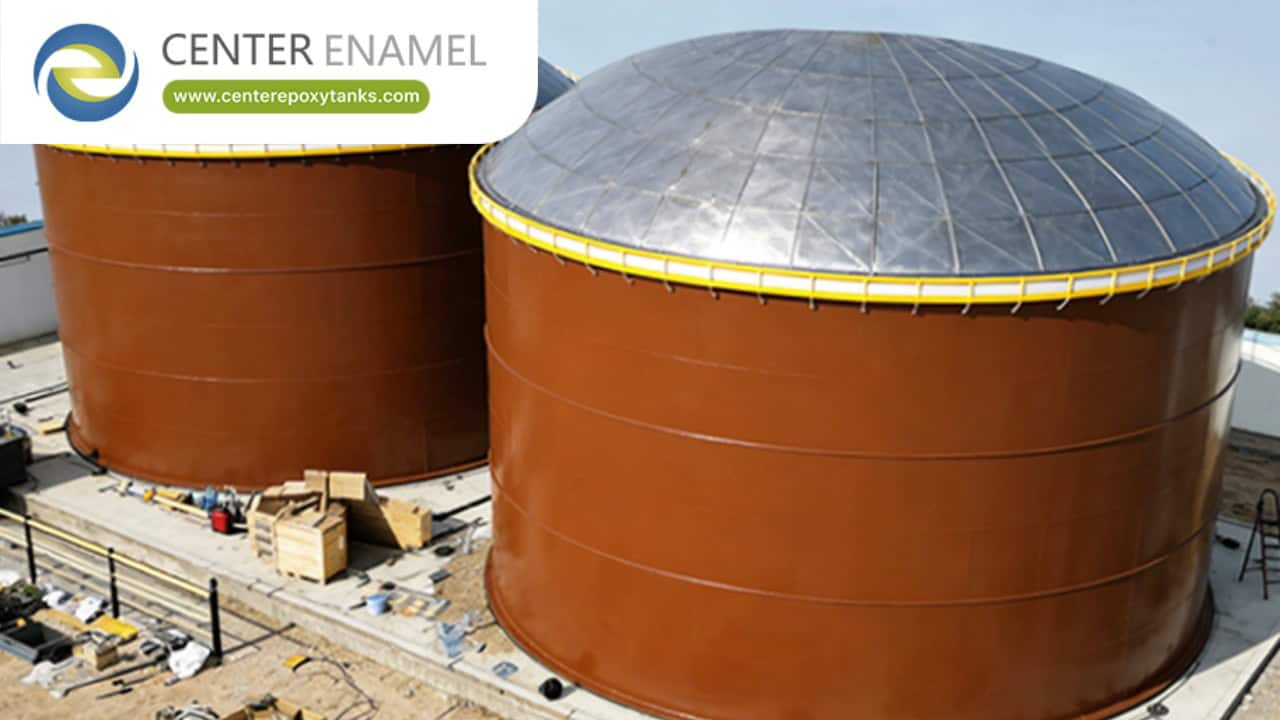
The following verified installation demonstrates the containment engineering discipline behind crude oil storage epoxy-coated tanks. (Application shown is the tank's actual delivered service; the same bolted, coated, or stainless engineering underlies oil-storage designs discussed here.)
Project Information | Details |
Location | China |
Year | 2024 |
Industry / Application | Industrial wastewater treatment |
Product / Tank type | Epoxy-coated bolted |
Configuration | 3 tanks, φ 13.76 × 7.8 m and φ 11.46 × 4.2 m |
Capacity | 2,752 m³ |
Standards | ISO 28765 |
Status | Completed |
This reference is cited for its documented liquid-containment and corrosion-control engineering; it is not represented as an oil tank where it was a water or wastewater installation.
Advantages and Limitations
Advantages
· Inert glass lining — no taste or odor transfer in edible oil
· Fast bolted erection versus welded field construction
· Strong corrosion resistance in water and mild oil streams
· Food-grade option with LFGB / NSF compatibility
Limitations
· Not the primary choice for flammable crude or gasoline
· Abrasion from hard solids still needs mechanical design
· pH and temperature must stay inside the lining envelope
Comparison
Feature | GFS (glass) | Epoxy-coated (FBE) | Stainless 316L |
Inertness | High (glass) | Good | High |
Edible-oil fit | Excellent | Good | Excellent |
Flammable oil | Not primary | Possible | Possible |
Cost | Medium | Medium | High |
Erection | Bolted fast | Bolted fast | Welded/bolt |
How to Select the Right Solution
· Match the lining to the oil's flammability and pH
· Confirm food-grade certification for edible service
· Keep within the coating's pH and temperature envelope
· Choose bolted GFS vs epoxy by corrosivity and budget
· Validate holiday-test and joint-seal procedure
crude oil storage epoxy-coated tanks are well served by GFS where the product is non-flammable and the lining envelope fits. For crude and gasoline, a steel floating-roof or coated-steel route remains the code-aligned choice.
Frequently Asked Questions (FAQ)
What is a GFS oil tank?
A Glass-Fused-to-Steel tank fuses a vitreous enamel to steel at 820-930°C, giving an inert, hard (about 6.0 Mohs) lining. It suits non-flammable oils such as edible and vegetable oils.
Is GFS suitable for crude or gasoline?
Not as the primary choice. Flammable crude and gasoline favor steel floating-roof or coated-steel tanks by fire code; GFS fits edible, process-water, and mild oil-adjacent streams.
What standards apply to GFS tanks?
ISO 28765 for vitreous-enamel steel and AWWA D103-09 for bolted construction; NSF/ANSI 61 or LFGB apply for potable or food contact.
How hard is the GFS lining?
About 6.0 Mohs. It is hard but quartz abrasives are harder, so wear from solids is managed mechanically rather than by the lining alone.
What pH range can GFS handle?
Standard GFS covers about pH 3-11; special formulations reach 1-14. Confirm the envelope before specifying aggressive service.
When is epoxy-coated better than GFS?
Epoxy (FBE) suits petroleum-adjacent and higher-pH or more aggressive streams where the glass envelope would be exceeded.
For crude oil storage epoxy-coated tanks, share your product, capacity, vapor pressure, corrosivity, and site loads with an engineering team to receive a specification and quotation aligned to API 650, EN 14015, ISO 28765, or AWWA D103-09.


