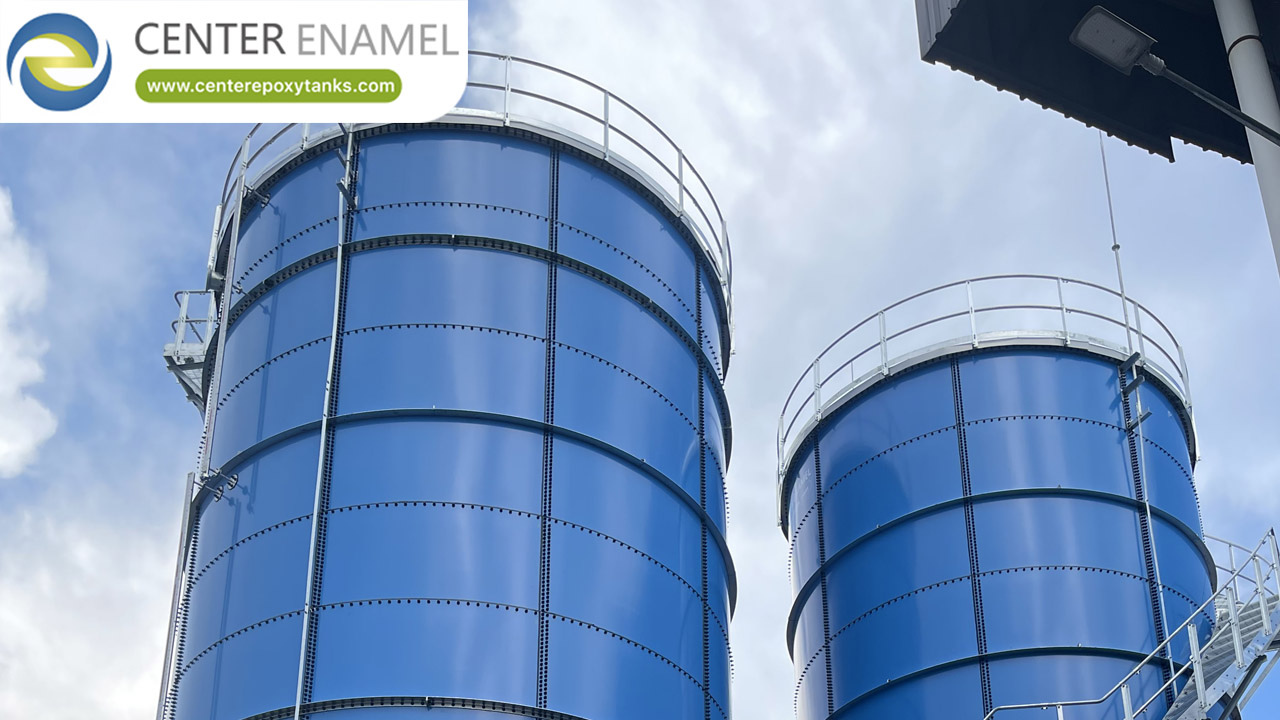
Epoxy Coated Bolted Tanks for Landfill Leachate Storage
Landfill leachate is one of the most challenging substances for containment infrastructure. Characterized by high organic loads, complex chemical profiles, and fluctuating pH levels, it requires storage solutions that prioritize chemical inertness, structural integrity, and long-term reliability.
Epoxy coated bolted tanks have become the industry benchmark for leachate management. By combining the precision of factory-applied coating technology with the versatility of modular bolted construction, these tanks offer a superior alternative to traditional field-welded steel or poured-in-place concrete.
The Engineering Challenge: Why Leachate Corrodes Traditional Infrastructure
Landfill leachate management involves two distinct threats to containment:
Chemical Aggression: The variable pH and high salt content of leachate can aggressively attack traditional metallic and concrete surfaces.
Permeability & Bio-fouling: Concrete is porous, allowing leachate to seep into the substrate, which can degrade internal rebar and cause structural instability.
The Solution: Fusion Bonded Epoxy (FBE) Bolted Systems
Unlike field-applied paints, Fusion Bonded Epoxy (FBE) is a thermoset polymer fused to steel panels in a factory-controlled environment. This creates a non-porous, dielectric barrier that completely isolates the steel from the leachate.
Performance Comparison: Leachate Containment Technologies
Feature | Epoxy Coated Bolted Steel | Reinforced Concrete | Field-Welded Steel |
Chemical Tolerance | High (pH 2–13) | Low (Requires Liner) | Low |
Porousness | Zero (Non-porous) | High | None |
Installation Speed | Fast (Modular/Bolted) | Very Slow (Pour & Cure) | Moderate |
Maintenance | Minimal (Smooth Surface) | High (Structural Repair) | High (Paint Cycles) |
Lifecycle ROI | Highest | Moderate | Low |
Why Landfill Operators Choose Bolted Epoxy Tanks
1. Superior Hygiene & Biofilm Control
The smooth, factory-applied epoxy surface prevents the accumulation of "fats, oils, and grease" (FOG) and biofilm growth. This simplifies sanitation protocols and ensures that the wastewater treatment process remains efficient and unobstructed.
2. Modular Scalability & Agility
Landfill site requirements evolve. Our bolted tank design allows for rapid commissioning, getting your leachate treatment system online faster than traditional construction. If your leachate volume increases, our tanks can be expanded or reconfigured, protecting your capital investment.
3. Reduced Structural Maintenance
Unlike concrete, which is prone to micro-cracking when exposed to temperature fluctuations and chemical loading, our epoxy-coated steel tanks remain structurally sound. This significantly reduces long-term maintenance costs and minimizes the risk of environmental leaks.
4. Precision Quality Control
Every panel undergoes rigorous quality checks before leaving the factory—including high-voltage "holiday testing" to detect microscopic defects. This level of quality assurance is impossible to replicate in field-constructed tanks, ensuring the integrity of the containment barrier from Day 1.
Frequently Asked Questions (FAQ)
Q: Are these tanks resistant to the high COD/BOD loads of leachate?
A: Yes. The epoxy coating is specifically formulated to be chemically inert, ensuring it remains intact even when exposed to the high organic loads and fluctuating chemical profiles common in landfill leachate.
Q: How do epoxy coated tanks handle the gases (H2S/Methane) in leachate?
A: Our tanks are designed with airtight bolted connections and specialized gaskets, making them an ideal, safe environment for containing leachate while managing the volatile gases produced during the degradation process.
Q: Why choose bolted steel over welded steel?
A: Bolted steel tanks are factory-finished, ensuring consistent, high-quality coating coverage that is impossible to match with field-welded tanks. Additionally, the modular design avoids the need for dangerous "hot work" (welding) during installation.
Q: How long do epoxy coated tanks last in a landfill environment?
A: With proper installation and routine visual inspection, these tanks typically offer a service life of 20 to 30+ years, providing the best return on investment for large-scale environmental infrastructure.
Q: Is it possible to repair the coating if it is scratched during operation?
A: Yes. Unlike glass-coated tanks, which are brittle and difficult to patch, small mechanical nicks in epoxy coatings can be easily addressed using field-proven repair kits that restore the chemical barrier integrity on-site.
Are you currently specifying infrastructure for a new landfill leachate treatment plant or looking to replace an aging, leaky containment vessel? [Contact our engineering team] today for a technical consultation or a custom capacity analysis tailored to your site's specific effluent profile.


