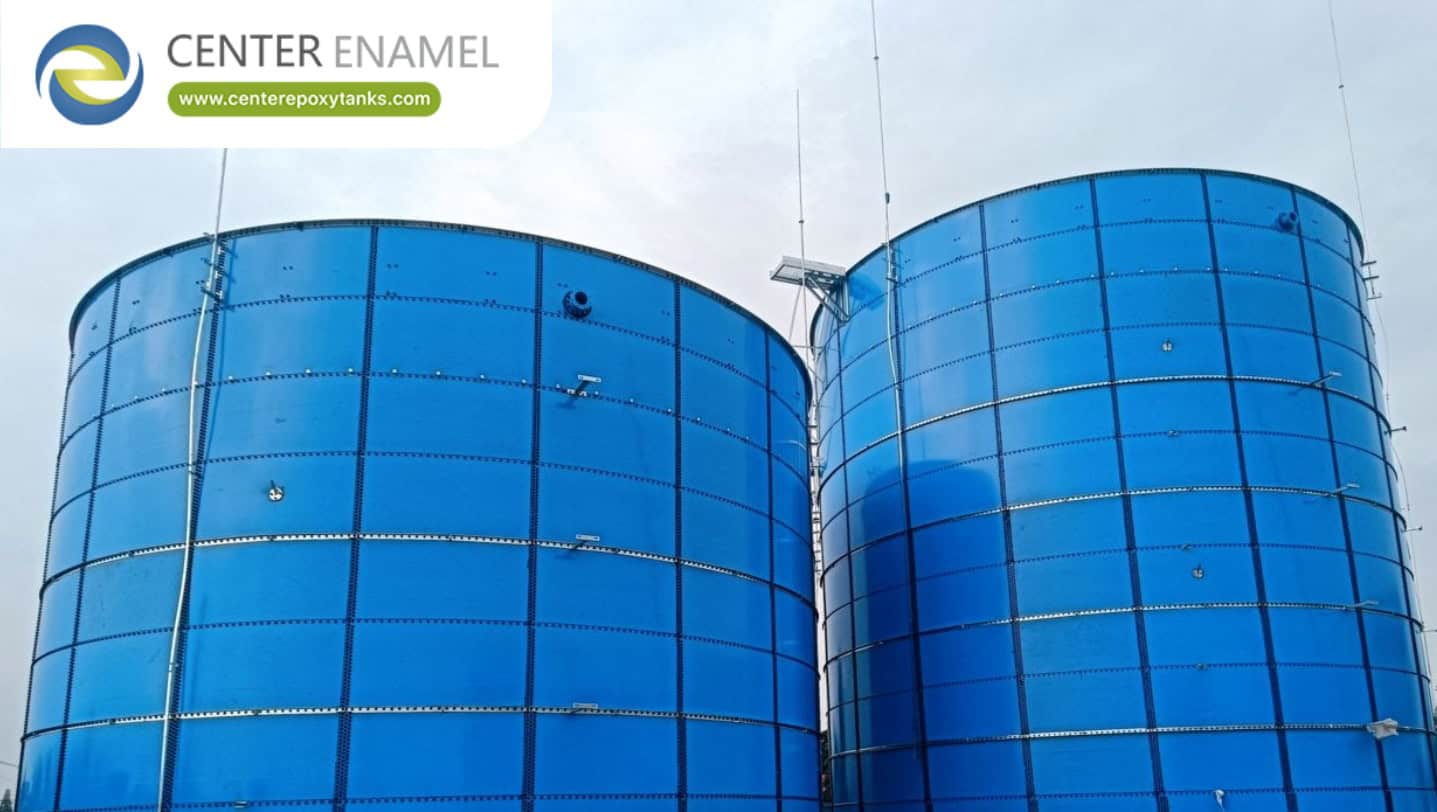
Epoxy Coated Bolted Steel Tanks: Municipal Sludge Storage Engineering Guide
For municipal wastewater treatment plants (WWTPs), the storage of sludge and biosolids presents an aggressive environment defined by high chemical activity, moisture, and potential microbial corrosion. Epoxy-coated bolted steel tanks have emerged as the industry-standard modular solution, providing the necessary balance between structural strength, chemical inertness, and rapid, cost-effective site assembly.
1. Engineering Specifications & Material Integrity
Unlike conventional concrete tanks, which are susceptible to chemical attack from hydrogen sulfide ($H_2S$) and sulfuric acid, epoxy-coated steel offers a specialized barrier system.
Key Performance Benchmarks
● Coating Chemistry: High-performance thermosetting epoxy resins are applied in factory-controlled environments to ensure uniform thickness and adhesion.
● Chemical Resistance: Ideally suited for a pH range of 3–13. The coating creates a seamless, impermeable barrier against acids, alkalis, and organic byproducts typical in anaerobic digestion processes.
● Structural Standard: Bolted tanks must comply with ANSI/AWWA D103 (Standard for Bolted Steel Tanks for Water Storage). This ensures the structural design withstands wind, seismic, and snow loads specific to the site location.
● Holiday Testing: A critical quality control metric. Certified tanks undergo 100% High-Voltage Holiday Testing (typically at 1100V or higher) to ensure the coating is pore-free and provides continuous protection for the steel substrate.
Coating Physical Properties
Property | Specification/Target |
Layer Thickness | 150 µm– 250 µm (Industrial grade) |
Adhesion | Excellent (Factory-applied bond) |
Abrasion Resistance | High (Critical for grit-heavy sludge) |
UV Resistance | High (For external storage) |
2. Comparison Matrix: Storage Technologies
Municipal managers must weigh initial capital expenditure (CapEx) against the total cost of ownership (TCO) and maintenance requirements.
Engineering Attribute | Epoxy-Coated Bolted | Glass-Fused-to-Steel (GFS) | Poured Concrete |
Chemical Resistance | High (Acid/Alkali) | Superior (Extreme Inertness) | Moderate (Needs liner) |
Installation Speed | Fast (Bolted Modular) | Fast (Bolted Modular) | Slow (Curing required) |
Maintenance | Low (Minimal patching) | Very Low | High (Crack/Leach issues) |
Flexibility | High (Expandable/Relocatable) | High (Expandable) | None (Fixed) |
Lifespan | 20–30+ Years | 30–60+ Years | 30+ Years |
3. Operational Advantages in Wastewater Treatment
The shift toward epoxy-coated bolted systems is driven by three primary operational factors:
1. Rapid Site Deployment: Because panels are prefabricated and factory-coated, on-site construction time is reduced by up to 60% compared to concrete or field-welded steel. This is essential for phased plant upgrades where downtime must be minimized.
2. Cost-Effective Scalability: Bolted designs allow for modular expansion. If a facility increases its throughput, additional ring sections can be added, or the tank can be disassembled and relocated, protecting the capital investment.
3. Controlled Quality Assurance: Coating failures often occur due to field application errors (e.g., improper surface prep or humidity interference). Factory-applied epoxy eliminates these variables, ensuring the barrier performs exactly as engineered under harsh conditions.
4. Frequently Asked Questions (FAQ)
Q: Is epoxy coating suitable for high-grit sludge?
A: Yes, modern industrial epoxy formulations are engineered with high abrasion resistance. However, if the sludge contains high levels of abrasive mineral grit, ensuring the correct micron thickness (250 µm+) and periodic inspections are necessary to maintain the coating integrity.
Q: How do we manage VOC emissions in sludge storage?
A: Bolted steel tanks are naturally easier to seal than concrete structures. They can be equipped with specialized covers (geodesic domes or fixed steel roofs) and integrated with ventilation/odour control systems to meet local emission regulations.
Q: Can these tanks be retrofitted into existing treatment processes?
A: Absolutely. Their small footprint and modular nature make them ideal for filling gaps in existing infrastructure where space is limited or where old concrete tanks are failing and need replacement without a total facility shutdown.


