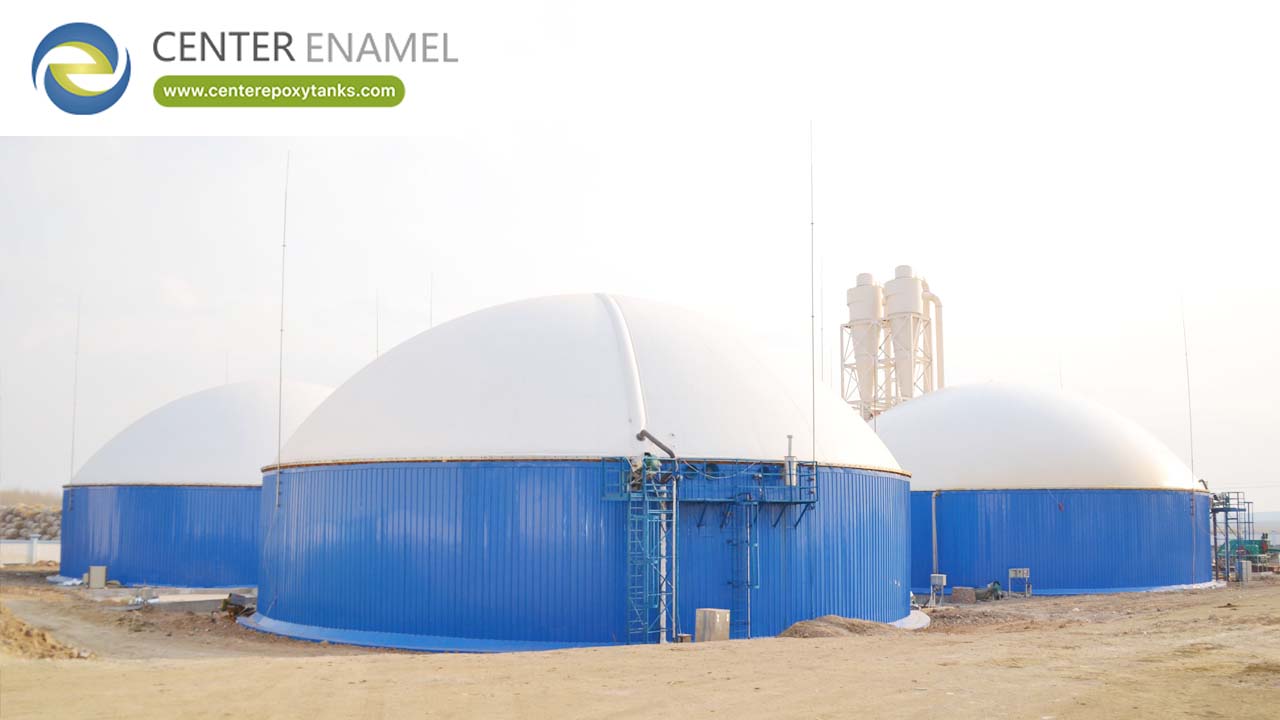
Efficient Biogas Storage: Center Enamel Double Membrane Covers
Double membrane gas holders—specifically those engineered by Center Enamel—provide a high-efficiency containment solution for biogas storage by utilizing a variable-volume, dual-layer membrane system. The inner membrane acts as the gas-tight primary storage vessel, expanding and contracting based on biological production rates, while the outer membrane creates a pressurized structural "balloon" that protects the system from environmental loads (wind, snow, UV). This design allows for constant-pressure biogas delivery to downstream equipment (CHP engines or boilers) without the need for high-maintenance, fixed-volume steel tanks. By decoupling storage from the digestion process, facilities can buffer gas supply, ensuring consistent energy output regardless of fluctuating biological fermentation rates.
The Engineering Mechanics: How Efficiency is Achieved
The efficiency of a biogas facility is often determined by its ability to manage gas pressure stability and storage elasticity. Traditional fixed roofs do not allow for pressure buffering, leading to efficiency losses when production spikes.
1. The Variable-Volume Advantage
Unlike rigid concrete or steel roofs, the Center Enamel double membrane system acts as a "lung" for the digester.
Dynamic Containment: As the bacteria produce methane, the inner membrane rises, storing excess gas.
Steady Output: When the downstream engine requires fuel, the inner membrane contracts, maintaining a constant supply pressure. This eliminates the need for expensive, complex compression stations, directly improving the plant’s energy ROI.
2. Advanced Material Science
Efficiency is only as good as the material's integrity. Center Enamel utilizes high-tenacity polyester fabrics coated with specialized polymers.
PVDF/PVC Coating: The outer membrane is treated with PVDF (Polyvinylidene Fluoride) for self-cleaning properties and UV resistance, preventing the fabric from becoming brittle—a common failure point in lower-quality membranes.
H₂S Resistance: Biogas is chemically aggressive. These membranes are engineered to be inert against hydrogen sulfide ($H_2S$) and moisture, ensuring that the storage system maintains its structural integrity for 15–20+ years.
Optimizing Plant Operations: Comparison Matrix
For engineers and facility managers, the shift from rigid storage to double-membrane systems represents a transition from high-maintenance infrastructure to "Asset Agility."
Operational Feature | Center Enamel Double Membrane | Rigid Steel/Concrete Cover |
Storage Capacity | Variable (Flexible Volume) | Fixed (Zero Buffer) |
Operational Pressure | Constant (Steady for Engines) | Variable (Often requires pump) |
Maintenance | Low (Minimal mechanical parts) | High (Paint/Corrosion repair) |
Installation Speed | Fast (Modular/Bolted) | Slow (Site-poured/Welded) |
Corrosion Risk | Virtually Zero (Inert Fabric) | High (Acid attack/Spalling) |
Strategic Integration with Center Enamel Infrastructure
The true efficiency of these covers comes from their modular synergy. Center Enamel designs these holders not as standalone products, but as integral components of the broader plant architecture:
Seamless Retrofitting: The modular design allows for installation on existing concrete, Glass-Fused-to-Steel (GFS), or epoxy-coated steel tanks, making them the standard choice for capacity upgrades.
Agitator Compatibility: In functioning anaerobic digesters, internal mixers are critical. Center Enamel’s systems include engineered clearance and high-density vibration-isolation gaskets at the mounting flange, preventing micro-vibrations from damaging the membrane seams.
Safety First: These systems are equipped with automated pressure control cabinets that monitor the air buffer zone. In the event of an over-pressure scenario, the system automatically regulates the air balance to protect both the gas holder and the tank structure.
Frequently Asked Questions (FAQ)
Q: Can these gas holders withstand extreme weather conditions?
A: Yes. The outer membrane is pressurized by a constant-duty blower system. This aerodynamic, spherical shape is engineered to shed snow and resist high wind loads (rated up to 150 km/h). The system essentially "self-clears" during storms, maintaining its integrity where flat or rigid roofs might trap snow.
Q: How does this system impact my plant's safety compliance?
A: The design meets international safety protocols for flammable gas containment. Because the system is sealed and utilizes flame-retardant materials, it significantly reduces the risk of accidental methane leakage, ensuring compliance with strict environmental emission and safety standards (e.g., TRAS 120 or similar international benchmarks).
Q: What is the primary cause of membrane failure, and how does Center Enamel prevent it?
A: The two main enemies are UV degradation and chemical attack from $H_2S$. We combat UV issues with premium PVDF coatings and prevent chemical failure by using high-frequency welding technology. Unlike stitching, which creates "pinholes" for gas and chemicals to attack the fibers, high-frequency welding creates a molecular bond stronger than the fabric itself.
Q: Is the installation process invasive to my existing biogas operations?
A: Not at all. Because these systems are prefabricated and modular, they are designed for rapid, crane-assisted "Top-Down" installation. This minimizes downtime, allowing facilities to upgrade their storage capacity without halting digestion processes for extended periods.


