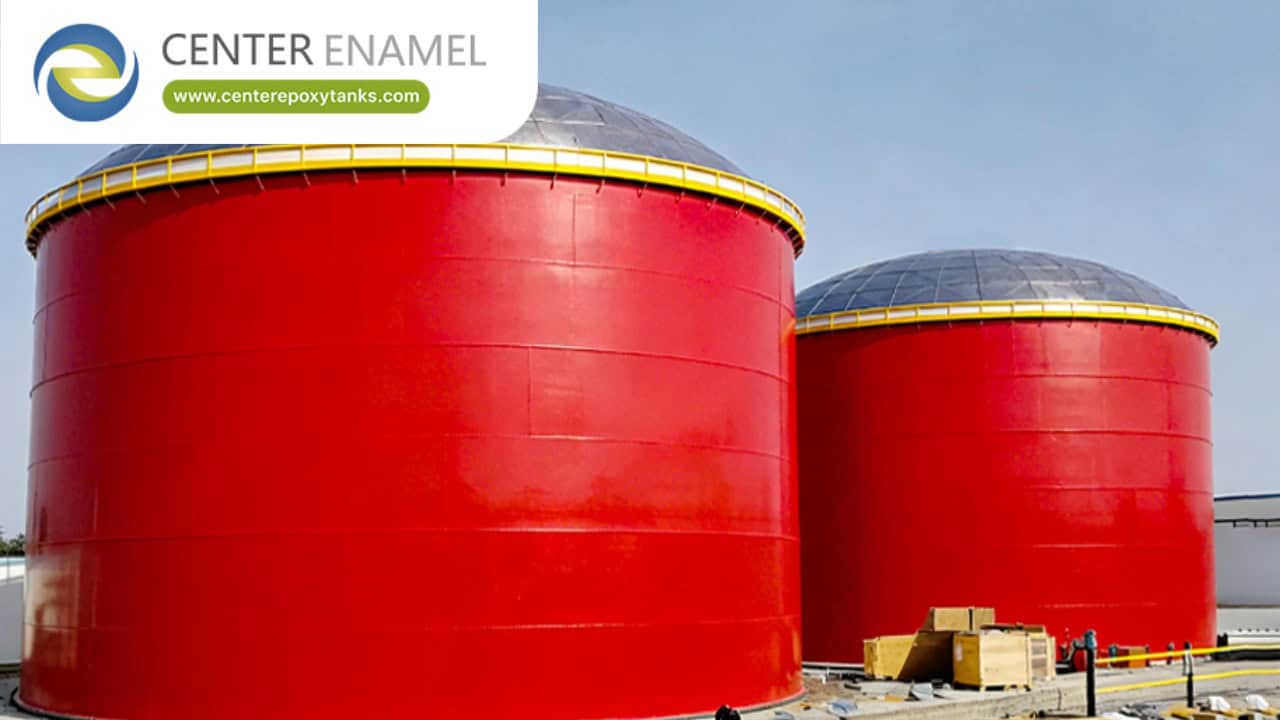
Durable and Efficient Oil Storage with Center Enamel FBE Coated Tanks: Engineering Hydrocarbon Integrity and Safety
In the demanding landscape of the global oil and gas sector, maintaining the integrity, purity, and safety of liquid hydrocarbons is paramount. From upstream wellhead production and midstream field gathering stations to downstream refinery feedstock management, storage infrastructure must withstand aggressive chemical compositions, volatile environmental conditions, and stringent safety regulations. Traditional carbon steel tanks often suffer from severe internal corrosion, hydrogen-induced cracking (HIC), and product contamination when exposed to sour crude, high-salinity brines, and sulfur compounds.
To overcome these critical engineering challenges, Shijiazhuang Zhengzhong Technology Co., Ltd. (Center Enamel) delivers premier Center Enamel FBE coated tanks. Combining over 30 years of bolted tank manufacturing expertise with world-class Fusion Bonded Epoxy (FBE) coating technology developed in strategic partnership with global coating leaders, Center Enamel provides durable, cost-effective, and highly efficient oil storage solutions engineered for maximum longevity.
Advanced Material Science: The Fusion Bonded Epoxy Advantage
The structural reliability of Center Enamel’s oil storage tanks lies in their advanced coating and modular design methodology:
Molecular Thermal Cross-Linking: Unlike conventional liquid paints that rely solely on mechanical adhesion, Center Enamel’s FBE powder coating is electrostatically applied to meticulously pre-treated steel plates (cleaned to near-white blast standards like SSPC-SP10) and cured in high-temperature industrial ovens. This triggers a permanent thermoset cross-linking reaction, creating an unbreakable physical-chemical bond with the steel.
Unmatched Hydrocarbon Inertness: The dense, non-porous FBE barrier is chemically inert to the diverse range of hydrocarbons, paraffin, aromatic compounds, and trace moisture found in crude oil and refined distillates. This hermetic seal prevents active sulfur and acidic compounds from reacting with the base steel, eliminating premature wall thinning and pitting.
Zero-Hot-Work Field Assembly: In active oilfields and operating refineries, on-site welding introduces severe fire and explosion risks requiring extensive safety shutdowns. Center Enamel’s bolted FBE tanks are assembled mechanically using high-strength hardware and specialized elastomeric seals, allowing safe, rapid construction without hot work.
C5-M Environmental Durability: Rated for extreme coastal and industrial environments under ISO 12944 (C5-M), the exterior and interior coatings resist UV degradation, salt spray, and extreme thermal fluctuations, ensuring a service life exceeding 30 years.
Technical Performance Matrix: FBE Tanks vs. Traditional Alternatives
Technical Parameter | Center Enamel Bolted FBE Tanks | Traditional Field-Welded Steel Tanks | Unlined Concrete Storage Basins |
Hydrocarbon & Brine Resistance | Superior; inert FBE matrix completely resists crude acidity, paraffin, and corrosive produced water | Moderate; internal coatings prone to blistering, delamination, and progressive corrosion | Poor; concrete absorbs hydrocarbons, cracks under shifting loads, and degrades from acids |
Installation Safety & Speed | Rapid mechanical bolting with zero hot-work required; safe for active oilfield sites | Slow, high-risk field welding requiring continuous fire watches and hot-work permits | Slow civil construction requiring weeks of framing, pouring, and curing |
Coating Integrity Assurance | 100% factory holiday-tested (1100V/1500V) ensuring zero pinholes or micro-discontinuities | Manual field touch-ups often prone to inconsistent thickness and hidden flaws | None (unprotected porous surface prone to seepage and chemical leaching) |
Volumetric Scalability & Lifecycle | High; modular design allows future capacity expansion or relocation; 30+ year lifespan | Rigid structure; modifications require complex cutting, welding, and recertification | Permanent monolithic structure; impossible to modify or relocate |
Frequently Asked Questions (FAQ)
Q: How do Center Enamel FBE coated tanks protect against corrosive crude oil and high-sulfur compounds?
A: The FBE coating forms an impermeable, chemically inert thermoset polymer barrier across the steel surface. This prevents corrosive elements—such as sulfur, organic acids, and saline produced water—from contacting the base metal, eliminating internal pitting and hydrogen-induced cracking.
Q: Why are bolted FBE tanks safer to install in active oilfields than welded steel tanks?
A: Center Enamel's FBE tanks are prefabricated in the factory and assembled on-site using mechanical bolting. This eliminates the need for on-site welding (hot work), drastically reducing fire hazards, regulatory permitting delays, and safety risks in active petroleum processing zones.
Q: Can FBE coated tanks handle refined petroleum products like diesel, jet fuel, or biofuels?
A: Yes. The specialized epoxy formulation exhibits exceptional chemical resistance across a broad pH range and is fully compatible with refined fuels, ethanol blends, bio-diesel, and refinery distillates without degrading or contaminating the stored product.
Q: What international standards do Center Enamel FBE tanks comply with?
A: They are engineered and manufactured in strict compliance with major global benchmarks, including AWWA D103, API 650 principles, ISO 12944, and rigorous quality control standards like high-voltage holiday testing on every panel.


