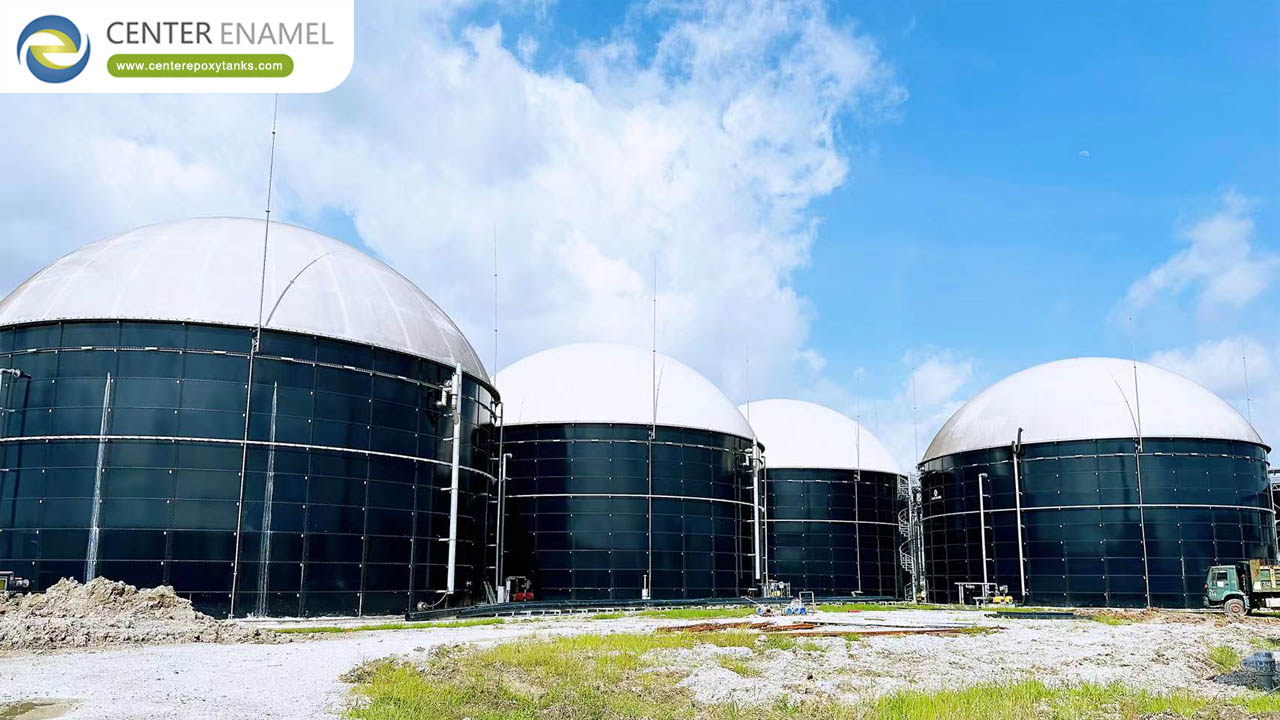
Double Membrane Roofs: The Gold Standard for Liquid Fertilizer Storage
In modern agriculture, liquid fertilizers—such as Urea Ammonium Nitrate (UAN) and Ammonium Thiosulfate (ATS)—are essential for high-yield crop production. However, these solutions are highly sensitive. Improper storage can lead to evaporation, nutrient loss, and environmental non-compliance.
Center Enamel provides advanced Double Membrane Roof solutions, engineered to seal, protect, and preserve your valuable liquid fertilizer inventory. By integrating cutting-edge material science with precision engineering, we offer a solution that significantly enhances both operational efficiency and environmental stewardship.
The Technology: Protecting Your Nutrient Investment
A Double Membrane Roof acts as an impermeable barrier, creating a controlled environment that traditional open or fixed-roof tanks cannot match.
Inner Membrane: Creates a gas-tight seal directly above the liquid, preventing the volatilization of nitrogen and other essential nutrients.
Outer Membrane: A robust, air-supported dome that protects the system from weather, UV radiation, and external debris.
Inter-Membrane Cavity: Maintained by precise air pressure, this space ensures structural stability and provides an insulating layer that prevents extreme temperature fluctuations.
Performance Comparison: Why Membrane Roofs Win
Feature | Double Membrane Roof | Rigid/Fixed Roof | Open Storage Tank |
Nutrient Preservation | High (Prevents evaporation) | Moderate | Low (High losses) |
Emission Control | Excellent (Hermetic seal) | Low | None |
Rainwater Ingress | None (Fully sealed) | Minimal | High (Dilution) |
Maintenance | Minimal (Self-cleaning) | Moderate (Painting/Rust) | High (Contamination) |
Operational Lifespan | Long-term | Medium | Short |
Key Benefits for Agricultural Operations
1. Nutrient Integrity & ROI
Evaporation is the hidden cost of fertilizer storage. By creating a sealed environment, our roofs minimize the volatilization of nitrogen compounds, ensuring that the fertilizer concentration remains stable from the day it is delivered until the day it is applied. This directly protects your investment and ensures uniform nutrient delivery.
2. Regulatory & Environmental Compliance
Ammonia emissions are a major focus for environmental regulators globally. Our roofs effectively contain odors and volatile organic compounds (VOCs), making it significantly easier for agricultural facilities to meet strict air quality standards and maintain positive relationships with surrounding communities.
3. Contamination Prevention
Liquid fertilizer potency is easily compromised by rainwater ingress or airborne debris. Our roofs provide a physical shield against contaminants, preventing the dilution of your product and ensuring that your spraying equipment remains free of clogs and impurities.
4. Extreme Durability
Engineered with UV-stabilized, high-strength technical fabrics, our roofs are designed to withstand the corrosive nature of fertilizers and diverse climate conditions. All metallic contact points are crafted from high-quality 316 stainless steel to ensure lifetime corrosion resistance.
Global Applications
Center Enamel’s Double Membrane Roofs are versatile, serving as the backbone for:
Bulk Fertilizer Terminals: Ensuring product quality for high-volume distribution.
Integrated Farm Operations: Reducing operational costs by enabling bulk storage on-site.
Industrial Blending Facilities: Protecting specialty liquid nutrient formulations from environmental degradation.
Frequently Asked Questions (FAQ)
Q: Why is a double membrane roof better for fertilizer than a standard steel roof?
A: Standard steel roofs are prone to corrosion from the acidic and ammonia-rich vapors present in fertilizer tanks. Our double membrane roofs are constructed from chemically inert, high-strength fabrics that are immune to this type of corrosion, significantly reducing your long-term maintenance costs.
Q: Will the roof touch the liquid fertilizer?
A: No. The air-supported, positive-pressure design of the outer membrane ensures the roof maintains its shape and structural integrity, while the inner membrane rests safely above the liquid surface, providing a consistent barrier without direct, high-pressure contact.
Q: Can these roofs be retrofitted to existing tanks?
A: Yes. Our engineering team can assess your current storage tank dimensions and provide a custom-engineered cover solution that integrates seamlessly with your existing infrastructure.
Are you losing profit to nutrient evaporation and emission management? [Contact the Center Enamel engineering team] today to receive a technical proposal for retrofitting your fertilizer storage tanks with a high-performance Double Membrane Roof.


