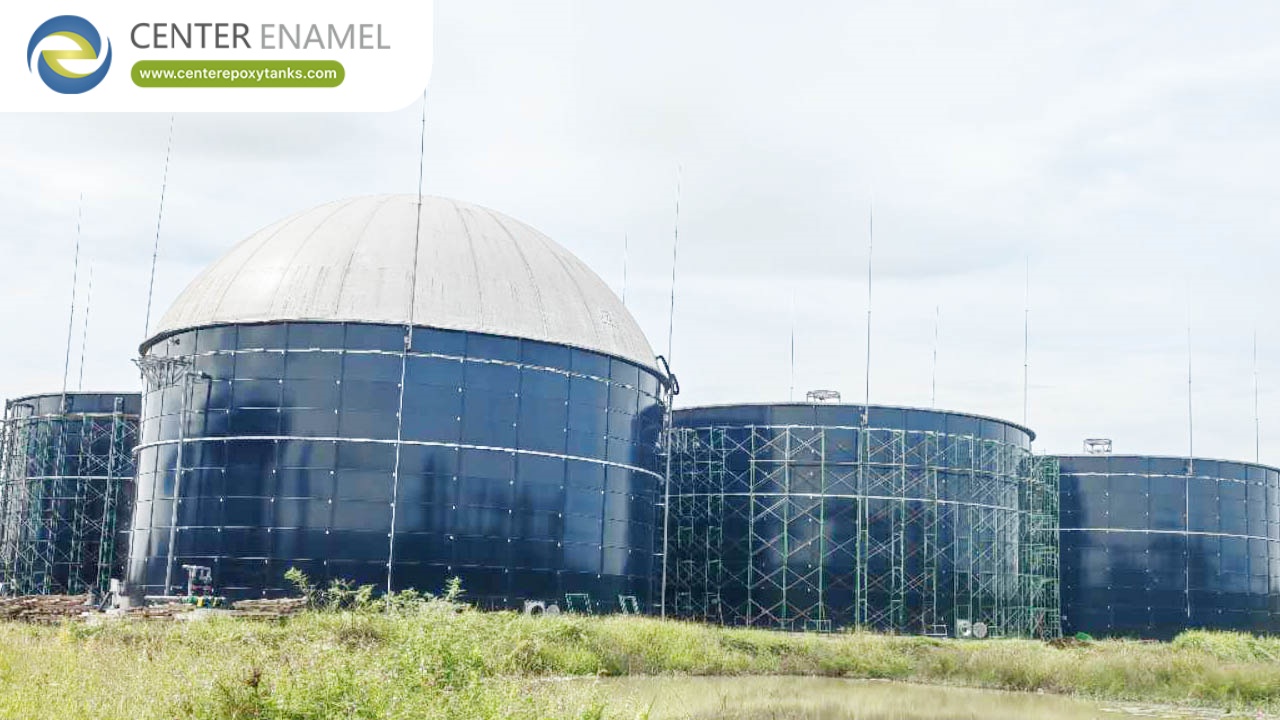
Double Membrane Roofs for Landfill Leachate Treatment Projects: Odor Control, Biogas Recovery, and Engineering Excellence
Managing municipal solid waste landfills involves addressing one of the industry's most persistent and complex environmental challenges: landfill leachate. As rainwater percolates through decomposing waste, it absorbs heavy organic loads, toxic chemicals, heavy metals, and high concentrations of ammonia. When this high-strength wastewater is collected and sent to biological treatment facilities or anaerobic digestion reactors, it produces severe odor emissions and flammable biogas (methane).
To ensure strict environmental compliance, eliminate toxic odors, and safely harness renewable energy, environmental engineers specify the double membrane roof.
Fabricated from heavy-duty, high-tenacity architectural polymer fabrics engineered to withstand aggressive chemical vapors and ultraviolet radiation, double membrane roofs provide a dual-purpose solution: weather protection and active gas storage. As a globally trusted leader in advanced liquid containment manufacturing, Shijiazhuang Zhengzhong Technology Co., Ltd. (Center Enamel) delivers precision-engineered double membrane gas holders and tank covers designed specifically for demanding wastewater and leachate treatment infrastructure worldwide.
The Dual Challenge of Leachate Treatment: Odors and Gas Management
Leachate treatment facilities—particularly those utilizing Upflow Anaerobic Sludge Blanket (UASB) reactors or membrane bioreactors (MBRs)—face intense operational hurdles:
Aggressive Odor and VOC Emissions: Leachate handling generates severe foul odors, including hydrogen sulfide (H2S), volatile organic compounds (VOCs), and high levels of ammonia gas that can trigger regulatory fines and community complaints.
Biogas Production and Safety: Anaerobic breakdown of organic compounds in leachate treatment generates methane-rich biogas. If left unmanaged, this gas creates explosive hazards and potent greenhouse gas emissions.
Precipitation Control: Preventing rainwater from entering biological equalization basins is vital to avoid hydraulic overloading and diluting active wastewater treatment chemistry.
Engineering Superiority of Double Membrane Roofs
Unlike traditional single-layer covers or rigid concrete slabs, a double membrane roof utilizes an innovative multi-layer pneumatic architecture:
Inner Membrane: Acts as the primary gas-tight barrier, floating or expanding inside the tank to hermetically seal the liquid surface while adjusting dynamically to varying gas volumes.
Outer Membrane: Maintains a constant hemispherical profile, protecting the system against wind, rain, and snow loads.
Support Air Blower System: An automated continuous-pressure blower system injects air into the intermediate space between the inner and outer membranes, providing structural rigidity and stability regardless of internal gas fluctuations.
Advanced Chemical Resistance: Manufactured from specialized PVC/FPP coated fabrics treated to resist hydrogen sulfide, methane, and concentrated ammonia attack found in municipal leachate environments.
Data Table: Comprehensive Comparison of Leachate Tank Cover Technologies
Technical Parameter | Double Membrane Roofs | Single Membrane Roofs | Rigid Concrete / Steel Fixed Roofs |
Primary Leachate Application | Advanced anaerobic digestion, UASB reactors, and gas-producing leachate tanks | Non-gas-tight equalization basins and primary stormwater/leachate collection tanks | Permanent structural enclosure for high-load or non-volatile wastewater basins |
Active Gas Storage Capacity | Variable volume gas storage; safely contains and manages generated biogas | None; non-gas-tight covers allow gas to vent or require external piping | Zero variable storage; requires separate high-pressure gasholder infrastructure |
Odor & Emission Control | 99% airtight containment; easily integrated with air scrubbing or biofilter systems | Moderate odor control, but prone to localized vapor seepage around edges | Prone to cracking and joint leakage, allowing fugitive gas and odor escape |
Corrosion Resistance | Highly resistant to $H_2S$, ammonia, and moisture condensation | Good resistance to weathering, but vulnerable to high-concentration chemical attack | Highly vulnerable to microbial induced corrosion (MIC) from leachate gases |
Frequently Asked Questions (FAQ)
Q: What is a double membrane roof in landfill leachate treatment projects?
A: It is a dual-layer pneumatic gas holder and tank cover system consisting of an inner membrane (for gas containment) and an outer membrane (for weather protection), designed to capture biogas and control severe odors in leachate treatment plants.
Q: How do double membrane roofs handle fluctuating gas volumes in leachate digesters?
A: The inner membrane rises and falls dynamically based on the volume of biogas generated inside the anaerobic reactor, while the outer membrane remains inflated by a dedicated support blower to maintain structural shape under wind and snow loads.
Q: Are double membrane roofs resistant to corrosive gases like hydrogen sulfide ($H_2S$) and ammonia?
A: Yes. They are constructed from high-durability polymer-coated fabrics specifically engineered to withstand harsh chemical environments, high humidity, and corrosive gases commonly present in landfill leachate processing.
Q: Why choose a double membrane roof over a traditional concrete cover for leachate tanks?
A: Double membrane roofs offer active biogas storage, superior corrosion resistance against microbial and chemical attack, rapid modular installation, and lower dead loads on the supporting tank structure compared to heavy concrete roofs.


