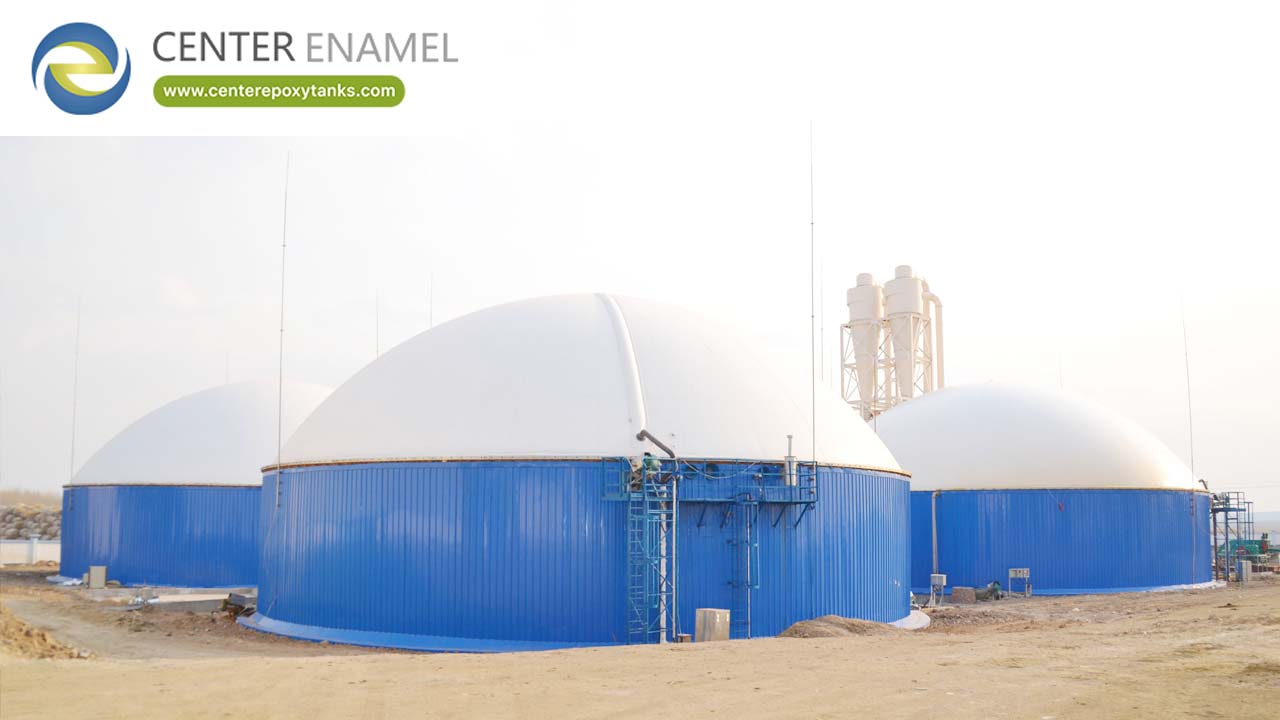
Double Membrane Roofs for Biogas & Agricultural Wastewater Tanks: Structural Dynamics & Gas Retention Specifications
In modern agricultural wastewater management and green energy production, methane collection is a core requirement for both environmental compliance and economic viability. Anaerobic digestion of livestock manure, food waste, and agro-industrial effluent generates high-value biogas that must be captured securely without fugitive atmospheric emissions. Double membrane gas holder roofs have emerged as the global standard for aboveground storage tanks (such as Glass-Fused-to-Steel and welded options). By integrating an adjustable, pressurized air-buffer system, these dual-layer structures serve as both a durable weather shield and an expandable, variable-volume gas containment asset.
1. Operating Mechanism and Membrane Stress Mechanics
A double membrane roof operates as a low-pressure, variable-volume gas storage vessel mounted directly onto the rim of a processing tank. Unlike rigid steel or aluminum domes, this system changes shape to absorb fluctuating gas production rates.
The Dual-Layer Architecture
The system relies on two separate polymer sheets working in tandem:
● The Inner Membrane: This layer forms the actual gas containment boundary. It rests directly on top of the liquid substrate when empty and rises as biogas (CH4 + CO2) accumulates underneath. It is manufactured from highly impermeable biogas-resistant polymers.
● The Outer Membrane: This layer acts as the external structural shell, shielding the inner layer from wind, snow, and ultraviolet (UV) degradation. A continuous-duty air blower pumps ambient air into the interstitial space between the inner and outer membranes, maintaining a constant internal pressure.
Structural Stress Formulas
To maintain a stable spherical profile under external wind load (w) and internal inflation pressure (p), engineers calculate the circumferential tensile stress (sigma) within the outer membrane using the membrane shell equation for a spherical dome:
Automated pressure-regulating valves continuously adjust the air-buffer layer. If the gas volume drops, the blower adds air to keep the outer membrane taut; if biogas generation spikes, the inner membrane rises, and excess air is vented out safely while keeping the gas pressure constant.
2. Advanced Material Science: Fighting H2S and Ambient Exposure
Agricultural wastewater and livestock slurry yield biogas with high concentrations of hydrogen sulfide (H2S), moisture, and trace ammonia (NH3). These components create a highly corrosive environment that degrades standard metals.
Polymer Layer Composition
To survive decades of exposure, premium double membrane roofs utilize high-tensile base polyester woven fabrics coated with specialized protective layers:
● Polyvinyl Chloride (PVC) Base Matrix: Provides the core mechanical tensile strength required to handle wind loads and internal operating pressures.
● Polyvinylidene Fluoride (PVDF) Top Coat: Applied to the outermost face of the outer membrane to create a self-cleaning surface that reflects UV radiation and prevents premature atmospheric cracking.
● Acrylonitrile Butadiene / High-Grade PVC Blend: Formulated specifically for the inner membrane's gas-contact face to block methane permeability (reducing gas loss to less than 400 cubic centimeters per square meter over 24 hours) and resist acidic H2S condensate.
3. Engineering Comparison: Digester Roof Configurations
Selecting the correct roof layout directly impacts the system's capital costs, gas recovery efficiency, and overall maintenance complexity.
Performance Variable | Double Membrane Gas Holder Roofs | Solid Aluminum / Steel Geodesic Domes | Single Membrane Elastic Covers |
Gas Storage Functionality | Integrated Variable Storage: Buffers gas without needing external pressure vessels. | None: Requires a secondary dedicated gas holder tank downstream. | Minimal: Low pressure control; prone to flapping during wind shifts. |
Corrosion Resistance | Immune: Non-metallic contact zones prevent acid and sulfur oxidation. | Variable: Requires specialty coatings or high-grade alloys to resist sour gas. | Good: Fabric construction avoids rusting, but offers low mechanical resistance. |
Operating Pressure Window | Controlled from 5 mbar up to 50 mbar | Rigid structures; requires complex pressure-relief tracking | Very low pressure; highly vulnerable to minor pressure drops. |
Snow & Wind Load Behavior | Excellent: Continuous internal air inflation prevents structural collapsing. | Excellent: High rigid load capacities; handles heavy snow zones easily. | Poor: Susceptible to pocketing, pooling water, and tearing under heavy wind. |
4. Operational Advantages in Agricultural Environments
Integrating a double membrane gas holder roof into a large-scale agricultural dairy, swine farm, or food processing facility delivers distinct practical advantages:
● Elimination of Secondary Gas Storage Costs: Because the tank cover itself functions as an expandable gas storage bladder, project developers do not need to purchase separate dry gas holders or high-pressure gas spheres, saving up to 30% on overall facility construction costs.
● Odors Kept Under Total Control: Agricultural wastewater lagoons emit intense odors. The double-membrane assembly creates a hermetically sealed enclosure that holds these emissions back, satisfying strict environmental regulations near residential zones.
● Rapid Field Erection and Low Weight: Compared to heavy concrete or metal roofs, flexible membrane kits add minimal dead load to the tank shell structure. The entire fabric assembly is shipped flat-packed in standard cargo crates and bolted down to the tank rim in just a few days, eliminating the need for heavy site cranes.
Deploying dual-layered double membrane roofs on agricultural wastewater and biogas processing tanks provides a reliable, chemically inert, and dual-purpose containment solution. By pairing advanced PVC/PVDF fabrics with precise automated pressure management, these engineering systems turn volatile waste streams into secure, harvestable bioenergy assets—minimizing atmospheric leakage and safeguarding regional agricultural operations for decades to come.


