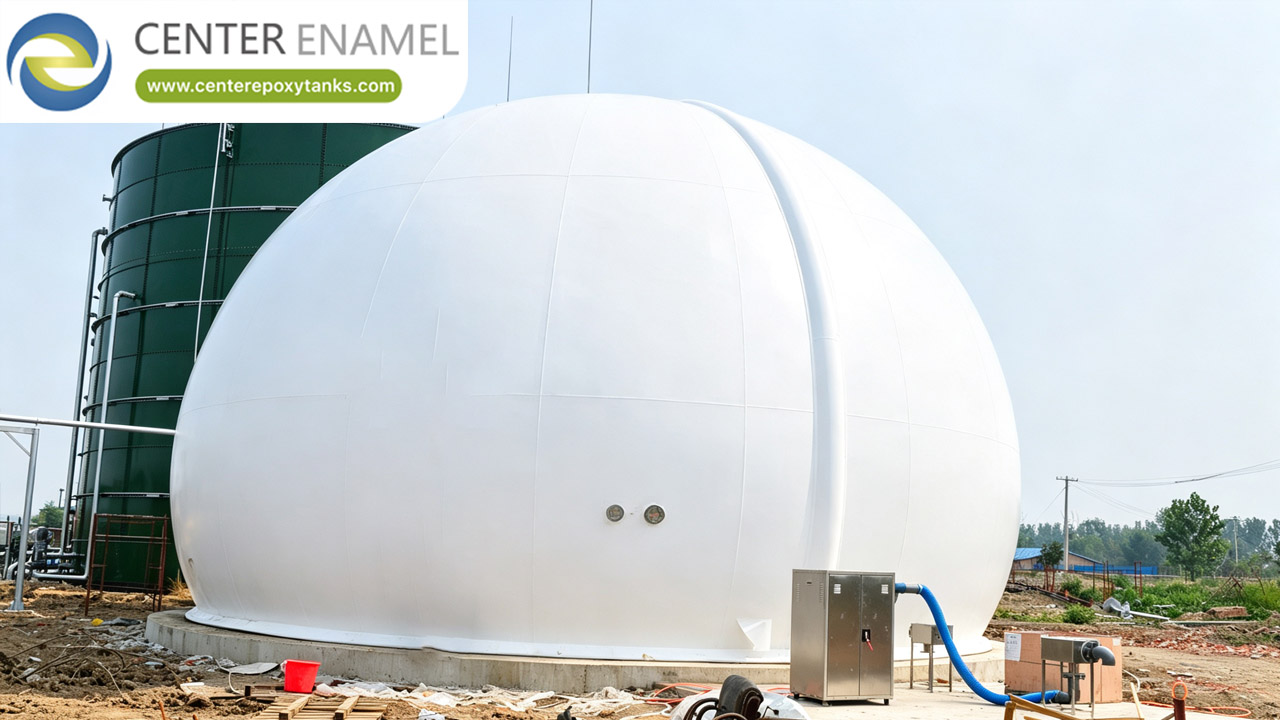
Double Membrane Gas Holder for Textile Mill Plant Wastewater Treatment
Textile manufacturing is one of the most water-intensive and chemically complex industrial sectors globally. Processes such as scouring, bleaching, dyeing, and finishing generate massive volumes of high-strength wastewater characterized by elevated chemical oxygen demand (COD), biological oxygen demand (BOD), high temperatures, volatile synthetic dyes, and persistent sizing agents (such as starch and polyvinyl alcohol).
To comply with stringent environmental regulations and reduce escalating energy overheads, modern textile mills increasingly implement biological anaerobic digestion systems (such as Upflow Anaerobic Sludge Blanket [UASB] reactors or Continuous Stirred-Tank Reactors [CSTR]) within their Effluent Treatment Plants (ETPs). These anaerobic processes break down complex organics and generate renewable biogas rich in methane. To safely store and regulate this variable gas supply for on-site boiler heating or combined heat and power (CHP) generation, double membrane gas holders have become the industry gold standard.
The Role of Biogas Storage in Textile Effluent Treatment Plants
Textile wastewater generation fluctuates based on batch production cycles, shifting chemical formulations, and daily operational schedules. Consequently, biogas production from anaerobic ETP digesters is inherently dynamic, varying in both flow rate and pressure.
A double-membrane gas holder acts as an elastic buffer between the anaerobic digester and downstream energy recovery equipment:
Continuous Pressure Stabilization: An automated air blower system maintains constant positive pressure in the outer protective membrane. This presses down on the inner gas containment bladder, ensuring a steady, reliable delivery pressure to gas burners or engines regardless of storage volume.
Surge and Peak Management: During peak organic loading phases, excess biogas is safely captured and stored, preventing emergency flaring and maximizing renewable energy utilization.
Technical Performance Matrix: Biogas Storage Technologies for Textile ETPs
Technical Parameter | Double Membrane Gas Holder Systems | Traditional Low-Pressure Steel Gasholders | Unlined Concrete Gas Vaults | Bolted Carbon Steel Storage Bins |
Chemical & Vapor Resistance | Superior; inert polymer fabrics resist corrosive trace gases and humidity | Low; vulnerable to internal pitting and oxidation from moist biogas | Moderate to Low; prone to concrete carbonation and acid gas degradation | Moderate; requires specialized internal protective linings |
Volumetric Flexibility | Dynamic variable-volume storage with constant positive delivery pressure | Fixed volume capacity with heavy mechanical piston counterweights | Fixed volume capacity with poor surge adaptability | Rigid configuration with limited pressure buffering |
Footprint & Foundation Needs | Lightweight modular design requiring minimal foundation work | Heavy structural steel framing demanding massive concrete footings | Massive civil engineering requirements with intensive earthwork | Moderate foundation requirements based on tank scale |
Global Standards Compliance | Manufactured strictly to ISO 9001, Eurocode 1, and ATEX directives | Varies based on field-welding execution quality | Dependent on local civil engineering batch pours and curing inspections | Standard bolted tank specifications with variable joint longevity |
Key Operational Advantages for Textile Mill ETPs
1. Robust Chemical and Moisture Resistance
Textile wastewater biogas often contains trace moisture and variable concentrations of hydrogen sulfide ($H_2S$) derived from sulfur dyes or protein-based sizing residues. Double-membrane gasholders utilize high-tenacity polyester fabrics coated with specialized PVC/PVDF layers that are chemically inert, preventing structural degradation and foul odor leakage.
2. Space-Saving Modular Integration
Textile mills frequently operate within constrained industrial footprints. Double-membrane gas holders can be installed as independent ground-mounted units or integrated directly onto the crowns of anaerobic digestion tanks (tank-mounted configurations), optimizing site layout and reducing piping infrastructure expenses.
Frequently Asked Questions (FAQ)
Q: Why are double membrane gas holders ideal for textile mill wastewater treatment plants?
A: Textile ETP anaerobic digesters generate variable volumes of biogas from high-COD effluent. Double-membrane gasholders provide dynamic variable-volume storage and constant positive delivery pressure, ensuring stable fuel supply for boilers or CHP engines.
Q: How do double-membrane gasholders handle corrosive gases like hydrogen sulfide ($H_2S$)?
A: They are fabricated using high-grade, chemically inert PVC/PVDF-coated polyester fabrics that resist moisture and corrosive trace gases commonly found in industrial wastewater biogas, ensuring long-term operational durability.
Q: Can double-membrane gas holders be mounted directly onto existing anaerobic digester tanks?
A: Yes. They can be engineered either as independent ground-mounted storage vessels or as tank-mounted covers installed directly on top of CSTR or UASB digester tanks to save valuable footprint space in textile facilities.
Q: What safety systems are integrated into double membrane gas holders?
A: Modern systems include automated air blower regulators, inner-membrane overpressure protection, weighted or hydraulic safety relief valves, continuous gas leak detectors, and lightning protection grounding to ensure fail-safe operation.


