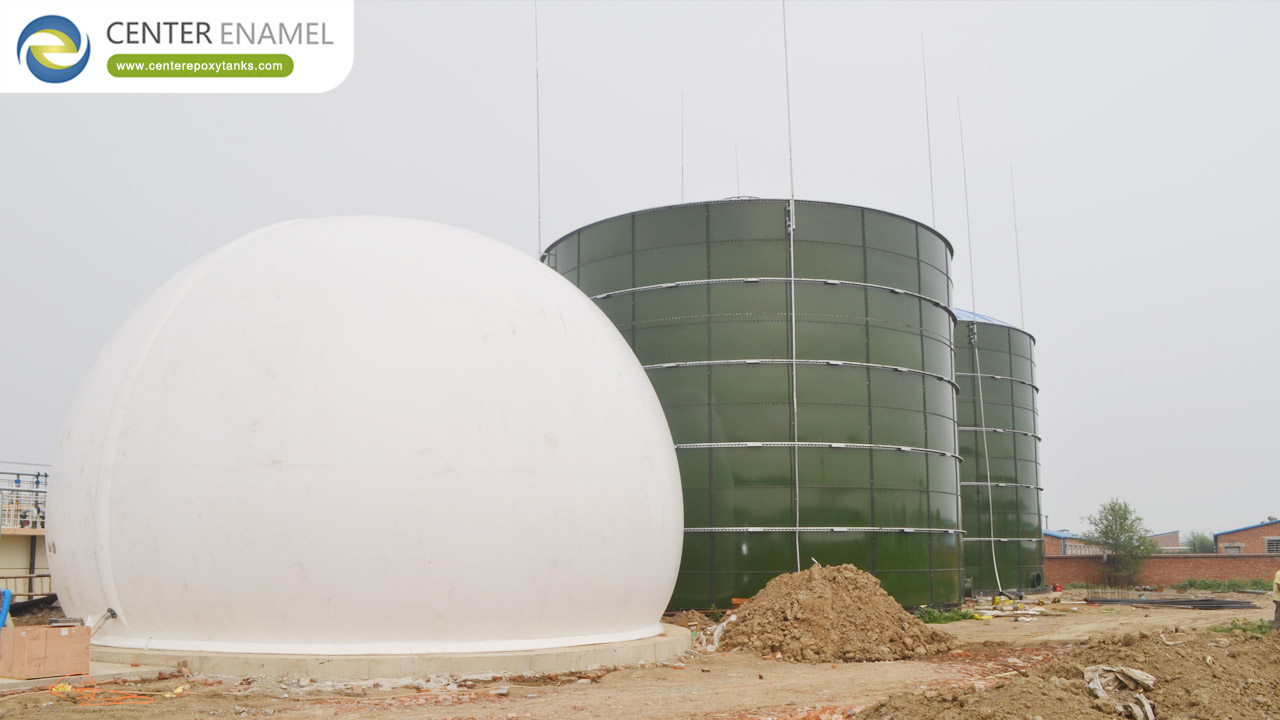
Double Membrane Biogas Storage: The 2026 Industrial Standard
Double membrane biogas storage balloons—also known as gas holders—have become the global industry standard for variable-volume methane containment. Unlike traditional fixed-volume steel tanks, these systems provide a flexible, airtight, and highly responsive solution for managing fluctuating gas production in anaerobic digestion and industrial wastewater treatment.
Shijiazhuang Zhengzhong Technology Co., Ltd. (Center Enamel) is a premier manufacturer specializing in the advanced fabrication of these systems. With a focus on high-tenacity, PVDF-coated materials, our solutions are engineered to meet the highest safety and longevity standards, serving as the benchmark for biogas projects in over 100 countries.
Technical Advantages of Double Membrane Systems
The shift toward double membrane technology is driven by its ability to resolve the limitations of rigid storage structures.
1. Superior Pressure Regulation
The system utilizes a dual-layer design:
Inner Membrane: Directly contacts the biogas, expanding and contracting with gas volume changes.
Outer Membrane: Acts as a weather-resistant protective shell, maintained at constant positive pressure via an automated air blower system.
This constant pressure ensures a steady, regulated discharge of gas to Combined Heat and Power (CHP) units or upgrading systems.
2. Industry-Leading Material Integrity
We utilize high-strength, PVDF-coated polyester fabric. This material is inherently:
Corrosion-Immune: Highly resistant to H2S (Hydrogen Sulfide) and biogenic sulfuric acid, which rapidly degrade traditional welded steel.
UV-Protected: Built to withstand long-term outdoor exposure without hardening or cracking.
Flame Retardant: Compliant with DIN 4102 B1/B2 standards, ensuring safe deployment in hazardous industrial zones.
3. Logistical & Installation Efficiency
Because the components are flexible and modular, our storage balloons are significantly easier to ship and install than rigid vessels.
Reduced Footprint: High-density packing in standard containers reduces global freight costs.
Rapid Deployment: On-site installation times are reduced by 40% compared to traditional tank construction, as the system does not require large-scale, open-fire on-site welding.
Comparison: Double Membrane vs. Traditional Storage
Feature | Double Membrane Balloon | Welded Steel Tank |
Service Life | 15–25 Years | 10–15 Years |
Corrosion Maintenance | None Required | Annual Anti-Rust Coating |
On-Site Installation | 7–15 Days | 30–60 Days |
Leakage Rate | $leq$ 0.02% (Hermetic) | High (Weld/Seam failure risk) |
Pressure Control | Automated / Constant | Difficult to adjust |
Safety & Certification
At Center Enamel, safety is the primary metric of success. Our biogas storage systems are fully compliant with:
ATEX/IECEx: Certified for hazardous explosive atmosphere zones.
ISO 9001: Adherence to rigorous quality management throughout fabrication.
Integrated Safety Systems: Each unit is equipped with hydrostatic relief valves and ultrasonic level sensors, providing real-time inventory data (0–100%) to your facility's PLC (Programmable Logic Controller).
Frequently Asked Questions (FAQ)
1. How does the double membrane balloon handle extreme temperatures?
Our custom membrane materials include anti-freeze additives that maintain flexibility in environments as cold as -40°C. They are engineered to prevent cracking or hardening, ensuring year-round performance in diverse climates.
2. Can I expand my biogas storage capacity later?
Yes. One of the key advantages of our membrane systems is modularity. If your gas production increases, the membrane unit can be replaced with a larger size or a secondary unit can be added to the existing site layout without requiring major civil engineering changes.
3. Why is this solution "methane-leakage proof"?
Traditional tanks often suffer from seal degradation. Our membrane storage balloons use advanced high-frequency welding to create seamless, airtight barriers. This prevents the escape of methane (a potent greenhouse gas), helping you meet stringent ESG and carbon credit verification standards.
4. Does the storage balloon require a specific foundation?
While the weight is significantly lower than a concrete or steel tank, a level, load-bearing concrete pad or ring beam is required. We provide precise foundation blueprints tailored to the specific wind and seismic loads of your project location.
5. How do I request a technical proposal for my project?
To receive a customized quote, please provide the total gas volume required ($m^3$), the application (e.g., agricultural, municipal wastewater, or industrial effluent), and your project’s geographic location for environmental load calculations.


