Data Center Thermal Energy Storage Tank Explained: The Thermal Battery Behind Efficient Cooling
This is the complete explainer on a data center thermal energy storage tank explained: what it is, how it stores energy, the forms it takes, and why data-center cooling operators rely on it. Use it as a technical primer before sizing or specifying.
A data center thermal energy storage tank explained is an engineered thermal store - most commonly a large stratified chilled-water vessel - that decouples cooling production from cooling demand. It captures low-cost or low-carbon cooling when available and releases it during peaks, improving efficiency, resilience, and economics across data-center cooling duty.
Core Concept
Thermal energy storage converts a timing problem into a volume problem. Instead of sizing the plant for the worst-case instantaneous peak, you size it for average production and add a tank for the peaks.
The stored medium is usually water (sensible) but can be ice or encapsulated phase-change material (latent), each with different density of storage and system complexity.
Anatomy of the Tank
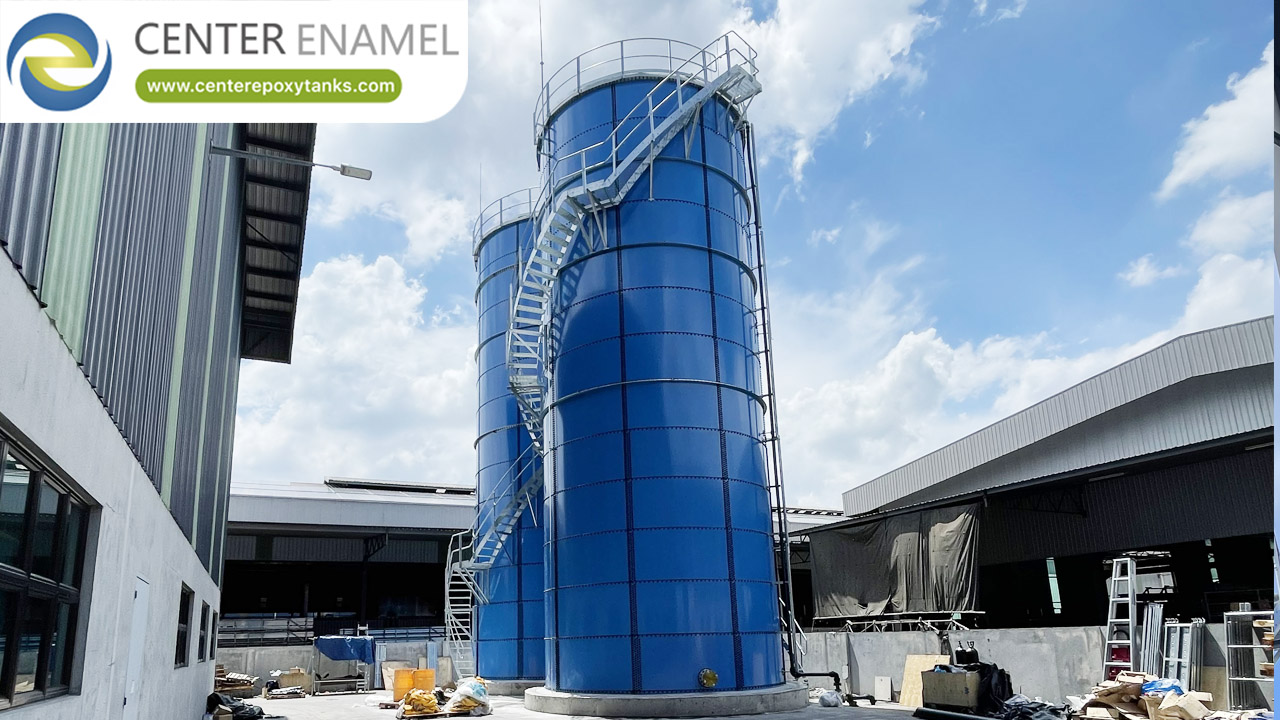
A stratified TES tank is a tall, insulated, code-built vessel with inlet and outlet diffusers near the top and bottom, plus instrumentation to track the thermocline and temperature.
Bolted GFS, FBE-coated, stainless, or welded shells are all viable; the choice follows water chemistry, pressure class, and site logistics.
Operating Modes
Time-of-use shifting charges the tank on cheap off-peak power. Free-cooling augmentation charges from cold ambient air or water. Emergency bridging discharges to protect the load during outages.
In data-center cooling duty all three modes are valuable: cost, carbon, and resilience in one asset.
Technical Specifications
Parameter | Specification |
Tank type | Atmospheric, stratified, or ASME-coded (duty dependent) |
Shell material | bolted glass-fused-to-steel (GFS) |
Capacity range | 20-60,000 m3 (bolted GFS, water/liquid duty) |
Stored medium | Chilled water (sensible) or phase-change medium (latent) |
Design temperature | -10 to 50 C (site / water dependent) |
Corrosion protection | Glass enamel, FBE, stainless, or galvanizing |
Insulation | Optional PU / mineral wool for chilled duty |
Codes / standards | AWWA D103, ISO 28765, EN 1090, ASME VIII |
Erection | Bolted modular panels, short site schedule |
QA | ISO 9001, NSF/ANSI 61, WRAS where applicable |
Foundation | Ring wall or slab per geotech report |
Verified Tank Engineering Reference
Center Enamel's verified record includes a 2022 Drinking water project in Namibia - 4 unit(s), φ41.26*8.4m (H) 4 set, 44,900 m3 total, GFS (Glass-Fused-to-Steel) bolted tank. Center Enamel has no published thermal-energy-storage or data-center TES project; this reference demonstrates the comparable large-tank manufacturing capability relevant to supplying stratified chilled-water TES vessels.
Project location | Namibia |
Application | Drinking water |
Tank type | GFS (Glass-Fused-to-Steel) bolted tank |
Scale | 4 unit(s), φ41.26*8.4m (H) 4 set |
Total volume | 44,900 m3 |
Year | 2022-09 |
Note | Cited as manufacturing-capability evidence, not a thermal-energy-storage project. |
Center Enamel Capability
Center Enamel (Shijiazhuang Zhengzhong Technology) manufactures bolted glass-fused-to-steel (GFS) tanks and ASME-coded pressure vessels for water and thermal-energy storage duty. For thermal-energy-storage (TES) service, the relevant products are large-diameter bolted GFS tanks, FBE-coated tanks, stainless steel tanks, welded shells, and ASME Section VIII vessels for pressurized or stratified chilled-water storage.
Quality is managed under ISO 9001, with bolted tanks built to AWWA D103 and ISO 28765 and available certified to NSF/ANSI 61 and WRAS where potable or indirect-potable contact applies. GFS shells are fired at 820-930 C to fuse the glass enamel, giving a durable, inert liner suited to treated chilled water; stainless and FBE options serve aggressive or high-purity loops. CE's verified delivery record - including a large Namibia installation - demonstrates the manufacturing capability behind these specifications.
Frequently Asked Questions
Q: What are the main parts?
A: Shell, insulation, top/bottom diffusers, and temperature instrumentation.
Q: Which shell material?
A: GFS, FBE, stainless, or welded steel, chosen by chemistry and code.
Q: What operating modes exist?
A: Off-peak shifting, free-cooling charge, and emergency bridge discharge.
Q: Is it worth the capital?
A: Often yes - it cuts peak plant size and energy cost across multi-hour shifts.
Q: Explain a data center thermal energy storage tank explained simply.
A: It is a large insulated vessel that stores cooling as a temperature difference and releases it when needed.
Q: Sensible or latent storage?
A: Sensible (water) is simpler and common; latent (ice) is denser but more complex.
A data center thermal energy storage tank explained turns a peak-cooling problem into a storage-volume problem, and that reframing is what unlocks efficiency and resilience for data-center cooling operators.
Suggested Next Step
Use this primer as the basis for a sizing study - send us load and tariff data to start.


