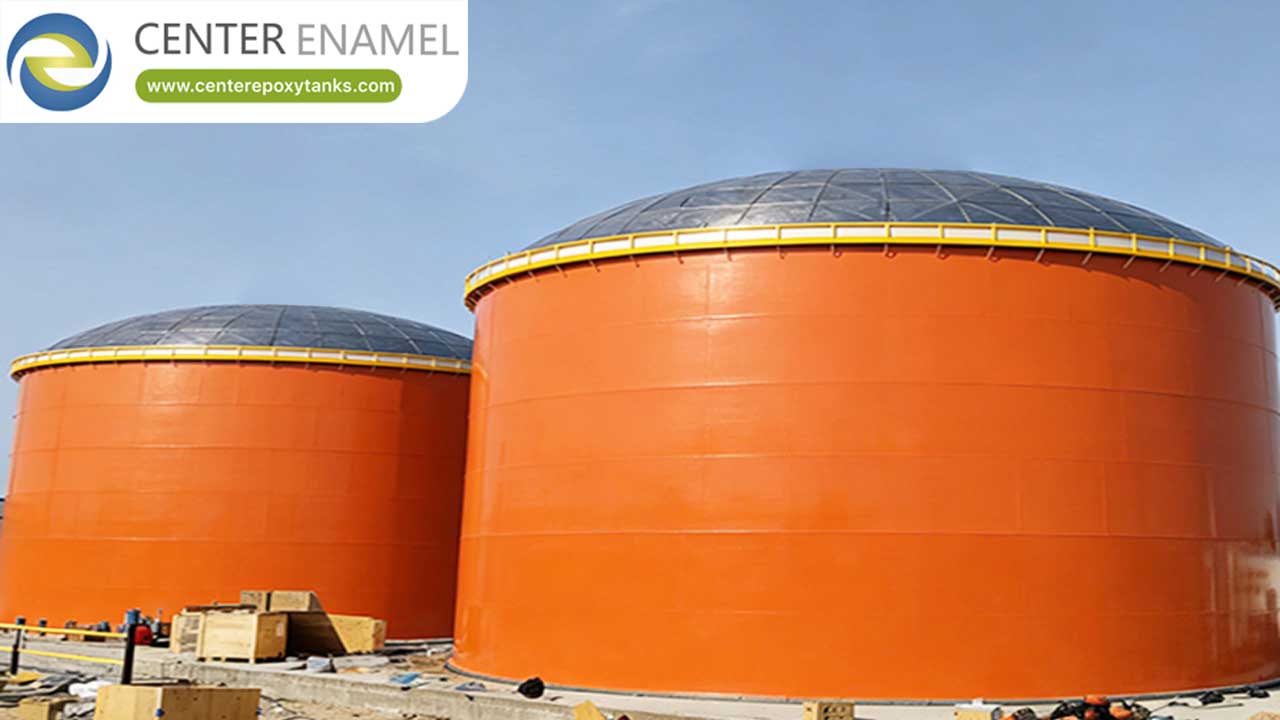
Crude Oil Storage Tanks Sizing a Terminal's Buffer
Selecting the right Engineered Storage tank for Oil & Fuel is rarely a straightforward catalogue purchase. The stored medium sets the corrosion budget, the duty cycle sets the mechanical budget, and the regulator sets the paper trail - all three have to close before a tank earns its place on site.
Center Enamel addresses this with Engineered Storage systems built to ISO 9001, NSF/ANSI 61, CE-EN1090 and WRAS. engineered bolted and welded storage tanks are selected per the stored medium, duty cycle and site constraints, balancing speed, capacity and lifecycle cost. For engineers specifying Crude Oil Storage Tanks, the sections below translate that capability into the parameters, comparisons and compliance evidence a procurement file actually needs.
Whether the project is a greenfield Oil & Fuel facility or a retrofit of aging infrastructure, the objective is the same: a containment asset that meets specification on day one and still meets it a decade later.
What Is a Engineered Storage Tank and How It Contains Oil & Fuel Liquids
At its core, a General tank converts a storage requirement into a controlled, inspectable asset. The shell, roof and foundation are matched to the stored medium, the operating temperature and the local seismic and wind profile rather than treated as a generic commodity.
Defining a General tank begins with duty: what is stored, at what concentration and temperature, and for how long. That duty then drives material choice, joint design and the certification path that lets an EPC or plant owner sign off with confidence.
Engineering Assurance and Project Support
Oil & Fuel operators face three recurring pressures: tougher discharge limits, aging infrastructure and thinner capital budgets. A storage decision that ignores any one of them tends to surface as a lifecycle penalty within the first decade.
The Oil & Fuel duty cycle is unforgiving. Levels swing, temperatures drift and abrasive or acidic fractions appear without warning, so the selected General tank has to absorb that variability rather than fight it.
Material Science: How Center Enamel’s Engineered Storage Technology Outperforms
Center Enamel’s edge comes from controlling the process end to end. engineered bolted and welded storage tanks are selected per the stored medium, duty cycle and site constraints, balancing speed, capacity and lifecycle cost. Every panel is inspected before it ever reaches the site, which is why field performance tracks the specification.
Material selection is where most Oil & Fuel failures are decided. engineered bolted and welded storage tanks are selected per the stored medium, duty cycle and site constraints, balancing speed, capacity and lifecycle cost. Specifying the right combination up front is cheaper than repairing a compromised tank later.
Key Design Parameters and Capacity Range for Engineered Storage
The numbers below translate the technology into purchasable specification. They are the line items an engineer compares against a bid and against the duty the Oil & Fuel process actually imposes.
Design parameters are not marketing figures; they are the constraints a structural reviewer will check. The table contrasts Center Enamel’s documented specification with a typical industry baseline so the gap is explicit.
Parameter | Center Enamel Specification | Typical Industry Benchmark |
Material / substrate | carbon, stainless or coated steel | Variable; often unspecified |
Protection system | engineered bolted and welded storage tanks are selected per | Field-applied paint, weather dependent |
Capacity range | 20-60,000 m3 | Often constrained by method |
Joint method | 8.8-grade bolts or field welds | Welded or cast in place |
Design standard | AWWA D103 / API 650 | Local / ad hoc |
Corrosion strategy | material and coating are matched to the service chemistry. | Recoat cycles required |
Typical install time | 50-70% faster than welded | Long, weather exposed |
Certification | ISO 9001 (+ more) | Partial / project-specific |
International Standards and Certifications for Oil & Fuel Storage
Standards such as AWWA D103 / API 650 exist because owners repeatedly learned the same lessons the hard way. Designing a General to them is the fastest route to a permit, an insurance sign-off and a quiet operating life.
For cross-border Oil & Fuel projects the certification stack matters as much as the steel. Center Enamel’s ISO 9001, NSF/ANSI 61, CE-EN1090 and WRAS coverage lets a single supplier serve multisite programmes without re-qualifying per market.
Bolted Assembly, Installation and Site Workflow
Site works for a General reduce to lifting, bolting and sealing. modules are shop-controlled and assembled on site, balancing speed and capacity. That simplicity is why delivery schedules stay predictable even on remote Oil & Fuel sites.
Installation quality is locked in before shipment. modules are shop-controlled and assembled on site, balancing speed and capacity. Field crews follow a panel sequence rather than improvising welds, which protects both the schedule and the warranty.
Engineered Storage vs Alternative Storage Technologies: A Comparison
No single technology wins every Oil & Fuel case, so the honest comparison matters. The matrix below sets a General against welded steel and concrete on the criteria owners actually weight.
Choosing between a General, a welded tank and a concrete reservoir is a trade across cost, speed and flexibility. The table makes that trade explicit rather than leaving it to a sales conversation.
Criterion | Center Enamel Engineered Storage | Welded Steel Tank | Concrete Tank |
Capital cost | Mid; factory-efficient | High (labor heavy) | High (formwork) |
Installation speed | Fast, bolted | Slow, welded | Slow, cast |
Corrosion resistance | Engineered barrier | Coating dependent | Good, but cracking risk |
Capacity flexibility | Modular, relocatable | Very large single unit | Fixed by pour |
Transport & logistics | Flat-pack panels | Heavy plate | Site-intensive |
Maintenance | Inspect & reseal | Recoat shutdowns | Patch & monitor |
Best fit | 20-60,000 m3 range | Ultra-large bulk | Permanent buried |
Lifecycle Cost, Durability and Maintenance Planning
Lifecycle thinking changes the ranking. material and coating are matched to the service chemistry. That durability, plus the ability to relocate bolted panels, keeps the asset valuable long after a fixed concrete basin would be demolished.
Maintenance planning for Oil & Fuel should assume the tank will outlast the process around it. material and coating are matched to the service chemistry. A documented inspection interval turns an unknown risk into a scheduled, budgeted task.
Engineering Selection Criteria for Oil & Fuel Duty
A disciplined selection sheet prevents scope creep. For Oil & Fuel, rank criteria - corrosion, capacity, speed, certification - before requesting quotes, then hold suppliers to that ranking rather than the lowest headline price.
The right General is the one whose weakest property still clears the Oil & Fuel duty. material and coating are matched to the service chemistry. Build the shortlist from margins, not averages.
Common Failure Modes and How to Avoid Them
Failure modes are predictable, which means they are preventable. For a General, the highest-leverage checks are joint integrity, foundation tolerance and chemical compatibility of every wetted surface against the Oil & Fuel stream.
Avoiding failure is mostly discipline. material and coating are matched to the service chemistry. Pair that with proper grounding and bonding and the familiar Oil & Fuel incident scenarios largely disappear.
Conclusion: Specifying Engineered Storage for Oil & Fuel
The takeaway for Oil & Fuel owners is simple: lead with duty and standards, then let cost follow. A General built to ISO 9001, NSF/ANSI 61, CE-EN1090 and WRAS is an asset, not an expense line.
Done well, the General becomes invisible - which is the highest praise a piece of Oil & Fuel infrastructure can earn. Plan the duty, verify the certification, and the operating life takes care of itself.
Project Case Study
Center Enamel’s delivery record includes a Glass-Fused-to-Steel (GFS) Bolted Tank installation in Mexico for Potable Water duty. The project applied the same Glass-Fused-to-Steel (GFS) Bolted Tank engineering described above, adapted to local codes and site conditions.
Scope covered 1 tank(s) with dimensions φ17.58*4.8m(H), 1 unit, delivering a total volume of 1164 cubic metres. Completion was recorded as 2026-07.
Supply scope: Tank + Roof. The General relevance grade reflects how directly this reference maps to the current Potable Water topic, giving specifiers a verified, auditable precedent.
Project Reference | Glass-Fused-to-Steel (GFS) Bolted Tank Mexico [ID 012] |
Location | Mexico |
Application | Potable Water |
Product / Technology | Glass-Fused-to-Steel (GFS) Bolted Tank |
Tank Count | 1 |
Tank Dimensions | φ17.58*4.8m(H), 1 unit |
Total Volume | 1164 |
Completion | 2026-07 | Tank + Roof |
Supply Scope Note | General relevance grade to this topic |
About Company
Shijiazhuang Zhengzhong Technology Co.,Ltd(Center Enamel) is a professional manufacturer dedicated to the design and fabrication of bolted storage tanks since 2008. Our products range includes Glass-Fused-to-Steel (GFS) tanks, fusion bonded epoxy tanks, stainless steel tanks, galvanized steel tanks and aluminum geodesic dome roofs. With professional enameling R&D team and nearly 200 enameling patents, Shijiazhuang Zhengzhong Technology Co.,Ltd has become the leader in bolted tanks industry of Asia. Our products are certified to ISO9001, NSF61, EN1090, ISO28765, WRAS ,FM, LFGB, BSCI, IS0 45001 and other international standards.
Shijiazhuang Zhengzhong Technology Co., Ltd is not only the first manufacturer in China which produces Glass-Fused-to-Steel tanks, but also the most experienced professional bolted tanks manufacturer in Asia.The engineering & design, product testing and quality system of Center Enamel Glass-Fused-to-Steel tanks is in strict accordance with AWWA D103-09, OSHA, ISO 28765, NSF/ANSI 61, NFPA and other international standards. Until 2023, Center Enamel bolted tanks have been exported to more than 100 countries including USA, Australia,Canada, Malaysia, Indonesia, Russia, UAE, Panama,Brazil and South Africa etc., the superior tank quality and prompt service gains us worldwide recognition.
As an outstanding containment and cover system provider with decades of industry experience, Shijiazhuang Zhengzhong Technology Co., Ltd sincerely expects to establish long-term cooperation with the local partners throughout the world and make continuous contribution to the development of the industry.
Suggested CTA
Center Enamel delivers general engineered for oil & fuel duty, with nearly 200 enameling patents and iso/nsf/ce/wras/fm certified production. Contact our engineering team for selection and procurement guidance on your next Crude Oil Storage Tanks project — including sizing, standards compliance and delivery scheduling.
Frequently Asked Questions
Q: What capacity range do Engineered Storage tanks cover?
A: Center Enamel Engineered Storage systems cover roughly 20-60,000 m3, scaled through standardized panel modules so capacity grows without re-engineering the shell.
Q: Which international standards apply to Engineered Storage tanks for Oil & Fuel?
A: For Oil & Fuel duty the relevant stack is ISO 9001, NSF/ANSI 61, CE-EN1090 and WRAS, with AWWA D103 / API 650 as the design baseline; each tank ships with mill certificates and third-party test records.
Q: How does a Engineered Storage tank compare with a welded steel tank?
A: A Engineered Storage is assembled from factory-finished panels using 8.8-grade bolts or field welds, avoiding field welding. That cuts install time 50-70 percent and eases relocation versus welded construction.
Q: What steel grade and joints does Center Enamel use for Engineered Storage tanks?
A: The substrate is carbon, stainless or coated steel, joined with 8.8-grade bolts or field welds. material and coating are matched to the service chemistry.
Q: How long does installation of Engineered Storage tanks take on site?
A: Because coating is applied in the factory, site work reduces to lifting, bolting and sealing; most Engineered Storage projects complete in a fraction of the welded-tank schedule.
Q: Why choose Center Enamel as the Engineered Storage tank manufacturer?
A: Center Enamel is Asia’s experienced bolted-tank manufacturer with nearly 200 enameling patents and ISO 9001 certified production, exporting to 100+ countries with documented references.


