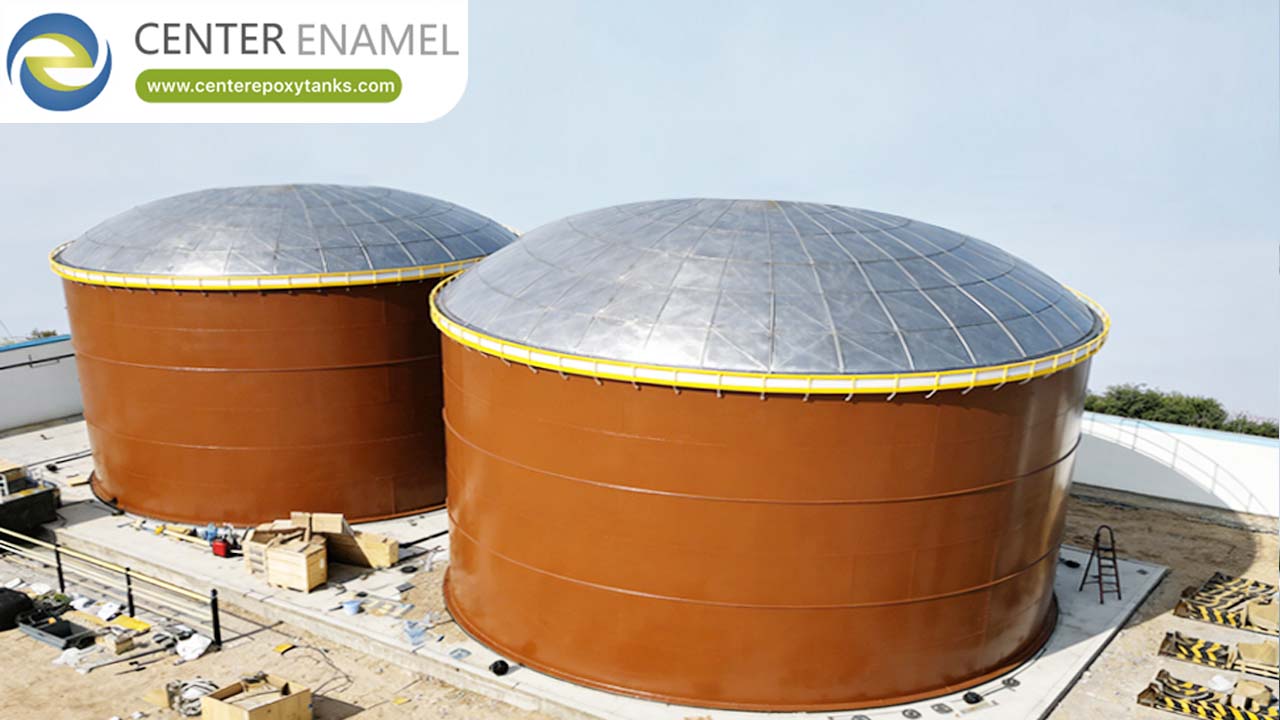
Crude Oil Floating Roof Tanks: Engineering Solutions for Vapor Loss and VOC Control
In the 2026 energy landscape, the storage of crude oil demands more than simple containment; it requires sophisticated engineering to mitigate Volatile Organic Compound (VOC) emissions and maximize product retention. Crude oil floating roof tanks—governed by the API 650 standard—are the definitive solution for large-volume storage, utilizing a floating deck that rises and falls with the liquid level to virtually eliminate the vapor space (ullage).
Shijiazhuang Zhengzhong Technology Co., Ltd (Center Enamel) is a global leader in specialized storage technology, leveraging over 30 years of experience and successful deployments in 100+ countries to provide advanced floating roof systems that meet modern environmental and safety mandates.
1. Technical Architecture: External vs. Internal Floating Roofs
Choosing the correct floating roof configuration depends on the storage volume, environmental factors, and the specific chemical profile of the crude oil.
External Floating Roof Tanks (EFRT)
EFRTs are the industry standard for massive crude oil storage (typically > 10,000 m3).
● Design: An open-top tank where the roof floats directly on the oil.
● Secondary Protection: Features heavy-duty floating roof drainage systems (multi-layered flexible hoses) and rolling ladders to allow safe operational access.
● Economic Scale: Offers a cost-effective solution for ultra-large capacities while drastically reducing evaporation.
Internal Floating Roof Tanks (IFRT)
Increasingly used in 2026 for medium-capacity crude storage and refined products.
● Dual Barrier: A floating deck operates inside a fixed-roof tank (often an Aluminum Geodesic Dome).
● Weather Protection: The fixed roof shields the oil from rain, snow, and sand, guaranteeing product purity—earning them the title of "all-weather storage tanks."
● Enhanced Safety: By shielding the liquid surface from wind, IFRTs provide superior fire protection and even lower VOC emission rates than EFRTs.
2. Advanced Sealing Systems & Fire Safety
The "Rim Space"—the 200–300 mm gap between the floating roof edge and the tank shell—is the most critical area for emission control and safety.
● High-Performance Rim Seals: Shijiazhuang Zhengzhong Technology utilizes advanced mechanical shoe seals and liquid-filled seals that maintain constant contact with the shell, even during thermal expansion.
● Double Seal Configurations: Adding a secondary seal creates a "double barrier," reducing vapor loss by up to 98% compared to fixed-roof tanks.
● Automated Fire Protection: Modern tanks incorporate automated foam dam systems and linear heat detection cables around the rim to instantly suppress potential lightning-induced fires.
3. Technical Standards
Shijiazhuang Zhengzhong Technology (Center Enamel) engineers floating roof systems in strict accordance with:
● API 650 (Appendix C & H): The global standard for welded oil storage tanks.
● ISO 28765: International benchmark for enamel-coated and bolted tank durability.
● Quality Assurance: Every panel and seal component undergoes rigorous testing, including a 1500V high-voltage holiday test for coated components, ensuring 100% integrity.
4. Proven Global Project Benchmarks (Information Gain)
The reliability of Shijiazhuang Zhengzhong Technology is proven by large-scale deployments across the energy and industrial sectors:
● Large-Scale Industrial Infrastructure (Swaziland, 2020): A record-breaking project featuring tanks with a combined volume of 42,188 m3.
● High-Capacity Municipal Storage (Namibia, 2022): A modular system featuring 4 tanks with a total volume of 44,900 m3.
● Record-Breaking Verticality (Indonesia, 2018): Construction of a bolted tank reaching a height of 34.8 meters, showcasing superior structural engineering.
5. Why Partner with Shijiazhuang Zhengzhong Technology Co., Ltd?
As Asia's premier manufacturer with a 150,000 m2 smart manufacturing base, the company provides comprehensive EPC Technical Support.
Feature | Industrial Benefit |
Vapor Control | Reduces crude oil evaporation loss by up to 95%. |
Maintenance | Non-corrosive materials (GFS/FBE/Aluminum) lead to a 30–50 year service life. |
Rapid Deployment | Bolted designs allow for assembly 60% faster than traditional welding. |


