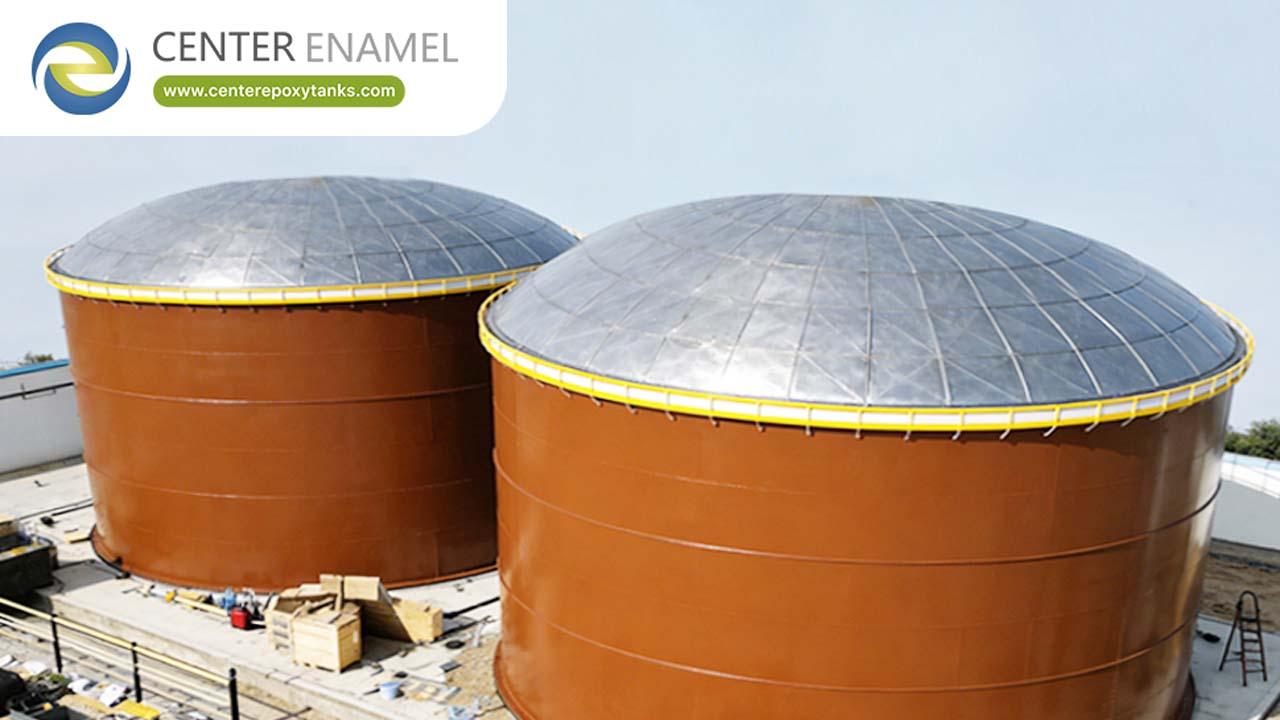
Comparisons Between Internal Floating Roof (IFR) and External Floating Roof (EFR) Storage Tanks
In the 2026 energy landscape, storage efficiency is defined by the dual goals of Resource Conservation and Emission Reduction. As global environmental regulations tighten, selecting between an Internal Floating Roof (IFR) and an External Floating Roof (EFR) is a critical decision for tank farm operators. Both systems are engineered to float directly on the liquid surface to eliminate vapor space, yet they serve distinct operational roles.
Shijiazhuang Zhengzhong Technology Co., Ltd (Center Enamel), a global leader in storage infrastructure, provides precision-engineered solutions for both IFR and EFR configurations, ensuring compliance with API 650 Appendix H and other international standards.
1. Technical Authority: Structural Definitions
Internal Floating Roof (IFR)
An IFR tank features both a permanent fixed roof and a floating cover inside. This "tank-within-a-tank" design shields the floating deck from wind, rain, and snow. IFRs are often constructed from lightweight materials like Aluminum (AIFR) to minimize the load on the tank structure.
External Floating Roof (EFR)
An EFR tank has no fixed roof; the floating deck is the only cover, exposed directly to the atmosphere. These are typically heavy-duty steel structures used for massive crude oil reserves where a fixed roof would be economically or structurally impractical.
2. Comparative Performance Matrix
This table summarizes the core differences extracted from 2026 engineering benchmarks:
Feature | Internal Floating Roof (IFR) | External Floating Roof (EFR) |
Primary Use | Highly volatile refined products (Gasoline, Jet Fuel). | Large-scale crude oil storage. |
Vapor Control | Superior; shielded from wind-driven evaporation. | High; but sensitive to wind-induced "vapor pull" at seals. |
Environmental Protection | Prevents rainwater and debris from entering the product. | Requires complex primary/secondary seals and rain drains. |
Fire Safety | Highest; fixed roof prevents lightning strikes to the product. | Higher risk of rim-space fires; requires fire suppression on the deck. |
Maintenance | Lower; floating deck is protected from the elements. | Higher; deck must withstand UV, snow loads, and corrosion. |
Construction Cost | Higher (includes both fixed and floating roofs). | Lower for very large diameters (eliminates the fixed roof). |
3. Advanced Engineering: The Logic of Selection
Vapor Loss and VOC Compliance
By eliminating the vapor space, both roofs prevent the evaporation of volatile organic compounds (VOCs) by up to 99%. However, IFRs are preferred for 2026 ESG (Environmental, Social, and Governance) targets in urban areas because the fixed roof acts as a secondary containment barrier for any fugitive emissions.
Operational Integrity in Extreme Weather
● IFR Tanks: These are the gold standard for regions with high snowfall or heavy rain, as the fixed roof prevents accumulation on the floating deck, eliminating the need for expensive "roof drains".
● EFR Tanks: While structurally robust, these require sophisticated drainage systems to prevent the weight of rainwater from sinking the floating deck.
4. The Center Enamel Advantage in Floating Roof Design
As a global authority with over 30 years of experience, Center Enamel integrates advanced manufacturing with meticulous engineering to deliver world-class storage accessories.
● Precision Fabrication: Our facilities utilize advanced CNC technology to ensure precise components and seamless on-site assembly.
● Material Diversity: We offer Aluminum Internal Floating Roofs for chemical compatibility and Steel External Floating Roofs for heavy industrial use.
● Global Reach: With projects in over 100 countries, our storage solutions are trusted by leading energy firms to meet API and AWWA specifications.
Maximizing Storage Efficiency in 2026
Choosing between an IFR and EFR depends on the product volatility, tank diameter, and local environmental conditions. For high-purity refined products, the Internal Floating Roof remains the superior choice for safety and purity. For massive crude storage, the External Floating Roof provides necessary scale.
Optimize your storage operations with world-class vapor control technology. Contact Center Enamel today for a customized technical consultation and quote.


