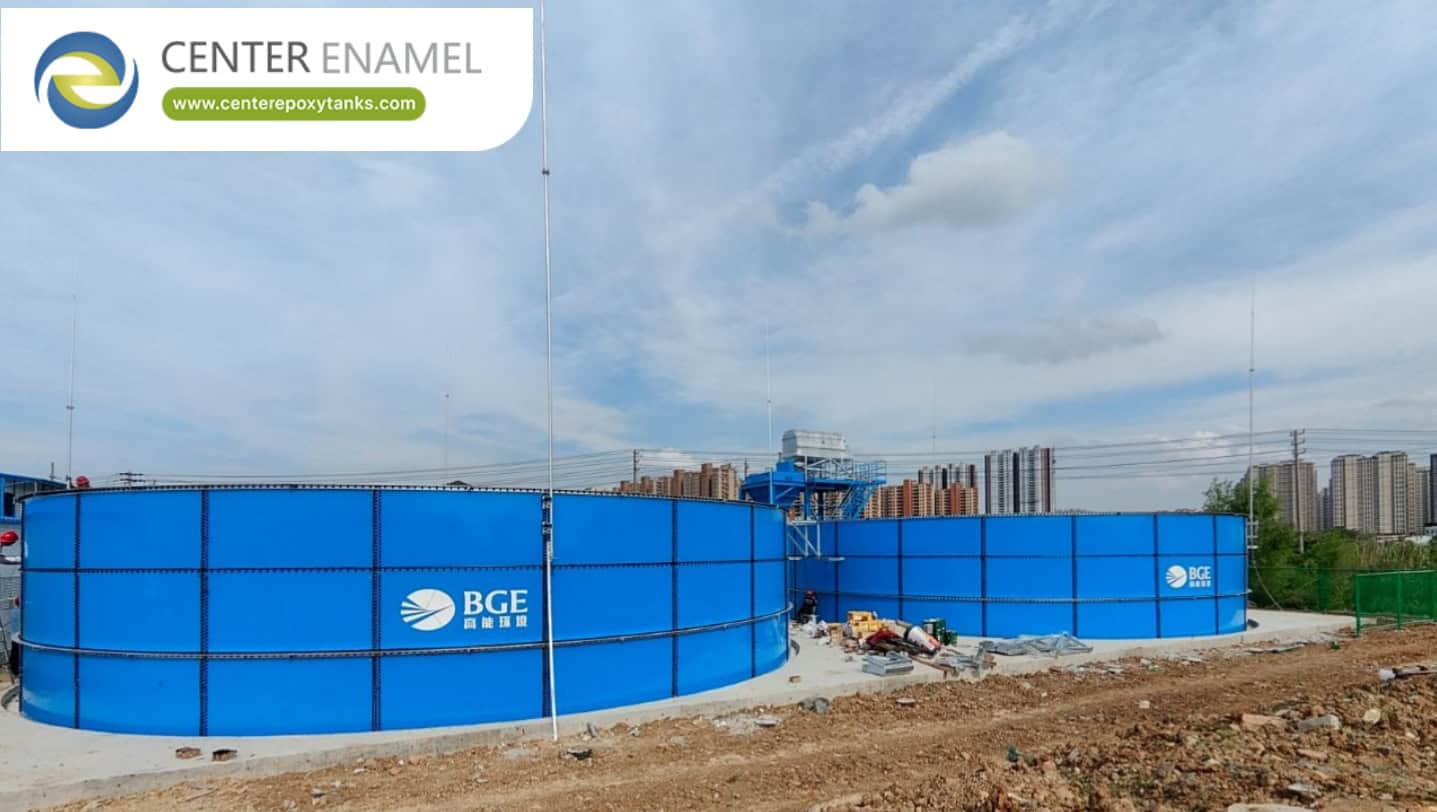
Coated Steel Wastewater Tanks: Engineering Resilience and Compliance
How do advanced coating technologies like Fusion Bonded Epoxy (FBE) and Glass-Fused-to-Steel (GFS) solve the hyper-corrosive challenges of municipal and industrial sewage? Wastewater infrastructure is a high-stakes environment where containment failure is not an option. From the production of biogenic sulfuric acid in anaerobic digesters to the abrasive nature of grit and sludge, the material choice for your tank defines its 30-year lifecycle cost.
Shijiazhuang Zhengzhong Technology Co., Ltd (Center Enamel) is the leading manufacturer of high-integrity Coated Steel Wastewater Tanks. By integrating advanced material science with modular bolted design, we provide tanks that meet AWWA, ISO, and NSF international standards for over 100 countries.
1. The Engineering Mandate: Why Coatings Matter
Wastewater is not a static fluid; it is a chemically volatile mixture. Standard concrete or untreated steel will succumb to:
● Microbial-Induced Corrosion (MIC): Bacteria in sewage produce Hydrogen Sulfide (H2S). In the tank's headspace, this gas reacts with moisture to form sulfuric acid, which aggressively eats through conventional materials.
● Abrasive Wear: Heavy grit and organic solids in primary clarifiers act as abrasives, stripping away liquid-applied paints.
● Thermal Stress: Industrial effluents often enter the tank at high temperatures, requiring coatings that maintain molecular adhesion during thermal expansion.
2. Primary Coating Technologies: FBE vs. GFS
Center Enamel specializes in the two most durable coating technologies for the global wastewater market:
A. Fusion Bonded Epoxy (FBE) Bolted Tanks
● The Process: High-quality carbon steel is grit-blasted to White Metal (SSPC-SP 5), then electrostatically sprayed with a high-performance epoxy powder. The panels are cured at 200°C, creating a monolithic, cross-linked polymer barrier.
●
● Key Benefit: FBE provides exceptional chemical resistance at a lower initial capital cost than stainless steel or glass-fused alternatives. It is the gold standard for equalization (EQ) tanks and auxiliary treated water storage.
B. Glass-Fused-to-Steel (GFS) Bolted Tanks
● The Process: Glass frit and steel are fused together in a furnace at temperatures exceeding 800°C. This creates a "chemical bond" that combines the strength of steel with the inert corrosion resistance of glass.
●
● Key Benefit: With a hardness of Mohs 6.0, GFS is virtually immune to biogenic corrosion (H_2S) and UV degradation. It is the premier choice for Anaerobic Digesters and Sludge Holding Tanks.
●
3. Comparison: Lifecycle and Performance Metrics
Feature | Reinforced Concrete | Welded Carbon Steel | Center Enamel Bolted Coated Steel |
H₂S Resistance | Low (Corrodes) | Poor (Requires lining) | High (Inert Barrier) |
Installation Speed | Slow (Curing time) | Slow (On-site welding) | Rapid (4-8 weeks) |
Maintenance | High (Repairing cracks) | High (Periodic recoating) | Minimal (30-50 Year Life) |
Expansion Capability | Impossible | Difficult | Easy (Add Panel Rings) |
Compliance | Variable | Site-dependent | AWWA D103 / ISO 28765 |
4. Strategic Integration: The Modern Treatment Plant
A 2026-standard wastewater treatment plant (WWTP) utilizes a multi-material approach for maximum ROI:
● Primary Treatment: Coated steel tanks with Aluminum Dome Roofs contain malodorous compounds while resisting atmospheric corrosion.
●
● Secondary Treatment: Double Membrane Roofs are integrated onto coated steel reactors to capture biogas, contributing to the facility's energy self-sufficiency.
●
● Final Clarification: Smooth, non-porous coatings minimize sludge adhesion, reducing cleaning downtime and improving process efficiency.
●
5. Why Partner with Center Enamel?
As the first and most experienced bolted tank manufacturer in Asia, Center Enamel provides more than just a vessel; we provide a certified engineering solution.
● High-Voltage Testing: Every panel undergoes 1100V - 1500V zero-defect holiday testing to ensure 100% coating integrity before shipping.
●
● Global Certifications: Our manufacturing adheres to ISO 9001, NSF 61, WRAS, and FM Global, simplifying the regulatory approval process for engineers and municipalities worldwide.
●
● Turnkey EPC Capability: From initial structural analysis (Finite Element Analysis) to on-site commissioning, we provide end-to-end expertise.


