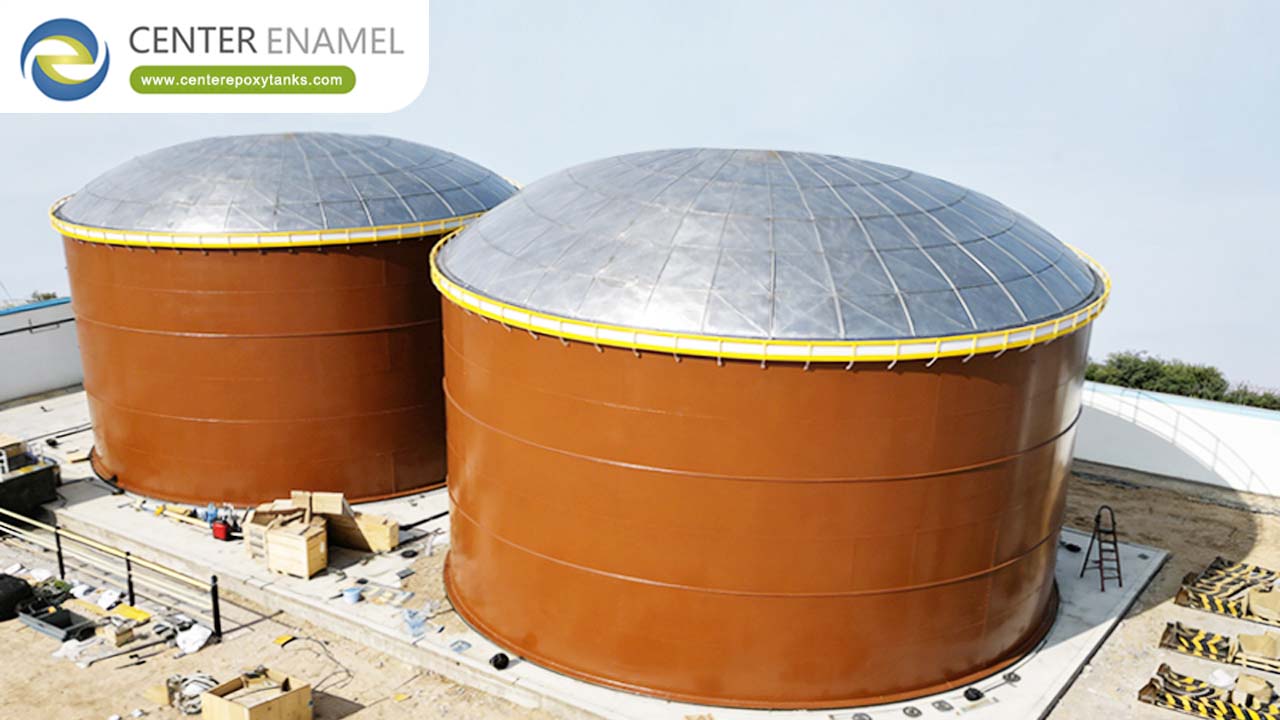
Closed-Loop Cooling Tank For Data Center
A Stainless for Closed-loop must be specified by duty, not by catalogue: match the material and barrier to the stored medium, confirm the applicable standard, and verify performance with real project evidence.
What Is A Stainless
A Stainless for Closed-loop is a contained, documented asset engineered for that duty. Its lining must be proven for water contact (NSF61/WRAS), and it must integrate with pumps, controls and the data center's 24/7 availability rather than stand alone.
Selecting by catalogue misses the real constraint: water chemistry, redundancy and the cost of an outage decide the material and ancillaries.
For Closed-loop, the lining is the single point of failure — GFS and FBE give a bonded inert film, stainless a homogeneous barrier, and only NSF61/WRAS certificates prove contact safety for non-potable duty.
Why Closed-loop Demands A Purpose-Built Tank
Cooling-water tanks in a data center interconnect make-up, buffer, expansion, chilled and thermal-storage roles into one resilient loop.
Because data centers run continuously, the tank must tolerate transient loads, integrate with controls and include leak safety where liquid cooling is involved.
A common miss is treating Closed-loop as one vessel when it is a node in the cooling loop — the tank, CDU, pumps and controls must be specified together or availability and PUE targets slip.
Technical Specifications
Parameter | Center Enamel Stainless | Typical alternative | Why it matters |
Liner / coating | NSF61 / WRAS certified | Uncertified steel | Non-potable contact still needs proven inertness |
Capacity range | 20 - 60,000 m3 modular | Fixed pour | Phased data-center build |
Joint | Bolted, sealed | Welded / cast | Leak path and speed |
Material options | GFS / FBE / stainless | Single material | Chemistry match |
Certification | ISO 28765 / NSF61 / WRAS | Partial | Regulatory acceptance |
The table contrasts the specified Center Enamel configuration with a typical alternative so the gap — in barrier life, speed and certification — is explicit rather than assumed.
Stainless Vs Alternatives
Criterion | Center Enamel Stainless | Welded steel | Concrete |
Capital cost | Mid, modular | High | High |
Install speed | Fast, bolted | Slow | Slow |
Water purity | NSF61/WRAS lining | Coating dependent | Good but sealing |
Flexibility | Relocatable | Fixed | Fixed |
Best fit | Phased DC build | Ultra-large | Permanent |
Selection And Sizing Framework
Define the water source and quality, the make-up or buffer volume from the balance, the lining by chemistry (NSF61/WRAS), and redundancy for 24/7 duty; then verify the supplier's water-contact certificates.
Document the duty, the chosen standard and the supplier's certificate set before issuing the specification; this prevents the most common failure — a tank that meets price but not the authority.
Application Engineering
With no single project case published for Closed-loop in the library, the engineering here rests on documented Stainless technology and certifications (NSF61 / WRAS / ISO 28765 / EN 1090 / AWWA D103).
Specify by duty — lining per medium, flow per Jenike for solids or volume per standard for water — and verify the supplier's QA and certificate set rather than relying on a generic brochure.
Installation And Maintenance
Bolted, factory-finished panels are installed on a foundation with pipework and controls; verify water-tightness, then commission level and pressure sensors.
Maintain a plan for the lining and instrumentation, and keep an air gap and backflow prevention where non-potable and potable networks are close.
Standards And Certifications
Relevant references: AWWA D103, ISO 28765, NSF/ANSI 61, WRAS. Center Enamel products are built to ISO 9001, NSF/ANSI 61, WRAS, FM-ready, CE (EN 1090) and ISO 28765 where applicable, with certificates available on request.
Confirm the specific standard and certificate scope for your project before specification, because acceptance depends on the authority and insurer, not the supplier's marketing.
Engineering Considerations
For Closed-loop, the engineering priority is the water balance: source quality, the make-up or buffer volume, and 24/7 redundancy must be set before the tank is drawn. Stainless answers the lining and speed need once the volume is known.
Because a data center cannot tolerate an outage, Stainless here also needs level, pressure and — for liquid cooling — leak sensing integrated to controls, plus an air gap from potable networks; a vessel that is watertight but blind to its own level still risks the loop.
Common Specification Pitfalls
· Sizing the buffer from guesswork instead of a Closed-loop water balance — the tank either starves the loop or wastes capital.
· Using an uncertified lining for non-potable water — only NSF61 / WRAS-proven materials survive variable Closed-loop chemistry.
· Forgetting 24/7 redundancy and leak sensing — a watertight but blind tank still risks the data-center loop.
· Mixing non-potable and potable networks without an air gap — cross-connection rules reject the installation.
Specification Checklist
· Define the water source, quality band and the make-up or buffer volume from a water balance.
· Specify a lining proven for water contact (NSF61 / WRAS) and confirm the supplier's certificates.
· Engineer redundancy for 24/7 duty and keep an air gap / backflow prevention from potable networks.
· Integrate level, pressure and (for liquid cooling) leak-detection sensors with the controls.
· Confirm the tank works with the pumps, treatment train and thermal loop, not as a stand-alone vessel.
Frequently Asked Questions
Buffer tank vs expansion tank in a data center?
A buffer tank stores chilled water to trim chiller cycling; an expansion tank absorbs thermal volume change in a closed loop — different roles, often both present.
What material for liquid-cooling / CDU buffers?
316L stainless with secondary containment is typical for CDU buffers because of purity and leak-safety requirements.
Does ice storage help PUE?
Ice storage shifts cooling to off-peak power and can reduce chiller peak load, improving energy and cost economics where tariffs reward it.
What pressure does an expansion tank hold?
Size the pre-charge to system design and set the relief and pump set-points so the loop stays within pressure limits.
How do I size a buffer tank?
Use the chiller delta-T, cycling limit and load profile to set the stored volume that rides through transients without short-cycling.
How is leak risk managed in liquid cooling?
Secondary containment, leak detection and 316L with validated joints manage leak risk for liquid-cooling loops.
What is WUE and why does on-site storage affect it?
Water Usage Effectiveness is total facility water divided by IT water; on-site harvest, condensate and reclaimed storage lower WUE by offsetting municipal draw and blowdown.
Should a data-center cooling tank be above or below ground?
Above-ground bolted tanks install fast and stay inspectable; below-ground suits space or freeze risk but needs access for lining and leak checks. Choose by site and climate.
For Closed-loop, specify the Stainless by duty, standard and supplier track record rather than price alone. Center Enamel provides documented, certified stainless systems and project references on request.
CTA: Request a technical specification or project reference for your Closed-loop from Center Enamel.
About Company
Shijiazhuang Zhengzhong Technology Co., Ltd (Center Enamel) has engineered bolted storage tanks and silos since 2008 and is the first Chinese manufacturer of Glass-Fused-to-Steel tanks, holding nearly 200 enameling patents and shipments to more than 100 countries.
For Closed-loop, Center Enamel supplies Stainless and related containment engineered to ISO 9001, NSF/ANSI 61, WRAS, FM-ready, CE (EN 1090) and ISO 28765, with in-house panel production, enameling control and global installation support.
For data-center water and cooling duties, Center Enamel provides NSF61/WRAS-lined bolted tanks that decouple storage from supply risk and scale with phased builds.


