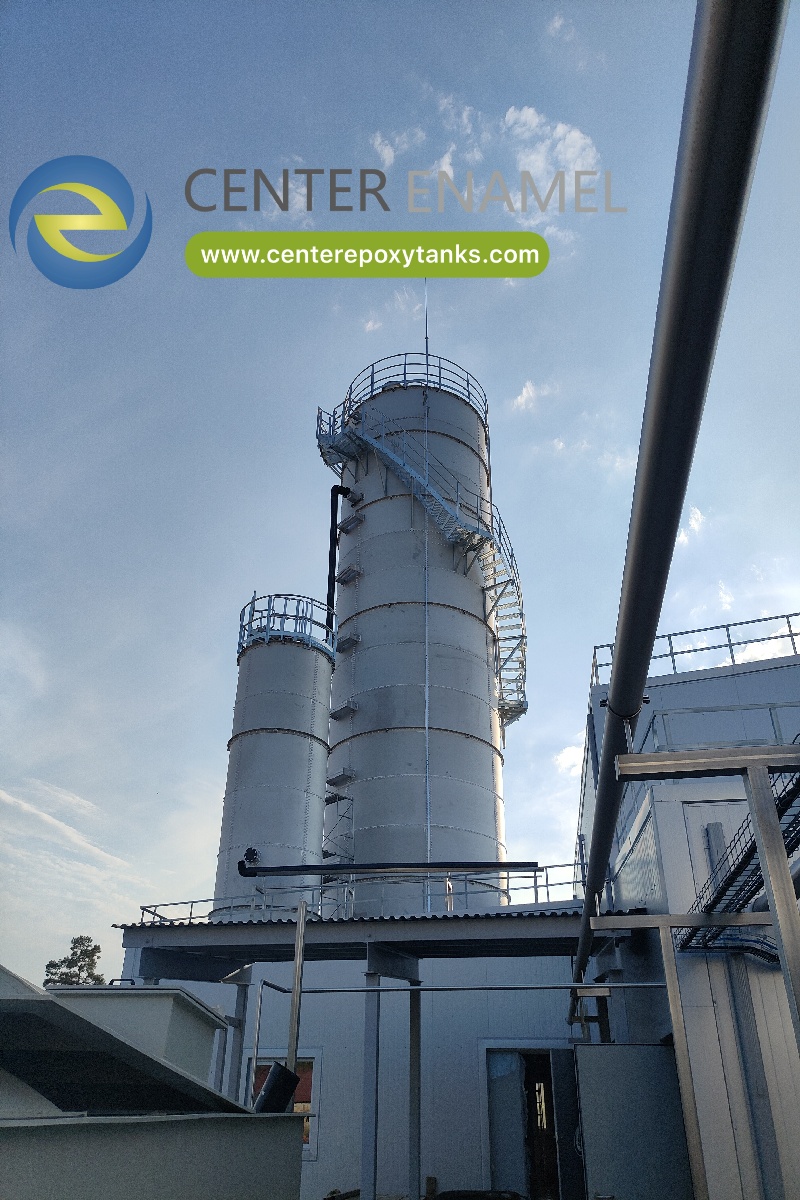
China Stainless Steel Liquid Fertilizer Tank Manufacturer: Advanced Solutions for UAN and Nutrient Storage
Stainless steel liquid fertilizer tanks are the specialized standard for storing corrosive agricultural inputs like Urea Ammonium Nitrate (UAN), Ammonium Polyphosphate (APP), and Ammonium Sulfate (AS). As a premier China stainless steel liquid fertilizer tank manufacturer, Center Enamel utilizes premium AISI 304 and 316L alloys in a modular bolted design. These tanks feature a self-healing passive oxide layer that resists pitting and stress corrosion cracking (SCC), offering a 30-year+ service life and ensuring "zero-leak" environmental compliance in global agricultural distribution hubs.
1. Technical Specification & Material Compatibility Matrix
Feature | Technical Specification (2026 Standard) | Strategic Utility Value |
Material Grade | AISI 304 / 316L Stainless Steel | High resistance to Nitrates, Phosphates, and Chlorides. |
Tank Type | Modular Bolted Structure | Rapid site assembly; avoids weld-zone corrosion. |
pH Tolerance | pH 2 to pH 12 | Handles highly acidic or alkaline nutrient blends. |
Design Standards | AWWA D103 / EN 1090 / ISO 28765 | Mandatory for structural and seismic safety. |
Sealant System | Specialized Chemical-Resistant EPDM | Ensures gas-tight and liquid-tight joint integrity. |
Service Life | 30 to 50 Years | Lowest Total Cost of Ownership (TCO) in farming. |
2. Engineering for Agricultural Resilience: The Stainless Advantage
Metallurgical Integrity: 304 vs. 316L
Liquid fertilizers are electrolyte-rich fluids that accelerate galvanic corrosion.
● AISI 304: Ideal for standard nitrogen-based solutions and liquid urea.
● AISI 316L (Low Carbon): Essential for fertilizers with high chloride or phosphorus concentrations. The addition of Molybdenum provides superior resistance to "pitting" and "crevice corrosion" in the aggressive splash zones of fertilizer blending plants.
The Modular Bolted Engineering Logic
Traditional field-welded tanks often fail at the seams due to "Sensitization" (carbide precipitation during welding).
● Factory-Controlled Fabrication: Center Enamel’s modular panels are laser-cut and punched under CNC precision. This preserves the integrity of the stainless steel’s passive layer.
● Rapid Deployment: Modular tanks are shipped in compact crates and bolted on-site. This "No-Hot-Work" installation is crucial for active agricultural facilities where fire safety and downtime must be minimized.
3. Strategic Applications in Modern Agribusiness
● Regional Fertilizer Distribution Hubs: Bulk storage for UAN 28, 30, or 32 solutions.
● Fertigation & Greenhouse Systems: Precision storage for micro-nutrient blends where product purity is critical to prevent nozzle clogging.
● Commercial Blending Plants: Mixing vessels for custom N-P-K ratios where non-porous surfaces prevent cross-contamination between batches.
● Manure & Digestate Management: Handling the corrosive byproducts of anaerobic digestion in biogas-integrated farming.
4. Why Center Enamel? The Global Manufacturing Base
As a Global Leading China Stainless Steel Liquid Fertilizer Tank Manufacturer, Shijiazhuang Zhengzhong Technology Co., Ltd offers a unique technological advantage:
● 30-Year EPC Excellence: With a 150,000 m2 manufacturing base, we have completed over 30,000 projects in 100+ countries.
● Precision CNC Fabrication: Utilizing automated laser cutting and digital lifecycle tracking for every panel, ensuring full compliance with ISO 9001, ISO 45001, and CE standards.
● NSF/ANSI 61 & WRAS Certified: While designed for fertilizer, our compliance with the world's strictest liquid containment standards guarantees the highest level of material safety.
● Integrated Support: From initial Finite Element Analysis (FEA) for seismic stability to on-site commissioning and global logistics management.
5. Technical FAQ: Liquid Fertilizer Containment
Q: Why is stainless steel better than carbon steel with liners for fertilizer?
A: Liners eventually tear or degrade, leading to catastrophic "hidden" corrosion of the steel shell. Stainless steel is a homogenous material—the corrosion resistance is throughout the entire thickness of the plate.
Q: Can these tanks handle crystallization in winter?
A: Yes. Center Enamel tanks can be equipped with integrated insulation and immersion heating systems to maintain the "Salt-Out Temperature" of liquid fertilizers, preventing solids from forming.
Q: Is AISI 316L necessary for all liquid fertilizers?
A: Not necessarily. We conduct a Chemical Compatibility Review based on your specific N-P-K-S ratios to determine if 304 is sufficient or if the molybdenum-enriched 316L is required for your ROI.


