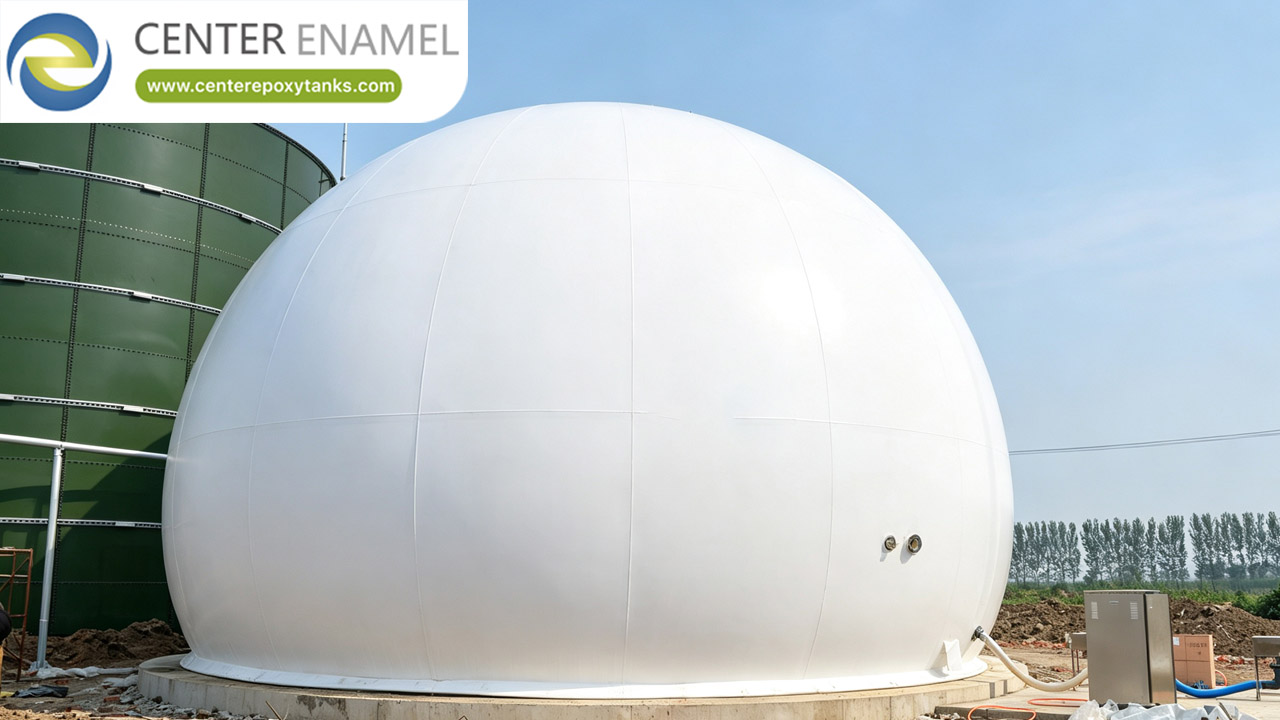
China Portable Biogas Balloons Manufacturer - Center Enamel
In the modern renewable energy sector, anaerobic digestion systems, agricultural waste-to-energy plants, and municipal wastewater facilities require flexible, highly reliable, and cost-effective gas containment solutions. As biogas production fluctuates based on feedstock supply and temperature variations, traditional rigid steel gasholders often fail to provide the necessary variable-volume buffer and rapid deployment capability. To solve this challenge, portable biogas storage balloons and flexible double membrane gas holders have emerged as the industry standard for safe, efficient, and mobile methane containment.
As a globally recognized industry pioneer with over three decades of engineering expertise, Shijiazhuang Zhengzhong Technology Co., Ltd. (Center Enamel) stands as a premier China portable biogas balloons manufacturer. Delivering high-performance flexible containment solutions to bioenergy projects across more than 100 countries, Center Enamel combines advanced polymer engineering with strict compliance with international quality standards.
Material Science and Structural Engineering of Portable Biogas Balloons
The performance and operational safety of any flexible biogas balloon depend entirely on its membrane composition and fabrication technology. Center Enamel engineers its portable biogas storage solutions using an advanced multi-layered polymer composite framework:
High-Tenacity Polyester Base Fabric: Provides exceptional tensile strength and tear resistance, ensuring the balloon can withstand continuous internal gas pressures and external environmental loads without structural deformation.
Specialized PVC/PVDF Coating: Both sides of the fabric are coated with specially formulated Polyvinyl Chloride (PVC) to establish an airtight barrier, while the external surface features a Polyvinylidene Fluoride (PVDF) lacquer shield. This provides self-cleaning properties, extreme UV solar resistance, and superior defense against biogenic sulfuric acid ($H_2S$).
High-Frequency (HF) Seam Welding: Unlike standard hot-air welding prone to degradation, Center Enamel utilizes advanced high-frequency welding technology. This fuses the membrane panels together at a molecular level, creating seams that exceed the tensile strength of the base material and guaranteeing a multi-decade operational lifespan.
Technical Performance Matrix: Biogas Storage Technologies
Technical Parameter | Center Enamel Portable Biogas Balloons | Traditional Rigid Carbon Steel Gasholders | Fixed-Dome Concrete Biogas Vaults | Standard Low-Cost Poly Bags |
Mobility & Portability | Superior; lightweight, collapsible, and easily transported to remote or temporary sites | Low; entirely permanent, heavy, and impossible to relocate once erected | None; heavy monolithic civil structures fixed permanently to a single location | High portability, but highly vulnerable to mechanical tear and rapid structural failure |
Methane Permeability & Sealing | Superior; advanced PVC/PVDF composite achieves ultra-low gas permeability ($< 400 text{ cm}^3/text{m}^2cdottext{d}cdottext{bar}$) | High gas-tightness, but vulnerable to corrosion-induced pinhole leaks over time | Moderate; prone to micro-cracking in concrete joints, resulting in fugitive methane loss | Low; high gas diffusion rates lead to significant methane loss and safety hazards |
Chemical & H2S Resistance | Superior; engineered specifically to withstand corrosive trace gases, moisture, and H2S | Moderate; requires continuous protective repainting and anti-corrosion maintenance | Low to Moderate; vulnerable to sulfuric acid attack from biogas condensate | Poor; degrades rapidly under exposure to UV radiation and chemical active elements |
Installation & Deployment Speed | Rapid modular setup; deployed quickly without heavy foundation requirements | Slow; demands extensive structural fabrication, heavy cranes, and field welding | Extremely slow; requires complex formwork, rebar tying, and multi-week curing | Instant setup, but inadequate structural safety and short operational lifespan |
Key Advantages of Center Enamel Portable Biogas Solutions
1. Flexible Variable-Volume Buffer Capacity
Portable biogas balloons dynamically expand and contract in response to gas generation and consumption rates. This constant-pressure or variable-volume buffer prevents over-pressurization in anaerobic digesters and ensures a smooth, steady feedstock supply for downstream combined heat and power (CHP) engines or gas upgrading systems.
2. Global Logistical Efficiency and Compact Shipping
Unlike bulky rigid tanks or concrete forms that incur exorbitant transportation costs, Center Enamel’s flexible biogas storage balloons are lightweight and foldable. They can be packed compactly into standard shipping containers, drastically reducing international freight expenses and enabling rapid deployment in remote agricultural or industrial locations worldwide.
Frequently Asked Questions (FAQ)
Q: What makes Center Enamel a trusted China portable biogas balloons manufacturer?
A: Center Enamel brings over 30 years of specialized environmental and containment engineering experience, advanced high-frequency membrane welding facilities, strict adherence to global quality benchmarks like ISO 9001, and a proven export track record across more than 100 countries.
Q: Are portable biogas balloons resistant to corrosive hydrogen sulfide ($H_2S$)?
A: Yes. Center Enamel utilizes high-grade PVC/PVDF coated polyester fabrics specifically engineered to resist corrosive biogas constituents, moisture, and trace hydrogen sulfide, ensuring long-term structural integrity.
Q: How does a portable biogas balloon handle internal pressure and environmental loads?
A: Our dual-layer and variable-volume balloon systems are designed with precise engineering margins. The internal membrane securely holds the biogas, while advanced pressure control valves and monitoring accessories maintain operational stability against wind and external weather loads.
Q: Can these biogas storage balloons be easily relocated?
A: Yes. Because they are constructed from lightweight, high-tenacity flexible technical textiles, they can be deflated, folded, and transported to new project sites, making them ideal for temporary or mobile bioenergy operations.


