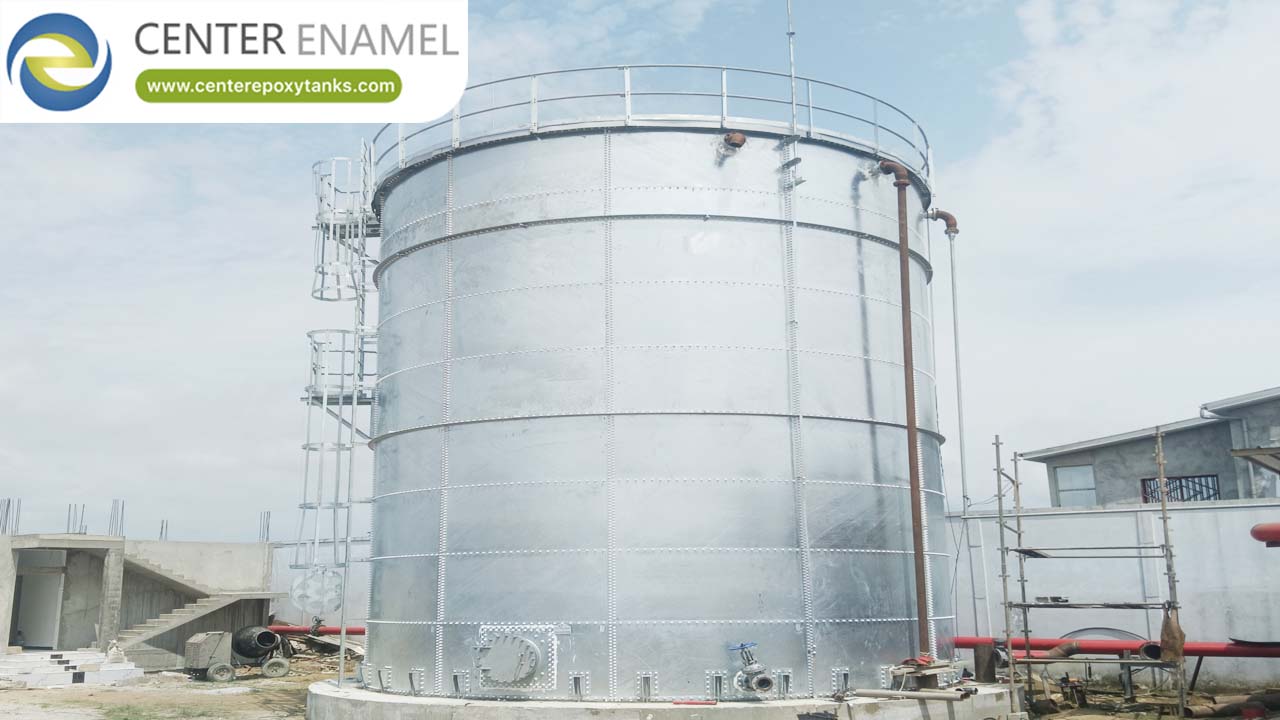
China Galvanized Steel Fire Water Storage Tank Manufacturer: Center Enamel
When planning emergency fire protection, the integrity of your water reserve is non-negotiable. Whether for an industrial warehouse, a massive commercial complex, or municipal infrastructure, fire water tanks must remain structurally sound and completely operational for decades without leakages.
Center Enamel stands out as a premier China galvanized steel fire water storage tank manufacturer. By pairing advanced structural engineering with efficient hot-dip galvanization techniques, the company delivers high-capacity, cost-effective bolted steel containment systems engineered to meet international safety and fire protection standards.
The Advantages of Bolted Galvanized Steel for Fire Protection
For private and public fire protection systems, choosing a tank material usually comes down to three things: total cost, installation speed, and long-term durability. Hot-dip galvanized bolted tanks consistently outperform traditional welded carbon steel or concrete structures across all three.
1. Superior Corrosion Protection via Zinc Sacrificial Coating
Hot-dip galvanization provides a robust, multi-layered barrier. The steel plates are completely submerged in molten zinc, creating a tough iron-zinc alloy bond.
Why it works: If the outer layer sustains mechanical scratches during shipping or installation, the surrounding zinc naturally acts as a sacrificial anode, corroding first to protect the underlying structural steel from rust.
2. High-Performance Internal Membrane Liners
To eliminate any direct contact between the stored water and the bolted seams, Center Enamel installs specialized, heavy-duty flexible membrane liners (such as EPDM or PVC). This ensures a completely watertight seal while protecting the tank interior from premature moisture-driven degradation.
3. Rapid Modular Field Assembly
Because every galvanized steel panel is pre-punched and finished at the factory, field construction requires zero welding or on-site painting. The panels are simply bolted together using high-strength structural fasteners and specialized sealants.
Technical Specifications & Engineering Standards
Center Enamel's bolted galvanized steel tanks are engineered from the ground up to comply with rigorous international safety and building codes.
Engineering Aspect | Specification / Compliance Detail |
Material Base Steel | High-strength carbon steel sheets (Q235B / Q355B or international equivalents) |
Galvanizing Thickness | Hot-dip galvanized to meet ISO 1461 or ASTM A123 (typically ≥ 85 microns / 610 g/m²) |
Capacity Volumes | Scalable from 50 m³ to over 10,000 m³ |
Internal Sealing Matrix | Heavy-duty EPDM / PVC waterproof membrane liner systems |
Global Design Standards | NFPA 22 (Private Fire Protection), AWWA D103, ASCE 7 |
Hardware Accessories | Premium Grade 8.8 / 10.9 hot-dip galvanized or stainless steel bolts |
Streamlined Field Installation Workflow
Building a welded steel or concrete fire tank can take months, often requiring heavy equipment and constant weather dependencies. Center Enamel utilizes a specialized synchronized hydraulic lifting technique that simplifies the assembly process on-site.
1.Base Ring Concrete Preparation:Foundation Check。
The concrete slab foundation is poured and cured. A circular galvanized starter ring or specialized channel profile is securely anchored to the slab to accept the first round of tank panels.
2.Top Ring Assembly and Roof Attachment:Safe Ground Operations。
The top row of steel panels and the roof structure (aluminum dome or steel cone) are assembled at ground level. This keeps high-altitude labor to an absolute minimum.
3.Hydraulic Jacking and Intermediate Layer Ring Insertion:Bottom-Up Expansion。
Heavy-duty hydraulic jacks lift the completed top section upward. The next ring of galvanized panels is positioned underneath and bolted into place. This cycle repeats until the tank reaches its full designated height.
4.Membrane Liner Installation and Hydro-Testing:Final Containment Layer。
The internal protective membrane liner is carefully unrolled, secured to the tank wall, and inspect-checked. The tank undergoes an exhaustive hydrostatic filling test to verify 100% watertight integrity before being commissioned into service.
Frequently Asked Questions (FAQ)
What makes hot-dip galvanized tanks ideal for fire water storage?
Galvanized tanks are highly favored for fire protection due to their exceptional cost-efficiency and decades-long service life. They meet all primary global fire code benchmarks (such as NFPA 22) and require almost zero maintenance, ensuring that massive volumes of emergency water remain reliably contained and ready for immediate deployment.
Does Center Enamel build fire water tanks to NFPA 22 compliance?
Yes. Center Enamel designs and manufactures its entire line of galvanized and Glass-Fused-to-Steel fire water tanks in strict accordance with NFPA 22 parameters. This covers critical design details like correct shell thickness, wind load capabilities, required nozzle configurations, vortex suppressors, and emergency water-level monitoring systems.
How long does a bolted galvanized steel water tank typically last?
When properly engineered and paired with a high-quality internal membrane liner, a hot-dip galvanized bolted tank offers a reliable service life of 30 to 50 years. Because the zinc coating provides deep sacrificial protection against atmospheric rust, the exterior shell withstands harsh weather conditions beautifully.
Can these tanks be shipped and assembled in remote or tightly enclosed areas?
Absolutely. Because the tank arrives completely disassembled in compact, modular crates, transport logistics are simple. The individual panels can be moved into tight interior spaces, high-altitude mountainous terrain, or remote industrial sites without requiring heavy-duty cranes or expansive staging yards.


