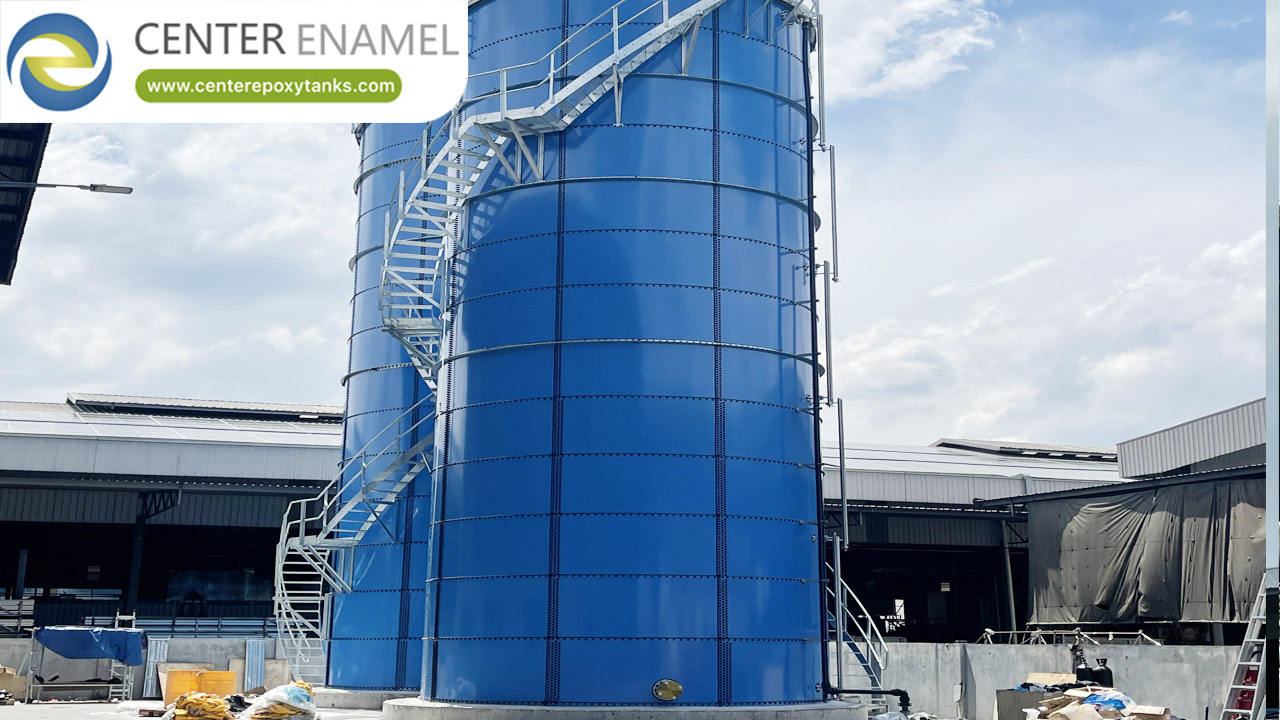
Chilled Water Thermal Energy Storage Tanks for Data Centers: Design Logic
Chilled-water TES tanks let a data center charge cooling overnight and discharge it during peak IT load, flattening chiller demand and adding resilience.
Chilled Water Thermal Energy Storage Tanks for Data Centers are engineered to hold the chilled, make-up, thermal-storage, or fire water that a facility's cooling and resilience strategy requires. The defining need is reliability under continuous duty: corrosion-resistant bolted construction (GFS/FBE), code-aligned design (AWWA D103, NFPA for fire), and N+1 thinking so a single tank or valve never takes the site offline.
Technical Explanation
Data-center cooling is fundamentally a water-loop problem. Chillers or evaporative units move heat from the IT space to a rejected sink; between them sit tanks that store water, smooth flow, and absorb volume and temperature transients.
The tank types are complementary. A makeup tank protects against supply loss, a buffer tank protects chillers from short-cycling, a TES tank stores cooling as a thermocline, and a fire-water tank is a separate code-driven reserve.
Application Scenarios
Hyperscale and colocation campuses, AI training clusters, and edge facilities all need staged water storage. The larger and denser the site, the more a stratified TES tank and a buffered chilled-water loop pay back in chiller efficiency and demand charges.
Geographies with weak or intermittent water supply lean harder on makeup and fire reserves; hot climates lean on TES to shave peak cooling load.
Selection and Comparison
Match the tank to its duty and code. Atmospheric GFS/FBE bolted tanks serve makeup, buffer, and TES; pressurized ASME vessels serve sealed chilled loops; fire water follows NFPA and often FM guidance with a dedicated reserve.
Redundancy matters: split large volumes into multiple bolted tanks so maintenance or a fault does not remove the whole reserve.
Data-Center Tank Duties
Duty | Typical tank type | Key driver |
Makeup | GFS / FBE bolted | Supply interruption |
Chilled buffer | GFS / FBE bolted | Chiller protection |
TES | Stratified GFS / FBE | Load shifting |
Fire water | Galvanized / FBE bolted | NFPA / FM code |
Technical Specifications
Parameter | Specification |
Tank / vessel type | Glass-Fused-to-Steel (GFS) bolted tank |
Primary design standard | AWWA D103-09 (bolted) / ASME Section VIII (pressurized) |
Coating / lining | GFS enamel or FBE epoxy, NSF-61 / WRAS approved for potable contact |
Typical diameter range | 4.6 m to 44 m (bolted modular panels) |
Typical height range | up to 34.8 m (verified single GFS tank) |
Operating temperature | 1 °C to 50 °C (chilled / ambient water service) |
Stratification control | Thermocline diffuser, vertical temperature layering |
Typical storage density | ~1–1.5 kWh of cooling per m3 (5–15 °C lift) |
Pressure class | Atmospheric (open/buffer) or pressurized (ASME, up to design code) |
Roof option | Aluminum dome / aluminum flat cover / internal floating |
Reference capacity | 44,900 m3 |
Certifications | ISO 9001, NSF 61, EN 1090, ISO 28765, WRAS, FM |
Center Enamel's verified project record does not include a published data-center cooling-water or thermal-energy-storage tank installation. The technical guidance in this article is supported by the company's certified bolted-tank and ASME-vessel manufacturing system and its deliveries across 100+ countries; no specific project is cited as a case here.
Center Enamel Capability
Center Enamel (Shijiazhuang Zhengzhong Technology Co., Ltd) has manufactured bolted storage tanks since 2008, with product lines spanning Glass-Fused-to-Steel (GFS), fusion-bonded epoxy (FBE) coated, stainless steel, and hot-dip galvanized bolted tanks, plus aluminum geodesic dome roofs. For the Glass-Fused-to-Steel (GFS) bolted tank technology discussed here, the company's verified manufacturing system — certified to ISO 9001 with NSF/ANSI 61, WRAS, FM and EN 1090 alignments — supports the fabrication, coating, and QA discipline a demanding water-storage or thermal-energy-storage duty requires.
The engineering and quality system follows AWWA D103-09, OSHA, ISO 28765, NSF/ANSI 61, NFPA and EN 1090, and the product range is certified to ISO 9001, NSF 61, EN 1090, ISO 28765, WRAS, FM, LFGB, BSCI, ISO 45001 and related standards. With approximately 200 enameling patents and export to more than 100 countries, Center Enamel supports specification, fabrication, and site erection for water-storage and thermal-energy-storage projects worldwide.
Frequently Asked Questions
Q: How is a stratified chilled-water TES tank kept stable?
A: A low-velocity diffuser at the top and bottom maintains a sharp thermocline; the tank charges cold at the bottom and warm at the top, and the layering is preserved by limiting inlet velocity and avoiding mixing.
Q: Which material is most suitable for a data-center cooling water tank?
A: GFS and FBE bolted tanks are the common choice for large atmospheric duty because the factory-applied enamel or epoxy lining resists corrosion and is NSF-61 / WRAS approved; stainless is used where hygiene or pressure demands it.
Q: Does Center Enamel have a published data-center TES project?
A: Center Enamel's verified record does not include a published data-center or thermal-energy-storage tank installation. Its large bolted-tank and ASME vessel deliveries are cited as manufacturing-capability evidence for the duty, not as a data-center reference.
Q: What standards apply to a bolted water-storage tank?
A: Atmospheric bolted tanks are typically designed to AWWA D103-09 with coatings qualified to NSF/ANSI 61 and ISO 28765; pressurized vessels follow ASME Section VIII. Fire-water duty may add FM or local authority requirements.
Q: How large can a single bolted GFS tank be?
A: Center Enamel has fabricated single GFS tanks up to 32,000 m3 and 34.8 m in height, demonstrating the modular-panel capability needed for large cooling-water or TES volumes on a data-center site.
Q: Why add a buffer tank to a chilled-water plant?
A: A buffer tank prevents short-cycling of chillers, decouples chiller and load flow, and absorbs expansion, improving part-load efficiency and protecting compressors during transient demand.
Chilled Water Thermal Energy Storage Tanks for Data Centers: Design Logic comes down to matching the tank type, material, and code to the specific duty — makeup, buffer, TES, fire, or pressurized — and verifying the supplier's lining certification and references. With corrosion-resistant bolted construction and AWWA/ASME-aligned design, a data-center or industrial water-storage tank becomes a reliable, long-life node in the cooling strategy.
Discuss your tank duty, capacity, and code requirements with a Center Enamel engineer, or request technical specifications and a reference list for a comparable project.


