Chilled Water Storage Tank Insulation Requirements
Insulating a chilled-water tank is the mirror image of insulating a hot tank: the enemy is heat gain, not heat loss, and the tank never freezes because it stores water above 0 C. The job of the insulation and its continuous vapor barrier is to keep the stored cold in and the ambient heat out. Get the vapor barrier wrong and you create a slow, hidden failure — moist air condenses against the cold shell, the insulation wets, performance collapses and corrosion starts under the jacket. That is why the vapor barrier detail matters as much as the insulation thickness.
Insulation Exists To Stop Heat Gain, Not Freezing
A chilled-water tank loses capacity to heat gain from the surroundings, not to freezing (it stores above 0 C). Insulation and a continuous vapor barrier keep the stored cold in and ambient heat out. Every degree of heat that leaks in is cooling the tank must later remove, eroding usable volume and wasting plant energy.
This is the opposite design problem from a hot tank, so the vapor barrier detail matters as much as the insulation thickness. On a hot tank the vapor drive is outward; on a chilled tank it is inward, and inward drive is what makes condensation at the cold surface the dominant risk.
Treating a chilled tank like a hot tank — thick insulation, weak vapor barrier — is a common and expensive mistake. The barrier, not the R-value alone, is what keeps the system dry and performing.
Material Choice: PU Or Mineral Wool
Polyurethane (PU) foam gives high thermal resistance per unit thickness and is common on bolted tanks, where a thin, rigid layer is easy to clad and handle. Mineral wool resists higher temperatures and is non-combustible where that is required by code. The choice follows code, climate and geometry.
Both need a weatherproof, continuous cladding and a vapor barrier on the warm side. The cladding protects the insulation from weather and mechanical damage; the vapor barrier protects it from the inward moisture drive that would otherwise wet the material.
For bolted tanks the insulation is often supplied as pre-formed panels that mate with the shell panels, keeping the assembly modular and the vapor barrier continuous across the joint. Joint continuity is where many systems succeed or fail.
Thickness Follows Climate And Loss Budget
Thickness is set by the acceptable standing loss (about 1-3% per day for a well-built tank) and the ambient swing. Hot, humid climates demand tighter vapor barriers and often greater thickness to avoid condensation at the jacket. Cold, dry climates are more forgiving but still need a continuous barrier.
The insulation specification is a trade between first cost and the value of stored energy saved. Thicker insulation costs more up front but recovers through lower chiller run time; the optimum is where the marginal energy saved equals the marginal cost.
Define the loss budget explicitly in the specification rather than defaulting to a thickness. A stated target (e.g., standing loss not to exceed 2%/day) makes the insulation enforceable and prevents both under- and over-design.
Where Insulation Fails
A broken or discontinuous vapor barrier lets moist air reach the cold shell and condense, degrading performance and risking corrosion under the jacket. Penetrations (nozzles, manway, roof) are the usual weak points and need careful detailing with sealed boots and collars.
Specify the barrier continuity and the penetration seals explicitly. A vapor barrier that stops at every nozzle is no barrier at all; the seal must follow the insulation around each penetration without a gap.
Field handling matters too. Insulation damaged during transport or erection must be repaired to the original continuity standard, not patched cosmetically. A small gap at a panel joint can wet a large area over a few seasons.
Verifying Performance After Installation
Insulation quality is best verified by measuring, not assumed. A thermal imaging survey of the shell and roof under operating conditions reveals cold spots where the vapor barrier has failed or the insulation has wet, often before the energy loss shows up in the bills.
Surface temperature checks against the design outside-surface temperature give a simple field test: if the jacket runs warmer than predicted, heat gain is higher than specified and the barrier or thickness should be investigated. The check is cheap and repeatable at each inspection.
For critical duties, a commissioning heat-gain measurement — comparing energy in versus stored and delivered — quantifies standing loss directly. That number, recorded at handover, becomes the reference against which future degradation is judged, turning insulation from a black box into a managed asset.
Insulation options
Material | Strength | Watch-out |
PU foam | High R per thickness | Vapor barrier continuity |
Mineral wool | Non-combustible | Thicker for same R |
Both | Need cladding + VB | Penetration seals |
Loss budget
Factor | Effect |
Climate / ambient swing | Drives thickness |
Standing loss 1-3%/day | Target, not guarantee |
Vapor barrier | Prevents condensation |
Frequently Asked Questions
Why insulate a chilled tank if it does not freeze? To limit heat gain from surroundings; heat gain erodes stored cooling and usable volume. Insulation keeps the cold in.
PU or mineral wool? PU gives more R per thickness; mineral wool is non-combustible where required. Both need cladding and a continuous vapor barrier.
How thick should insulation be? Set by the acceptable standing loss (about 1-3%/day) and climate; hot, humid sites need tighter vapor barriers and often more thickness.
What is the vapor barrier for? It stops moist ambient air reaching the cold shell and condensing, which would degrade insulation and risk corrosion under the jacket.
Where do insulation systems fail? At penetrations (nozzles, manway, roof) and anywhere the vapor barrier is discontinuous.
Does insulation affect codes? Yes — non-combustibility, cladding and penetration detailing may be set by local fire and building codes.
Project Case Reference (Capability Evidence)
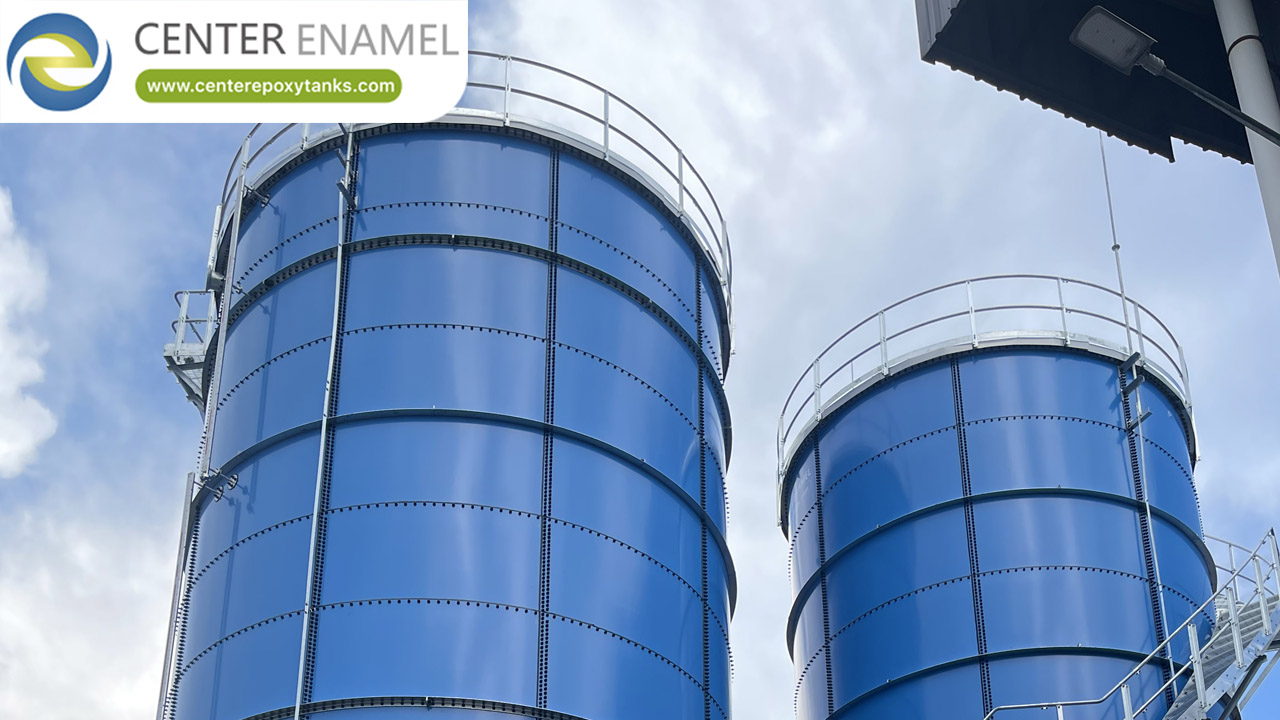
Guinea Fire-protection water — Hot-dip galvanized steel tank, φ14.51*12.0m(H) ×1, total 1983 m3, 2025.
Disclosure: Center Enamel's verified project case library (case_anchors.py) records no chilled-water / thermal-energy-storage delivery. The case(s) above are cited as manufacturing-capability evidence (shell fabrication, coating/liner, bolted construction, volume/diameter range) applicable to chilled-water tank containment. They are NOT presented as chilled-water or TES projects, and no chilled-water case is fabricated.
Work With Center Enamel
Center Enamel (Shijiazhuang Zhengzhong Technology Co., Ltd) is a storage-tank and process-equipment manufacturer established in 2008 and headquartered in Shijiazhuang, China. Its product range covers Glass-Fused-to-Steel (GFS) tanks, Fusion Bonded Epoxy (FBE) coated bolted tanks, stainless steel tanks, hot-dip galvanized tanks, welded steel tanks and aluminum geodesic dome roofs. The company holds ISO 9001, ISO 45001, ISO 28765, EN 1090, NSF/ANSI 61, WRAS, FM, CE, LFGB and BSCI certifications and designs to AWWA D103-09 and other recognized international codes. Its manufacturing base produces around 300,000 enamel steel plates per year and has delivered 30,000 installed tank projects, supported by a global distributor network with a 24-hour after-sales response.
Contact Center Enamel — Tell us your climate band and loss budget and we will specify insulation type, thickness and vapor-barrier detailing.