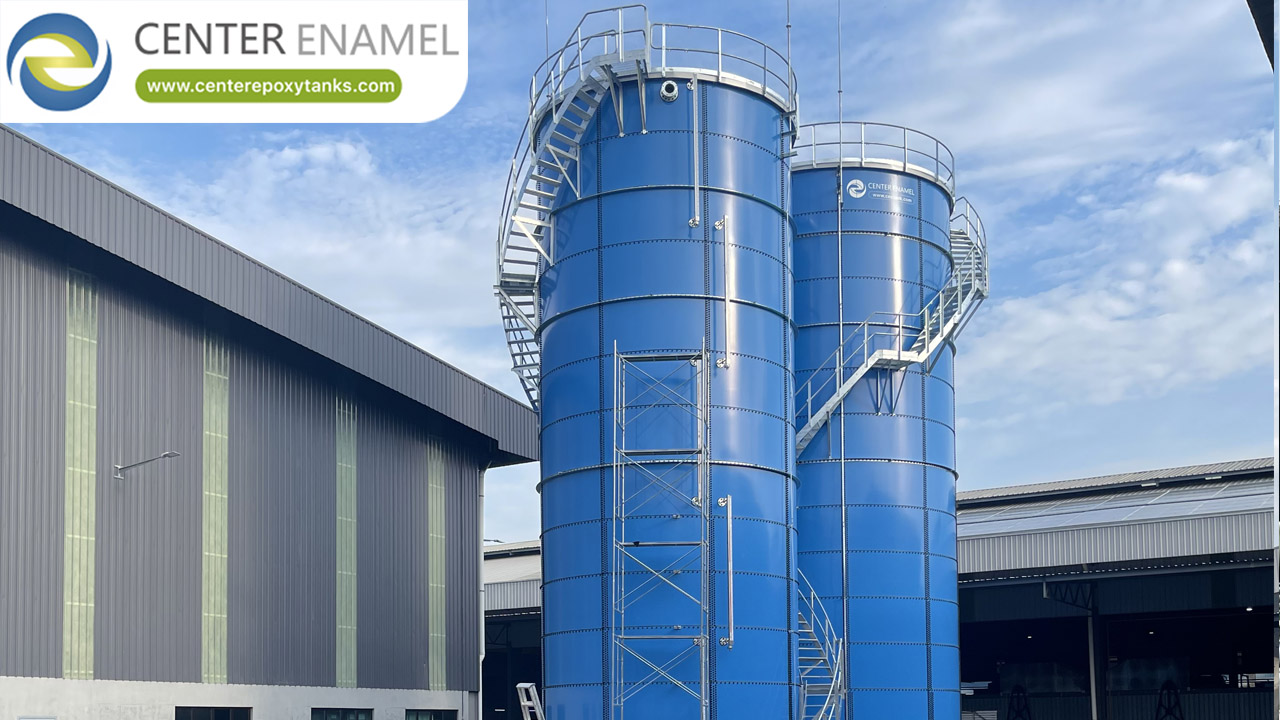
NSF Certified Fusion Bonded Epoxy Tanks for Drinking Water Storage: Ensuring Public Health and Structural Reliability
In municipal water supply management, rural community infrastructure, and emergency municipal reserves, storing potable water safely is a critical public health responsibility. Water authorities and civil engineers face rigorous regulatory requirements to ensure that stored drinking water remains completely free from chemical contamination, bacterial growth, and heavy metal leaching. Traditional welded steel tanks or unlined concrete basins often degrade over time, leading to structural corrosion, water quality degradation, and costly maintenance cycles.
To meet the highest standards of safety, durability, and cost-effectiveness, municipal project developers increasingly specify NSF Certified Fusion Bonded Epoxy (FBE) Tanks. As a globally trusted leader in bolted tank engineering, Shijiazhuang Zhengzhong Technology Co., Ltd. (Center Enamel) delivers world-class FBE storage solutions engineered specifically to safeguard municipal drinking water while complying with strict international public health benchmarks.
Engineering Excellence: The Importance of NSF/ANSI 61 Certification
When containing potable water, the interior coating material must be certified to ensure it does not leach toxic chemicals, volatile organic compounds (VOCs), or heavy metals into the water supply.
Rigorous Public Health Validation: Certification under NSF/ANSI 61 dictates that internal epoxy coatings undergo exhaustive toxicological testing. Center Enamel's specialized epoxy formulations (such as Resicoat® R4-ES) are certified safe for direct contact with drinking water at ambient and elevated temperatures.
Electrostatic Thermal Fusion Technology: Unlike field-applied paints that can blister or peel, FBE coatings are applied in a controlled factory environment. Thermoset epoxy powders are electrostatically sprayed onto precision-engineered steel panels and thermally fused in automated tunnel ovens, creating an unbreakable bond with the steel substrate.
100% High-Voltage Holiday Testing: To guarantee absolute coating integrity, every single panel undergoes strict high-voltage testing (1100V to 1500V) before packaging and shipping, ensuring zero pinholes or microscopic flaws that could compromise water purity.
Data Table: Potable Water Storage Technology Comparison Matrix
Technical Parameter | Center Enamel NSF Certified FBE Tanks | Traditional Concrete Reservoirs | Unlined Field-Welded Steel Tanks |
Potable Health Safety | Certified under NSF/ANSI 61; zero toxic leaching or heavy metal transfer | Prone to calcium leaching and microbial biofilm accumulation | High risk of rust flaking and iron contamination |
Corrosion Defense | High-performance thermoset epoxy barrier resistant to oxidation | Vulnerable to sulfate attack, carbonation, and rebar spalling | Rapid oxidation requiring constant field recoating |
Installation Velocity | Rapid modular bolted assembly completed in days or weeks | Extremely slow formwork, pouring, and multi-week curing | Slow field-welding, craning, and multi-coat painting |
Modularity & Expansion | Easily expanded or reconfigured as municipal demand grows | Permanent monolithic structure; impossible to expand or modify | Difficult to structurally modify or expand once erected |
Governing Standards | NSF/ANSI 61, AWWA D103-09, AWWA C550-05, ISO 9001 | ACI Structural Concrete Standards | API 650 / Standard steel codes |
Modular Bolted Advantages for Municipal Water Projects
Center Enamel's NSF certified FBE tanks feature a modular bolted design that streamlines logistics and accelerates project execution:
Cost-Effective Shipping: Standardized steel panels are packed compactly for efficient ocean freight transport, drastically reducing shipping expenses for international municipal projects.
Rapid Site Erection: Tanks are assembled using lightweight mechanical equipment without requiring complex on-site welding, reducing construction windows and minimizing community disruption.
Low Lifecycle Maintenance: The smooth, non-porous epoxy finish resists mineral scaling and biological growth, simplifying routine cleaning and ensuring decades of reliable municipal service.
Frequently Asked Questions (FAQ)
Q: What does NSF certification mean for fusion bonded epoxy drinking water tanks?
A: NSF certification (specifically NSF/ANSI 61) verifies that the interior epoxy coating has been rigorously tested and proven safe for contact with drinking water, ensuring no harmful chemicals or heavy metals leach into the water supply.
Q: How is the epoxy coating applied to Center Enamel's bolted steel panels?
A: The coating is applied in a state-of-the-art factory environment using advanced electrostatic spraying techniques followed by thermal curing in specialized tunnel ovens, ensuring a uniform, highly durable, and chemically bonded protective finish.
Q: Can NSF certified FBE tanks be expanded if a community's water demand increases?
A: Yes. Because Center Enamel's FBE tanks are built using a modular bolted system, municipal authorities can easily increase storage capacity by adding extra rings of steel panels or reconfiguring the structure as needed.
Q: What international engineering standards do Center Enamel's drinking water tanks comply with?
A: In addition to NSF/ANSI 61 potability standards, Center Enamel tanks comply strictly with AWWA D103-09 (bolted steel water storage tanks), AWWA C550-05, ISO 9001, and ISO 14001 quality and environmental management benchmarks.


