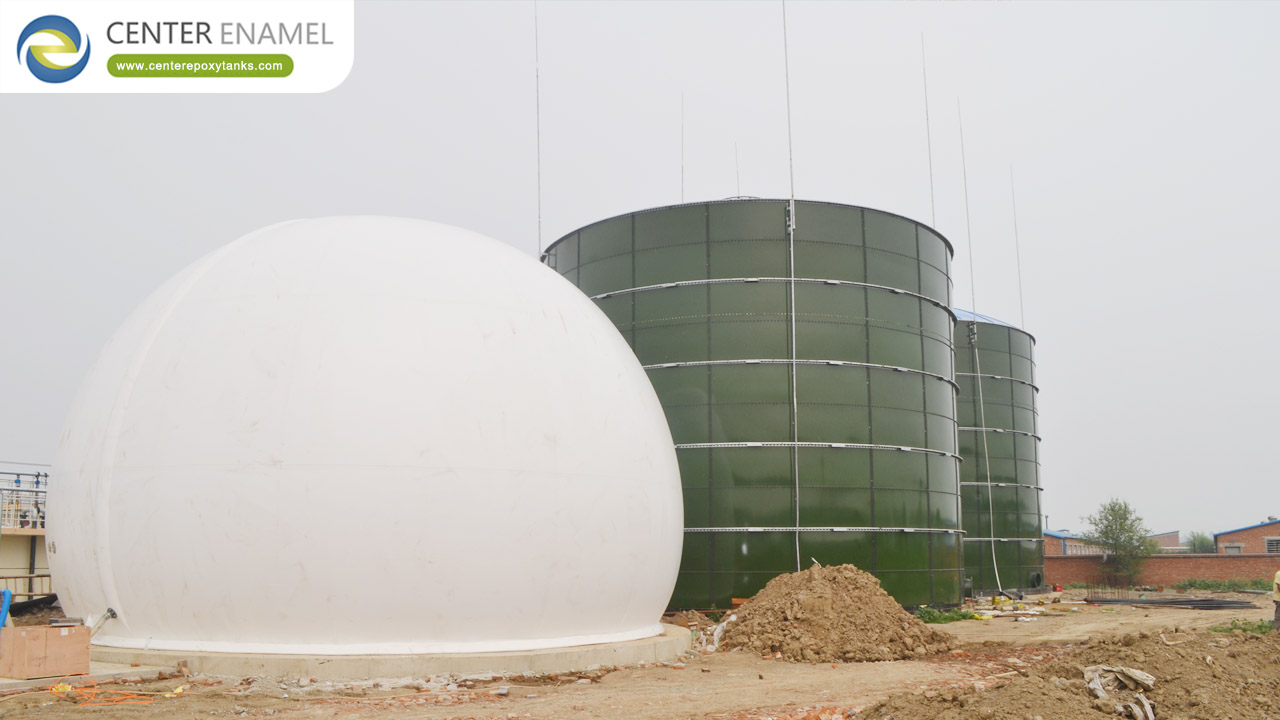
Certified China Double Membrane Biogas Gas Holder: Engineering & Procurement Guide
For large-scale anaerobic digestion (AD) facilities, the double-membrane biogas gas holder (often referred to as a "biogas balloon") is the critical buffer between production and utilization. In the Chinese manufacturing market, moving from generic fabrication to certified, industrial-grade production is essential for long-term operational success. This guide outlines the engineering standards and verification benchmarks necessary to identify a manufacturer capable of producing high-performance, compliant storage systems.
1. Defining "Certified" Reliability
A manufacturer’s "certification" is not a marketing badge; it is an audit trail of safety and performance. When evaluating a Chinese partner, prioritize manufacturers who provide verifiable documentation for the following standards:
● Material Certification: Membranes should comply with DIN 4102-B1 or equivalent international flame-retardancy standards. High-tenacity polyester fabric must be coated with UV-stabilized PVDF (Polyvinylidene Fluoride) or advanced PVC formulations for chemical resistance.
● Management Systems: Look for ISO 9001 (Quality Management) and ISO 14001 (Environmental Management). These indicate standardized production processes that minimize fabrication defects.
● Design & Safety Standards: Ensure the manufacturer follows structural design protocols equivalent to EN 13782 (temporary structures) or TRAS 120 (for biogas systems), ensuring safety during wind and snow load events.
2. Technical Engineering Requirements
Certified manufacturers do not simply "weld fabric"; they engineer a pressure vessel. Use these technical benchmarks to qualify your potential partner.
A. The Permeability Benchmark
Biogas is a high-value asset. A reliable gas holder must have a methane permeability rate of < 400 $cm^3/m^2 cdot d cdot bar$. High-frequency (HF) welding is the industry standard for seams; manual heat-sealing is a high-risk failure point.
B. Material Science: PVDF vs. PVC
Feature | Standard PVC Membrane | Premium PVDF-Coated Membrane |
Chemical Resistance | Moderate (Susceptible to H2S) | High (Chemically inert) |
Service Life | 5–8 years | 15–20 years |
Self-Cleaning | Low | High (Rain-washed surface) |
UV Resistance | Standard | Superior |
C. Safety & Control Systems
The "Double Membrane" integrity relies on the support air system. A certified manufacturer must supply:
● Redundant Blowers: Duty/standby operation to prevent membrane collapse.
● Pressure Logic: Automated differential pressure sensors that adjust air injection based on fluctuating biogas volumes.
● Safety Valves: Independent over-pressure and vacuum relief valves that function mechanically, even during power failure.
3. Vetting Checklist: The Procurement Scorecard
Use this scorecard during the Request for Proposal (RFP) process to filter out low-tier fabricators.
Audit Parameter | "Certified" Manufacturer | Low-Tier Fabricator |
Welding Tech | Automated High-Frequency (HF) | Manual heat welding |
Traceability | Batch-coded material testing (MTRs) | No material traceability |
Gas Tightness | 24-hour pressure holding test log | Visual inspection only |
Engineering Support | CAD-based wind/snow load modeling | Standard "off-the-shelf" sizing |
Commissioning | On-site technical supervisor provided | Remote support only |
4. Operational Advantages: Decoupled Storage
Moving from traditional rigid steel covers to flexible, ground-mounted double-membrane holders offers significant operational ROI:
1. Maintenance Access: Unlike integrated tank covers, ground-mounted holders allow for total isolation and inspection of the gas storage membrane without interrupting the anaerobic digestion process.
2. Scalability: If biogas production increases, flexible storage can often be upgraded or expanded with minimal civil engineering compared to rigid steel structures.
3. Pressure Regulation: These systems act as a "variable lung," keeping gas pressure constant for downstream gas engines or upgrading units, significantly reducing mechanical wear on CHP engines.
Frequently Asked Questions (FAQ)
Q: How do I verify if the PVDF coating is genuine?
A: Demand a certificate of origin for the raw membrane material (e.g., from major global polymer suppliers). A genuine PVDF coating will demonstrate self-cleaning properties and will not discolor or crack under a 1000-hour accelerated UV-exposure test.
Q: What is the risk of using non-fire-retardant membranes?
A: In the event of a lightning strike or static discharge, non-retardant membranes act as fuel, potentially causing a total loss of the gas storage asset and posing an extreme risk to the surrounding facility. Always specify DIN 4102-B1 or equivalent.
Q: How do we handle high-wind or snow-heavy locations?
A: The manufacturer must provide a structural calculation report that considers the specific wind speed (km/h) and snow load (kN/m2) for your site. Certified manufacturers utilize dynamic air pressure logic to increase support air volume, stiffening the dome during high-wind events.
Are you currently selecting a manufacturer for a new project, or are you looking to retrofit an existing storage system?


