Center Enamel Supplies High-Efficiency Full Contact Internal Floating Roofs for Egypt’s Refining & Petrochemical Sectors
As the Arab Republic of Egypt expands its role as a premier global energy hub—backed by the modernization of the Suez Canal Economic Zone (SCZONE), strategic expansions at the Mostorod and Midor refineries, and major storage terminals along the Mediterranean and Red Sea coasts—the demand for high-capacity midstream infrastructure is growing. Large bulk storage tank farms operating in regions like Ain Sokhna, Alexandria, Port Said, and Asyut must operate reliably under challenging conditions. Containment assets must maintain strict process safety, satisfy rigid environmental standards, and handle severe climate variations ranging from humid coastal maritime salinity to high desert ambient heat.
To counter aggressive product loss, secure maximum inventory yield, and eliminate hazardous vapor headspaces, Shijiazhuang Zhengzhong Technology Co., Ltd (Center Enamel) delivers custom-engineered Full Contact Internal Floating Roofs (IFRs) tailored specifically for industrial clients in Egypt.
As a global leader in bulk liquid storage with over 30 years of advanced manufacturing experience, Center Enamel designs and pre-fabricates aluminum and stainless steel floating decks in strict compliance with API Standard 650 Annex H. These systems provide molecular containment and long-term asset stability across more than 100 countries.
1. The Engineering Science of "Full Contact" Surface Containment
Traditional internal floating roofs—such as standard skin-and-pontoon models—are elevated several inches above the liquid line by a supporting framework. While cost-efficient, this configuration leaves a shallow air-gas headspace (ullage) directly beneath the deck skin. Under Egypt's high summer ambient temperatures, light hydrocarbons (like gasoline, jet fuel, and light naphtha) flash into gas, creating a localized vapor pocket that can escape through perimeter seals.
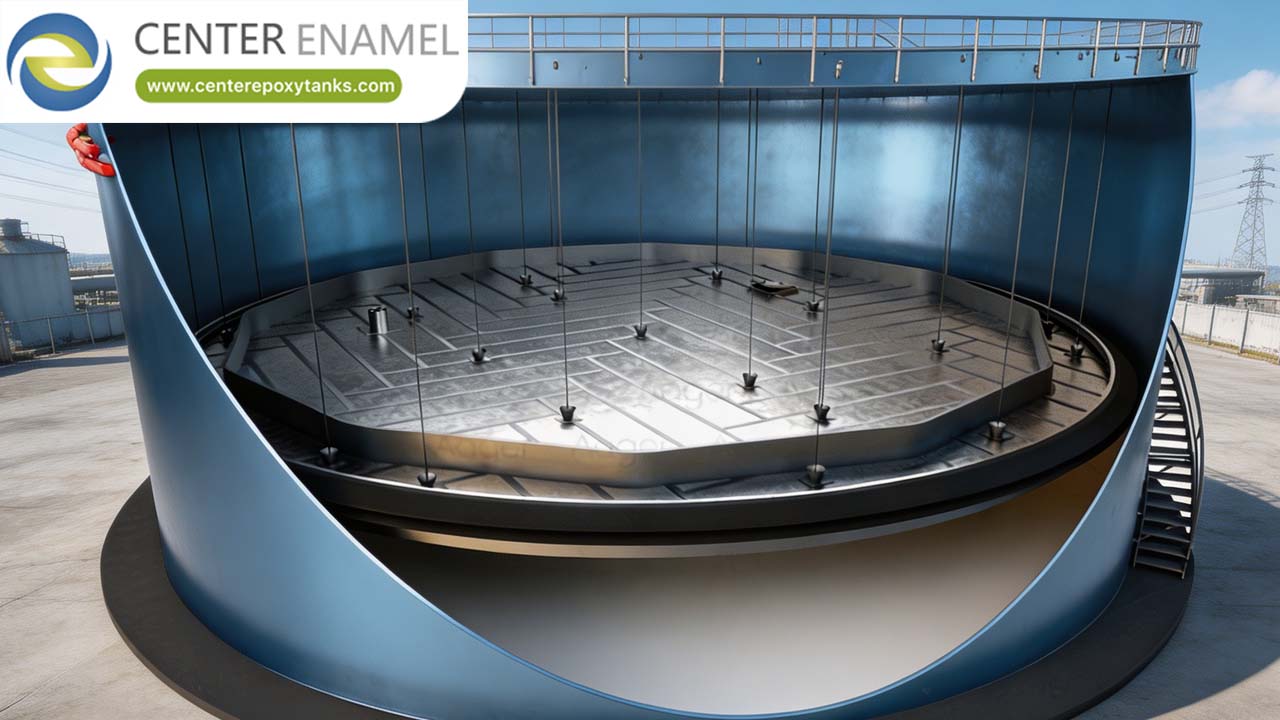
Center Enamel’s Full Contact Aluminum Floating Roof (FCAFR) solves this problem by using a true zero-gap approach.
Constructed from a high-buoyancy, modular panelized aluminum honeycomb matrix, the entire surface area of the deck rests in direct, continuous contact with the stored liquid. This physical configuration:
● Physically Displaces the Air-Vapor Interface: It leaves no underlying space where volatile gases can separate from the fluid, suppressing up to 99% of Volatile Organic Compound (VOC) emissions and routine breathing losses.
● Eliminates Internal Explosion Hazards: By removing the vapor zone beneath the deck, the roof effectively eliminates the medium required to support an internal tank fire or combustion event, providing a reliable safety profile for storing volatile products.
2. Advanced Metallurgy: Resisting Desert Heat and Maritime Corrosion
Operating storage assets in coastal marine lines or near desert processing zones introduces severe corrosion challenges. Salt-laden coastal air accelerates galvanic corrosion, while crude oil with high sulfur content ("sour" crude) and chemical intermediates release aggressive vapors like hydrogen sulfide ($H_2S$), which rapidly degrade standard carbon steel components.
To address these chemical threats, Center Enamel constructs its Full Contact IFRs from high-grade, marine-strength AA 6061-T6 aluminum alloys or premium stainless steel variants.
● Self-Healing Protective Layer: Aluminum naturally forms a continuous, micro-thin oxide film across its surface upon atmospheric contact. This layer provides long-term protection against sour oil vapors, moisture, and chemical oxidation, allowing for a 30+ year operational lifespan with near-zero routine maintenance.
● Distributed Buoyancy Redundancy: The interlocking panel structure distributes buoyancy evenly across the entire surface area of the tank. In compliance with API 650 Annex H, Center Enamel’s full contact roofs are engineered to provide over 200% excess buoyancy safety margins, ensuring the deck remains level and stable even under the weight of maintenance personnel or localized structural stresses.
3. High-Performance Boundary Seals and Rim Integrity
While the center body of a full contact roof handles surface evaporation, the perimeter boundary where the dynamic deck meets the static vertical tank wall remains a critical area for emission control.
● Vapor-Tight Rim Seals: The perimeter gap is protected by premium metallic mechanical shoe primary seals coupled with multi-layered fluoroelastomer (PTFE/Viton) secondary wiper seals. These systems maintain continuous contact along the interior wall, easily accommodating out-of-round shell irregularities to form an airtight barrier.
● Elevated Upstanding Rims: All structural penetrations through the floating deck—such as gauge pole wells, access hatches, and support leg sleeves—feature a continuous, 150mm elevated upstanding rim. This engineered lip prevents liquid product from sloshing onto the top of the clean deck surface during seismic movement or rapid fluid turbulence.
4. Technical Performance and Compliance Framework
Engineering Parameter | International Design Standard | Center Enamel Technical Target |
Mechanical Design Code | API Standard 650 Annex H | Continuous liquid-contact matrix with up to 200% redundant buoyancy. |
Emission Mitigation Yield | EPA / Best Available Technique | 98% to 99%+ suppression of routine VOC and working vapor losses. |
Fire Safety Rating | NFPA 11 / ATEX Framework | Eliminates combustible headspace; supports integrated foam systems. |
Material Base Options | Premium Global Metallurgy | High-tensile 6061-T6 Aluminum Alloy or 304/316L Stainless Steel. |
Global Certifications | International Standards Audited | ISO 9001:2015, CE/EN1090, ISO 28765, ISO 45001. |
5. A Unified Turnkey Containment Ecosystem Partner
The primary logistical obstacle for engineering procurement managers when executing major tank farm modernizations is procurement fragmentation. Sourcing the primary tank shell from one vendor, the internal floating roof from a second fabricator, and a protective cover from a third frequently introduces field measurement errors, installation delays, and split-warranty disputes.
Center Enamel removes this risk by operating as a single-source turnkey containment ecosystem provider. Holding nearly 200 proprietary patents and operating state-of-the-art automated manufacturing lines certified to ISO 9001:2015, Center Enamel designs, manufactures, and supplies the entire asset stack simultaneously under strict factory quality control.
The Premium Hybrid Configuration: Bolted Tank & Aluminum Geodesic Dome
For Egyptian projects located in high-wind sandstorm corridors or coastal zones, deploying an exposed open-top tank brings significant maintenance challenges. Sand and dust accumulate on the exposed deck, clogging center drainage screens and causing mechanical seal abrasion.
To overcome this environmental bottleneck, Center Enamel offers the ultimate protection upgrade: retrofitting or building an Aluminum Geodesic Dome Roof directly over the tank shell.
By combining an API 650 Appendix G aluminum dome with an internal floating deck, the storage asset is completely isolated from the environment:
● Zero Atmospheric Contamination: Rainwater, high winds, and desert sand dust are completely blocked by the outer dome, ensuring zero product contamination and protecting the internal floating deck from abrasive dust wear.
● Column-Free Dynamic Movement: Because the self-supporting aluminum dome requires no vertical internal support columns, the full contact roof can glide up and down without any mechanical path obstructions, eliminating the risk of deck binding.
● No Hot-Work Field Assembly: The modular aluminum components are secured mechanically using structural bolts and premium silicone gaskets. This eliminates the need for open-flame field welding or hot-work permits, allowing safe installation inside active, high-risk refinery zones.
Additionally, these systems integrate seamlessly with our field-welded steel tanks or premium Glass-Fused-to-Steel (GFS) bolted vessels—which have already been successfully deployed across municipal and industrial wastewater projects throughout Egypt.
Capital-Efficient, Future-Proof Infrastructure
As Egypt continues to expand its energy processing networks and strategic industrial grids, investing in durable, code-compliant infrastructure is vital. Center Enamel's Full Contact Internal Floating Roofs offer refinery and bulk terminal operators a reliable combination of evaporation control, operational safety, and structural durability. By matching advanced material science with single-source execution and weather-resistant upgrades, Center Enamel helps industrial operators protect inventory, reduce emissions, and secure decades of reliable asset service life.
Protect your refinery inventory, optimize asset safety, and eliminate product yield loss. Contact Center Enamel today for an expert technical engineering consultation and a code-compliant project quote for your Egyptian facility.


