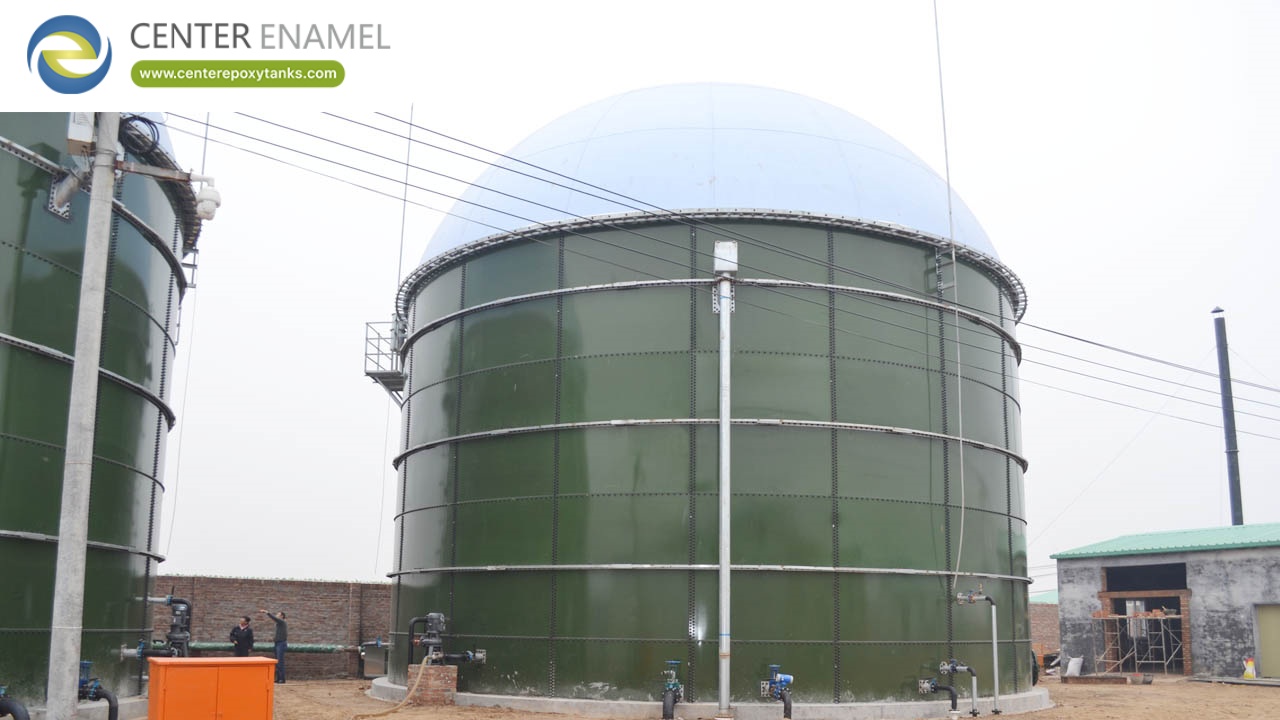
Center Enamel Single Membrane Roofs: Ideal Biogas Storage Tank Covers
As the global shift toward renewable energy accelerates, anaerobic digestion (AD) facilities, wastewater treatment plants, and agricultural biogas projects face rising demands for high-efficiency, reliable gas containment infrastructure. Biogas collection and odor control require specialized engineering to prevent gas leakage, resist corrosive hydrogen sulfide environments, and withstand variable climatic stressors.
To fulfill these exact operational needs, Shijiazhuang Zhengzhong Technology Co., Ltd (Center Enamel) provides advanced single membrane roofs engineered specifically as high-performance biogas storage tank covers. Combining structural simplicity, cost-effectiveness, and superior weather resistance, Center Enamel's single membrane solutions deliver dependable airtight sealing for modern fermentation tanks.
Engineering Principles of Single Membrane Biogas Covers
Center Enamel's single-layer membrane roofs are constructed from heavy-duty, reinforced polyester fabrics coated on both sides with specialized synthetic polymers (such as PVC or specialized specialized elastomer blends) designed to minimize gas permeability and maximize chemical resistance.
Airtight Sealing & Odor Control: The membrane panels are 100% high-frequency welded to form an absolute gas-tight barrier, trapping methane and other biogas components safely while eliminating fugitive odor emissions.
Tensioned Structural Design: Utilizing a streamlined configuration supported by a central column or specialized tensioning geometry, single membrane roofs distribute environmental loads evenly without requiring heavy internal metal support beams that are susceptible to corrosive attack.
Harsh Climate Defense: The exterior synthetic coating provides exceptional ultraviolet (UV) resistance, sun resistance, and fire retardation, ensuring structural stability under heavy rain, snow loads, and high winds.
Technical Performance Matrix: Biogas Storage Roof Options
Technical Parameter | Center Enamel Single Membrane Roofs | Center Enamel Double Membrane Roofs | Traditional Fixed Metal / Concrete Roofs |
Primary Application | Cost-effective biogas collection, basic gas storage, and primary odor control | Advanced biogas storage with continuous internal pressure regulation and thermal insulation | General non-airtight storage or basic weather protection for water and wastewater |
Air-Tightness & Gas Containment | Excellent; high-frequency welded seams prevent gas leakage | Superior; dual-membrane structure maintains constant operating pressure via an outer air chamber | Poor; prone to vapor leakage and cracks unless heavily sealed and fitted with gaskets |
Capital & Initial Cost | Highly economical; provides an affordable solution without sacrificing quality | Higher initial investment due to dual-layer architecture, blowers, and control instrumentation | High labor and material cost, especially for cast-in-place concrete or heavy steel welding |
Installation Speed | Rapid; lightweight modular materials allow for fast, efficient on-site erection | Fast, but requires additional blower and control system calibration on-site | Extremely slow; requires extensive civil work, formwork, or heavy crane lifts |
Corrosion Resistance | Superior; synthetic fabric is completely inert to moisture and corrosive biogas elements | Superior; high-grade anti-corrosion outer and inner membranes | Prone to severe internal oxidation and pitting from hydrogen sulfide (H2S) attack |
Key Advantages for Biogas and Wastewater Facilities
1. Exceptional Cost-Effectiveness
For projects requiring reliable biogas collection without the complex pressure-regulation systems of dual-layer gasholders, Center Enamel's single membrane roofs offer an ideal economic balance. They lower capital expenditure while delivering professional-grade airtightness and longevity.
2. Lightweight and Rapid Deployment
Heavy metal and concrete roofs impose heavy structural loads on tank walls and demand complex crane operations. Center Enamel's lightweight membrane covers reduce the load requirements on the underlying tank structure (whether Glass-Fused-to-Steel, stainless steel, or concrete) and streamline the installation timeline.
3. Low Maintenance and Long Service Life
Because synthetic membrane materials do not rust, flake, or degrade under typical anaerobic digester conditions, they eliminate the need for regular interior repainting or corrosion remediation, significantly cutting lifecycle operational costs.
Frequently Asked Questions (FAQ)
Q: What is a Center Enamel single membrane roof used for?
A: Center Enamel single membrane roofs are specialized, airtight tank covers designed primarily for anaerobic digestion systems, biogas collection, and odor control in wastewater treatment and agricultural applications.
Q: Are single membrane biogas covers resistant to hydrogen sulfide and UV radiation?
A: Yes. The heavy-duty reinforced polyester fabric is coated with specialized synthetic polymers that offer high resistance to UV rays, weathering, and the corrosive chemical gases typically found in biogas environments.
Q: Can single membrane roofs be installed on different types of storage tanks?
A: Yes. Center Enamel's single membrane covers are engineered to fit a wide variety of structures, including Glass-Fused-to-Steel (GFS) tanks, stainless steel bolted tanks, and concrete anaerobic fermenters.
Q: How do single membrane roofs compare to double membrane roofs?
A: Single membrane roofs feature a simple, cost-effective single-layer structure ideal for basic biogas collection and containment. Double membrane roofs incorporate an inner and outer membrane with an air-inflation system, making them suitable for projects requiring active gas storage volume and thermal insulation.


