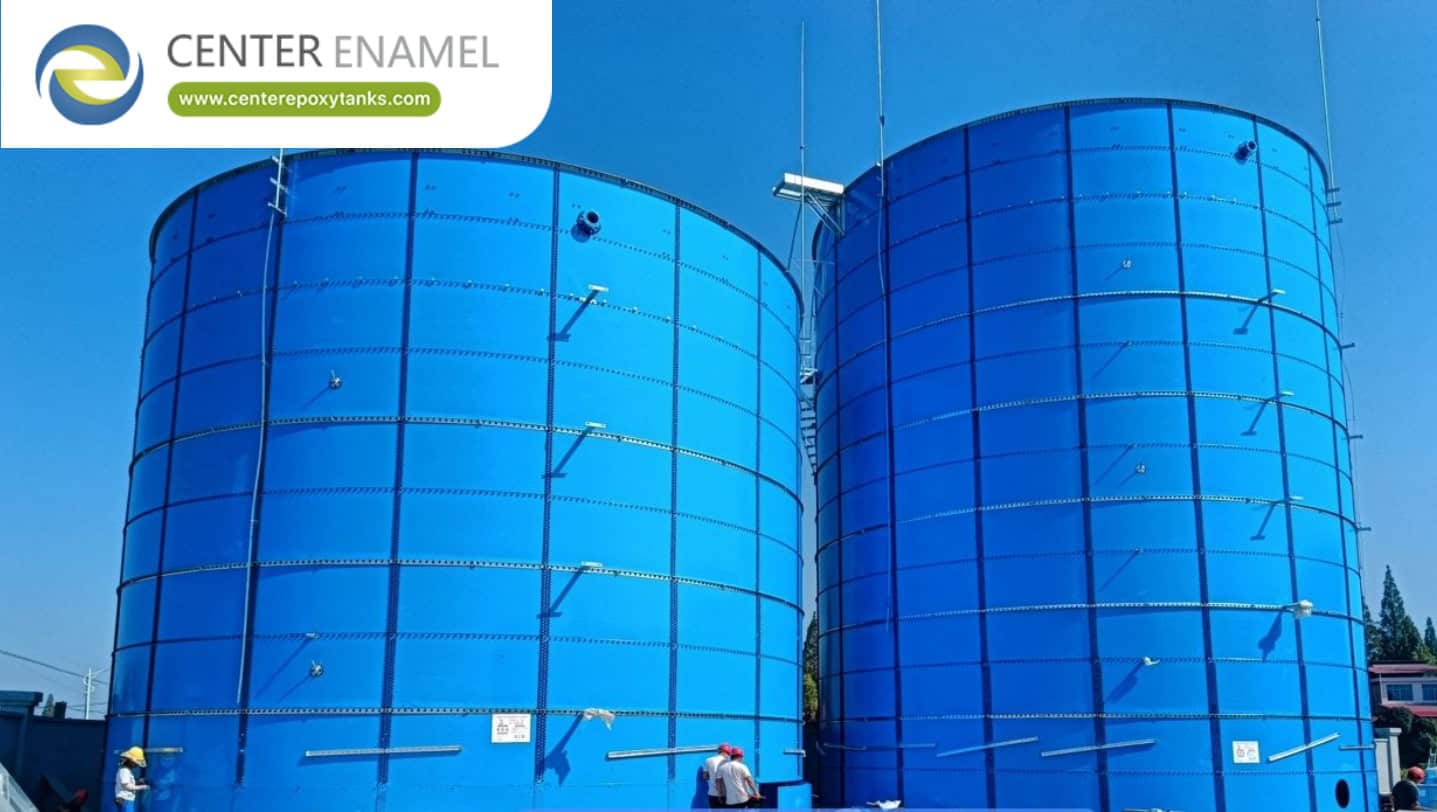
Center Enamel Provides Various Storage Tanks for Oilfield Brine Solutions
In oil and gas exploration and production operations, managing high-salinity fluids is a critical operational requirement. Oilfield brine—comprising drilling muds, completion fluids, workover fluids, and produced water—contains concentrated chlorides, dissolved salts, suspended solids, and occasional trace hydrocarbons. These aggressive fluids present severe corrosion risks to conventional carbon steel storage infrastructure.
Center Enamel—a globally recognized leader in the bolted tank manufacturing industry—provides a diverse portfolio of advanced, highly customizable storage tanks engineered specifically to withstand the punishing chemical environments of oilfield brine containment. By combining cutting-edge surface engineering with modular bolted construction, Center Enamel delivers dependable, long-lasting storage assets deployed across oil and gas fields worldwide.
Core Tank Technologies for Oilfield Brine Applications
Center Enamel provides several specialized tank solutions tailored to the specific chemical composition, volume requirements, and environmental conditions of oilfield operations:
1. Glass-Fused-to-Steel (GFS) / Enamel Tanks
Glass-Fused-to-Steel technology represents a premium corrosion-resistant solution. Manufactured by fusing molten glass to high-strength structural steel plates at temperatures between 820°C and 930°C, GFS tanks combine the mechanical strength of steel with the inert chemical resistance of glass.
Brine Resilience: The glass coating creates an impermeable, ultra-smooth surface that completely neutralizes attack from high chloride concentrations and corrosive salt solutions.
Operational Advantage: Prevents scaling, minimizes sediment buildup, and allows for quick cleaning between fluid batches.
2. Fusion Bonded Epoxy (FBE) Bolted Tanks
Center Enamel’s Fusion Bonded Epoxy tanks utilize factory-applied thermoset powder coatings that are thermally cross-linked to precision carbon steel panels.
Brine Resilience: Subjected to strict high-voltage holiday spark testing (1,100V to 1,500V) to guarantee zero pinholes, the dense polymer barrier isolates the steel substrate from corrosive brines.
Operational Advantage: Cost-effective deployment for large-capacity brine holding facilities, offering exceptional impact resistance and structural durability.
3. Stainless Steel Bolted Tanks
For ultra-corrosive brine compositions or operations requiring zero internal coatings, Center Enamel provides bolted tanks fabricated from high-grade stainless steel (such as AISI 304, 316L, or duplex grades).
Brine Resilience: The natural passive chromium oxide film on stainless steel offers intrinsic protection against aggressive chemical leaching and pitting.
Operational Advantage: Eliminates internal recoating cycles over the tank's lifecycle, ensuring maximum uptime in remote or demanding drilling locations.
Technical Performance Matrix: Brine Storage Solutions
Technical Parameter | Glass-Fused-to-Steel (GFS) Tanks | Fusion Bonded Epoxy (FBE) Tanks | Stainless Steel Bolted Tanks |
Chloride & Salt Resistance | Excellent; inorganic glass matrix is completely impervious to salt scaling and brine corrosion | Superior; cross-linked polymer barrier resists chemical penetration and blistering | Outstanding; intrinsic chromium oxide layer prevents localized pitting from heavy brine |
Internal Maintenance | Extremely low; glass-smooth surface resists biological growth and residue adhesion | Low; robust factory coating requires minimal routine inspection and upkeep | Zero internal coating maintenance required over the tank lifecycle |
Installation Velocity | Rapid modular bolted assembly; erected without heavy welding equipment | Quick modular erection using prefabricated panels and high-strength hardware | Fast on-site bolting; ideal for remote oilfield drilling sites |
Design Compliance | AWWA D103-09, ISO 28765, NSF/ANSI 61 | AWWA D103-09, ISO 9227, ASTM B117 | API 650, AWWA D103-09, ASME Section IX |
Key Advantages of Center Enamel Tanks in Oilfield Operations
1. Rapid Deployment and Modular Scalability
Oil and gas projects often require rapid mobilization in remote areas. Center Enamel's bolted tank design allows panels to be compactly shipped to site and erected quickly with minimal labor, significantly cutting project lead times. Furthermore, tanks can be easily expanded in volume or dismantled and relocated as drilling demands shift.
2. Strict Adherence to International Standards
To ensure environmental safety and prevent accidental fluid leaks, all Center Enamel storage solutions are engineered in strict compliance with globally recognized standards such as AWWA D103, API 650, and ISO 28765. This ensures structural resilience against extreme wind, seismic activity, and full hydrostatic pressure loads.
3. Comprehensive EPC and Engineering Support
Center Enamel supports global energy clients from initial engineering design and Finite Element Analysis (FEA) to precision manufacturing, export packaging, and on-site installation guidance. This integrated approach guarantees seamless project execution and long-term asset reliability.
Frequently Asked Questions (FAQ)
Q: What types of oilfield brine solutions can Center Enamel tanks store?
A: Center Enamel tanks are engineered to securely store a wide range of oilfield fluids, including drilling muds, completion brines, workover fluids, produced water, and high-salinity salt solutions generated during oil and gas extraction.
Q: Which tank material is best for highly corrosive high-chloride brines?
A: Glass-Fused-to-Steel (GFS) and 316L/Duplex Stainless Steel tanks offer exceptional resistance to high-chloride brines. GFS provides an inert glass barrier against chemical attack, while stainless steel delivers intrinsic corrosion defense without internal coatings.
Q: Are Center Enamel's oilfield storage tanks compliant with international standards?
A: Yes. Center Enamel designs and manufactures its bolted tanks in strict compliance with major global standards, including AWWA D103, API 650, ISO 28765, and ISO 9001.
Q: Can these bolted tanks be relocated if drilling operations move to a new site?
A: Yes. Because Center Enamel tanks utilize a modular bolted construction rather than permanent welded or poured-concrete structures, they can be disassembled, transported, and reinstalled at a new location.


