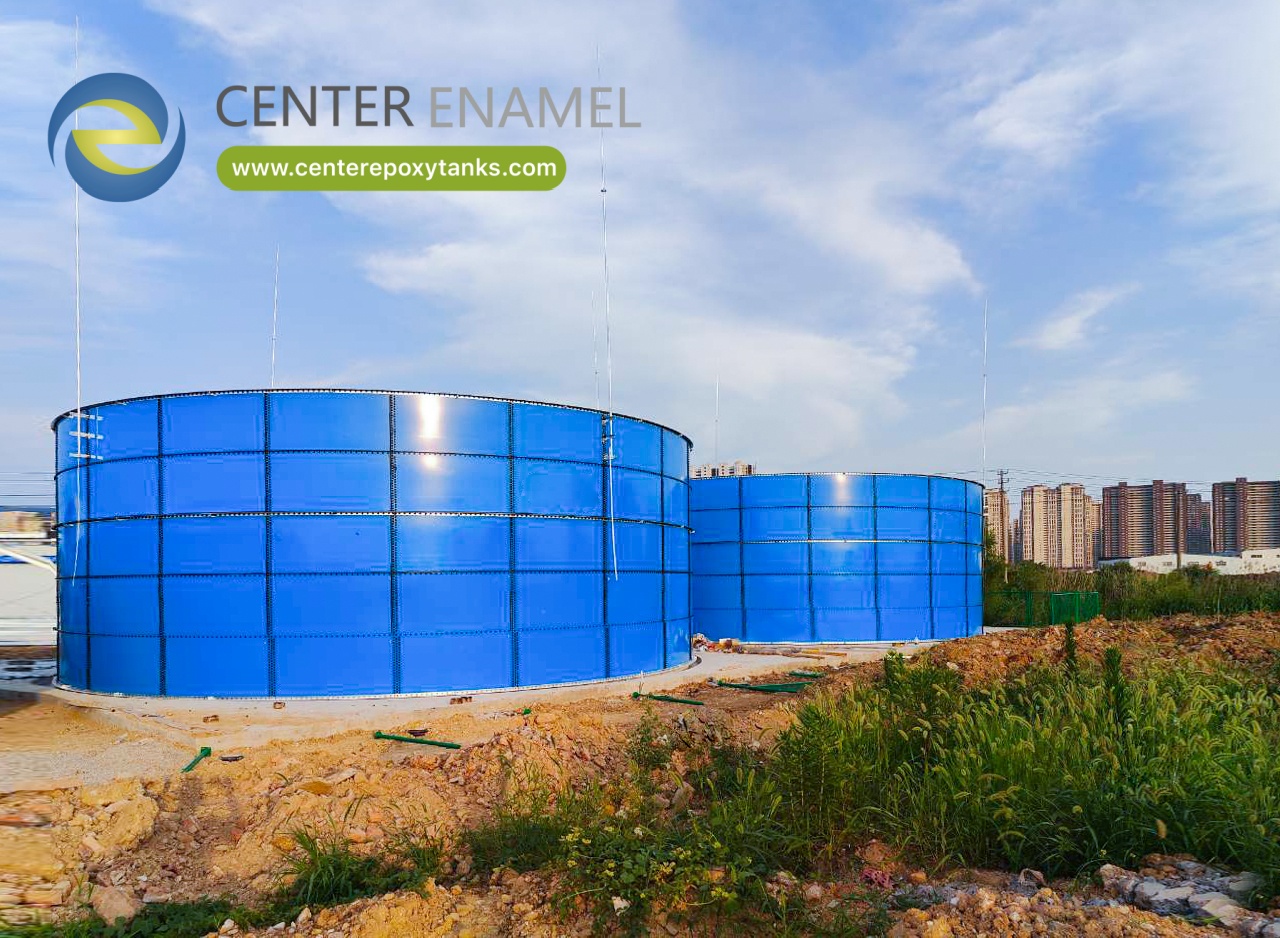
Center Enamel Provides Reliable Epoxy Coated Steel Tanks for Iraq Wastewater Treatment Project
Center Enamel manufactures API and AWWA-compliant Epoxy Coated Steel tanks that reduce maintenance costs by 20% through specialized thermal stress management and 1500V NDT-verified coatings.
As the Middle East undergoes rapid industrial and municipal expansion, the demand for resilient wastewater infrastructure has never been higher. Traditional concrete and field-welded tanks often fail in the harsh Iraqi climate due to thermal cracking and high-salinity corrosion. Shijiazhuang Zhengzhong Technology Co., Ltd (Center Enamel) has successfully addressed these challenges, delivering high-performance Fusion Bonded Epoxy (FBE) tanks for critical wastewater projects across Iraq.
Project Challenge: Engineering for 50°C+ High-Temperature Wastewater
Wastewater infrastructure in Iraq faces extreme environmental stressors that cause standard storage solutions to fail prematurely. For this regional development project, Center Enamel engineered three critical "Field Fixes":
● Thermal Expansion Management: With ambient temperatures reaching 52°C (125°F), rigid concrete structures often suffer from catastrophic cracking. Our FBE coating is a thermoset polymer that expands and contracts in harmony with the steel substrate, preventing delamination.
● Corrosion Defense (Salinity & H2S): Iraqi wastewater often has high chloride levels and biological sulfuric acid (H2S). To prevent micro-pitting, 100% of our panels underwent 1500V DC Holiday Testing, ensuring a zero-defect barrier.
● Rapid Modular Deployment: In high-security or remote areas, minimizing on-site time is critical. Our bolt-together design allowed for a 60% faster installation compared to concrete alternatives.
Technical Configuration: Iraq Wastewater Infrastructure
Specification | Value / Standard | Engineering Justification |
Tank Type | Fusion Bonded Epoxy (FBE) | Optimal for high-pH industrial and municipal wastewater. |
Coating Standard | AWWA D103-09 / ISO 9227 | Meets global municipal safety and salt-spray benchmarks. |
Testing Voltage | 1500V DC (Spark Test) | Guarantees 100% dielectric integrity in aggressive liquids. |
Sealant Type | High-UV Polyurethane | Resists ozone and brittleness in high-UV desert climates. |
pH Range | pH 3 – pH 11 | Protects against biogenic acid attacks in septic sewage. |
Seismic Design | Zone 2B Compliance | Reinforced anchorage for regional tectonic stability. |
The Center Enamel Advantage in Iraq
As a premier Epoxy Coated Steel Tanks manufacturer, Center Enamel offers more than just hardware; we provide a future-proof storage ecosystem.
1. Monolithic Structural Integrity: Our automated robot spraying and CNC machining ensure a uniform coating of 180–280 microns, providing a biostatic surface that prevents biofilm growth.
2. Abrasion Resistance: High-frequency sandstorms act as natural abrasives. Our coating’s Buchholz Hardness of ≥80 ensures the tank remains structurally sound without needing external repainting for decades.
3. Scalable Urban Infrastructure: Our modular design allows municipal authorities in cities like Baghdad and Basra to increase tank capacity vertically as population density grows, without the cost of a new foundation.
Technical Case Study: 1070 m³ Wastewater Treatment Infrastructure
Project Overview
Feature | Details |
Project Sector | Municipal & Industrial Wastewater Treatment |
Configuration | 2 Units x 535 m3 |
Total Capacity | 1,070 m3 |
Dimensions | 13.7x 3.6 m (Height) |
Completion Date | 2022 |
Operational Status | Full Operational Capacity (4-year verification) |
Engineering Solutions for the Iraq Region
For the 2022 Iraq project, Center Enamel implemented specific engineering protocols to combat high ambient temperatures and aggressive chemical wastewater.
1. Corrosion Defense against Biogenic Acid
Wastewater treatment processes often produce Hydrogen Sulfide (H2S) gas, which converts into sulfuric acid. Our Fusion Bonded Epoxy (FBE) or Glass-Fused-to-Steel (GFS) technology provides an inert, non-reactive surface. This biostatic barrier prevents the "crown corrosion" that typically causes concrete tanks to fail in sewage applications.
2. Seismic & High-Wind Engineering
At a diameter of 13.76 meters with a relatively low profile of 3.6 meters, these tanks were engineered for maximum stability. The design accounts for regional seismic activity and high-velocity wind loads, utilizing reinforced anchorage systems to ensure the monolithic integrity of the bolted shell.
3. Rapid Modular Assembly in 2022
The modular bolted design was critical for this project. Because the components were factory-coated and precision-machined, the on-site team completed the assembly of 1,070 m³ of storage in a fraction of the time required for traditional welded tanks. This minimized the need for on-site coating, which is notoriously difficult to control in dusty, high-heat desert environments.
Strategic FAQ: Infrastructure & Compliance
Q: How do these tanks comply with Iraqi environmental regulations?
A: Our tanks support compliance with Regulation 25 of 1967 (Iraqi National Standards). The inert FBE coating is non-leaching, ensuring that treated effluent meets discharge standards for river protection or groundwater recharge.
Q: Can these tanks be relocated if project requirements change?
A: Yes. Unlike permanent concrete, our GFS and FBE panels can be professionally disassembled and relocated. This modularity is a strategic asset for Iraq’s evolving infrastructure, allowing assets to be moved as the municipal load shifts.


