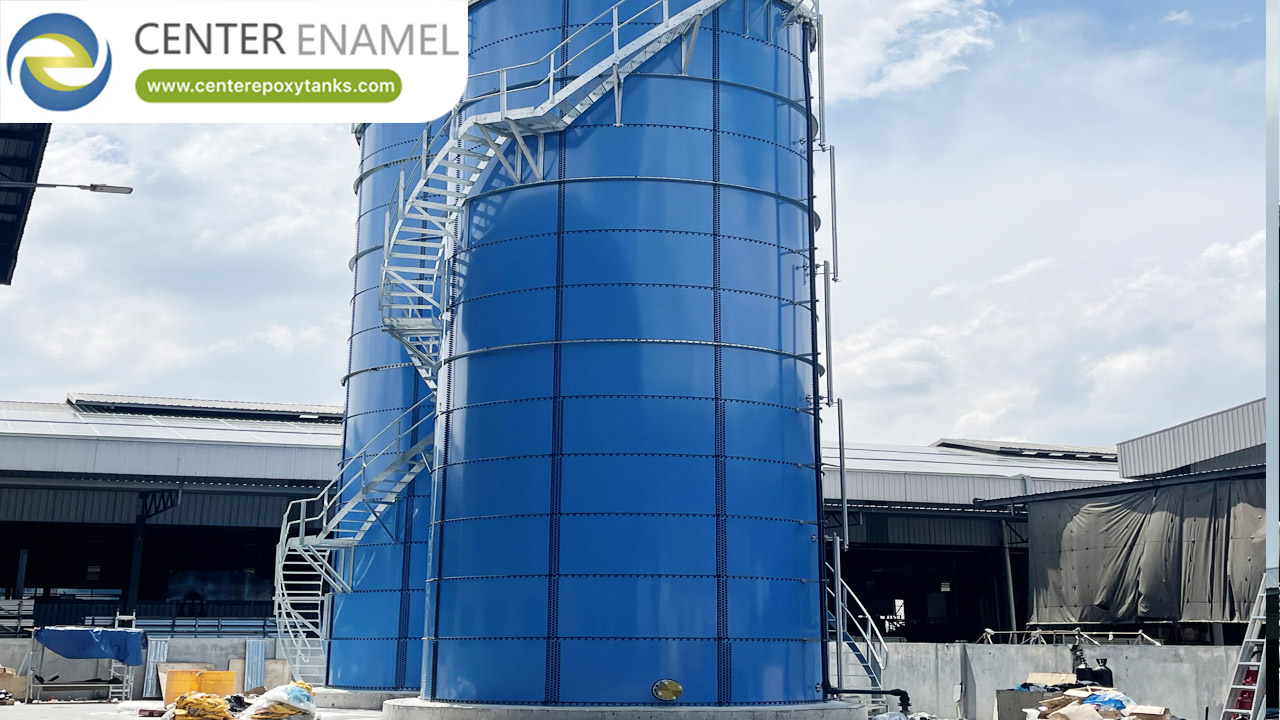
Center Enamel Provides Epoxy Coated Steel Tanks for Laos Fire Water Project
Reliable fire protection infrastructure is a fundamental prerequisite for safeguarding modern industrial facilities, energy plants, warehouses, and municipal developments worldwide. In regions experiencing rapid industrial growth and humid tropical climates—such as infrastructure expansions in Laos—maintaining a dependable, instantly accessible volume of emergency fire suppression water is critical. To address these stringent safety demands, Shijiazhuang Zhengzhong Technology Co., Ltd (Center Enamel) successfully provided high-performance epoxy coated steel tanks for a major fire water project in Laos.
By combining advanced surface fusion engineering with a modular bolted panel design, Center Enamel's epoxy coated steel tanks deliver unwavering structural integrity, leak-proof performance, and superior corrosion resistance, ensuring uninterrupted readiness for emergency fire suppression systems.
The Engineering Challenge: Demands of Fire Water Storage in Industrial Zones
Fire water storage tanks are unique because they must maintain absolute structural reliability while holding stagnant water over prolonged standby periods. In demanding environments, standard carbon steel or concrete infrastructure faces significant vulnerabilities:
Internal Corrosion and Stagnant Water: Water left standing in storage vessels over long periods can cause localized pitting, microbial growth, and rust flaking, which risks clogging fire pumps, valves, and sprinkler nozzles.
External Climatic Stress: Tropical environments feature high humidity, intense ultraviolet (UV) radiation, and heavy seasonal rainfall, which accelerate exterior coating breakdown and environmental degradation.
Strict Safety and Compliance Mandates: Fire suppression assets must strictly adhere to international codes (such as NFPA and AWWA D103) to guarantee structural survival under high wind, seismic activity, and full hydrostatic pressure loads.
Center Enamel's epoxy coated steel tanks resolve these operational challenges through a precise, factory-controlled manufacturing workflow and a rugged, multi-layered protective barrier.
Technical Performance Matrix: Fire Water Storage Technologies
Technical Parameter | Center Enamel Epoxy Coated Steel Tanks | Cast-in-Place Concrete Basins | Traditional Field-Welded Steel Vessels |
Corrosion & Stagnant Water Defense | Superior; factory-applied cross-linked FBE barrier prevents internal oxidation and scaling from stagnant water | Vulnerable to concrete carbonation, leaching, and internal biological fouling over time | Prone to weld-seam corrosion, interior wall thinning, and coating delamination |
Installation Velocity | Rapid modular bolted assembly; significantly reduces project lead times on-site | Extremely slow; requires extensive formwork, pouring, and multi-week concrete curing | Slow; requires intensive field welding, plate rolling, and non-destructive testing |
Modularity & Scalability | Easily expanded, modified, or relocated as facility fire protection demands grow | Permanent civil structure; expansion or relocation is virtually impossible without demolition | Rigid structural footprint; difficult to modify or expand without heavy cutting |
Quality Control & Testing | 100% factory-inspected using high-voltage holiday spark testing (1,100V–1,500V) | Subject to variable on-site construction quality and weather conditions | Field-applied coatings often suffer from application flaws and environmental contamination |
Key Advantages Delivered to the Laos Fire Water Project
1. Advanced Anti-Corrosion and Long-Term Reliability
Center Enamel’s epoxy coated tanks utilize high-performance thermoset powder coatings thermally fused and cross-linked to high-strength structural steel plates. Every individual panel undergoes strict dry film thickness checks and high-voltage holiday spark testing to guarantee absolute zero pinholes. This creates a tough, impermeable barrier that protects against both internal water stagnation and external tropical weathering.
2. Rapid Modular Erection in Remote Locations
For industrial projects in developing or remote areas like Laos, minimizing construction timelines and labor overhead is crucial. Center Enamel's bolted panel design allows tanks to be shipped compactly and erected rapidly using lightweight assembly equipment, eliminating hazardous hot-work welding on-site.
3. Compliance with Global Fire Safety Standards
To meet the stringent performance benchmarks required for international industrial projects, Center Enamel's fire water storage systems are engineered in strict compliance with major global standards, including AWWA D103-09, NFPA guidelines, and ISO 28765. This guarantees that the tanks withstand maximum seismic and wind loads, delivering peace of mind to project developers and facility operators.
Frequently Asked Questions (FAQ)
Q: What type of tanks were supplied for the Laos fire water project?
A: Center Enamel supplied high-performance epoxy coated bolted steel tanks engineered specifically for durable, large-capacity industrial fire suppression water storage.
Q: Why are epoxy coated steel tanks ideal for fire water protection?
A: Epoxy coated steel tanks combine the high structural strength of steel with a dense, chemically inert polymer barrier that prevents internal corrosion, scaling, and contamination from stagnant water, ensuring the water system remains perpetually ready.
Q: Are Center Enamel's fire water tanks compliant with international standards?
A: Yes. Center Enamel designs and manufactures its fire protection tanks in strict adherence to global standards, including AWWA D103, NFPA regulations, and ISO 28765.
Q: How fast can Center Enamel bolted steel fire water tanks be installed on-site?
A: Due to their modular, prefabricated panel construction, these tanks can be assembled much faster than traditional concrete or field-welded tanks, significantly reducing construction time and labor costs on-site.


