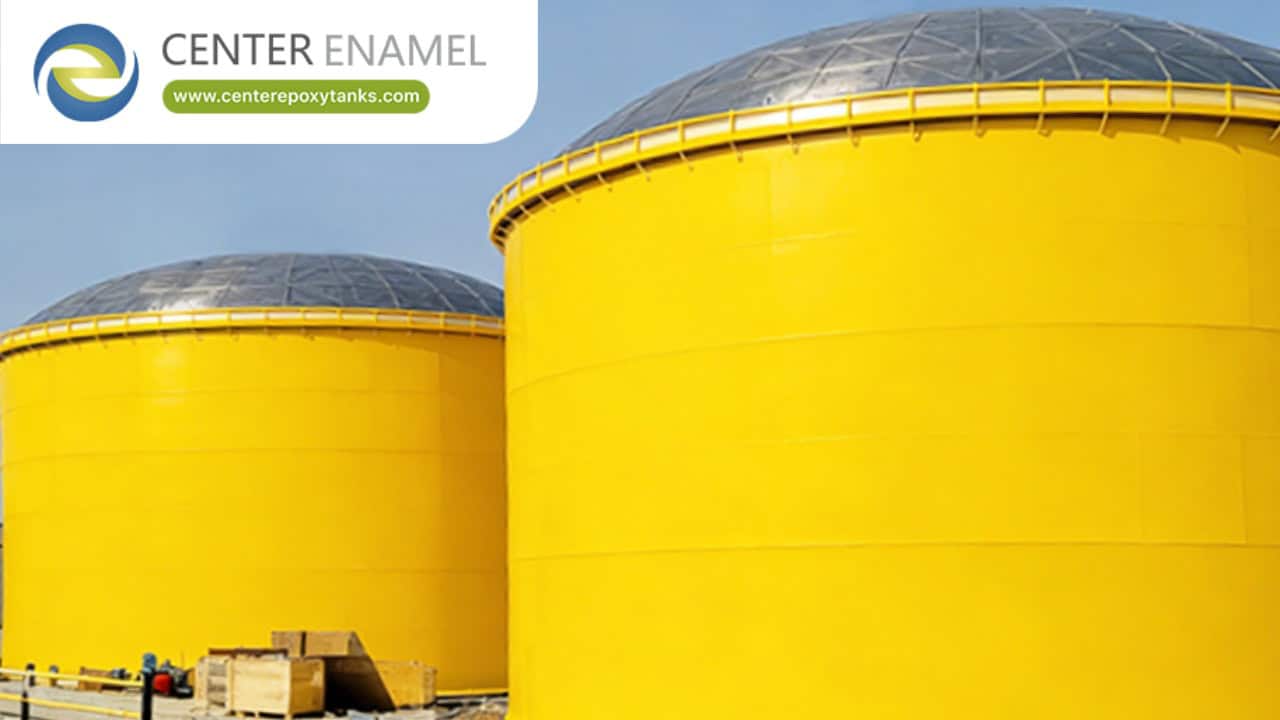
Center Enamel Provides Epoxy Coated Fuel Storage Tanks for the Petroleum Industry: Engineering Safety, Hydrocarbon Durability, and Precision Containment
In the global oil and gas sector—spanning upstream extraction facilities, midstream distribution terminals, and downstream retail fuel depots—maintaining the absolute purity and secure containment of refined petroleum products is vital. Storing volatile fuels such as diesel, gasoline, kerosene, aviation fuel, and heating oil demands storage infrastructure capable of resisting internal vapor corrosion, preventing environmental leakage, and maintaining structural integrity under extreme operational loads.
As a globally recognized leader in advanced industrial containment, Shijiazhuang Zhengzhong Technology Co., Ltd. (Center Enamel) delivers premier epoxy coated fuel storage tanks tailored specifically for the petroleum industry. Combining the high tensile strength of industrial-grade steel with state-of-the-art fusion-bonded epoxy (FBE) and specialized polymer coating technologies, Center Enamel provides secure, long-lasting storage assets that comply with stringent international standards.
Technical Excellence: Advanced Coating and Manufacturing Standards
The exceptional performance of Center Enamel's epoxy-coated petroleum tanks stems from rigorous, factory-controlled manufacturing and coating protocols that eliminate field application variables:
Precision Substrate Preparation: High-tensile steel plates undergo automated abrasive grit-blasting (meeting standards such as SSPC-SP 10 / Sa 2.5) to achieve a uniform micro-anchor profile, maximizing mechanical adhesion between the steel substrate and the epoxy coating.
Electrostatic Powder Deposition & Thermal Curing: Specialized epoxy resin powders are electrostatically sprayed and thermally cured in high-temperature ovens (around 200°C), triggering a permanent thermoset cross-linking reaction that fuses the coating to the steel.
Strict Quality Assurance & Holiday Testing: Every coated panel undergoes rigorous dry film thickness verification and high-voltage holiday testing (exceeding 1500V standards) to guarantee a 100% pinhole-free surface, protecting against corrosive fuel components and moisture.
Compliance with Global Petroleum Codes: Center Enamel designs and manufactures its containment systems in strict accordance with major global benchmarks, ensuring safety and reliability across diverse climatic and geopolitical operating environments.
Data Table: Comprehensive Comparison of Fuel Storage Tank Technologies
Technical Parameter | Center Enamel Epoxy-Coated Bolted Tanks | Traditional Field-Welded Carbon Steel Tanks | Cast-in-Place Concrete Petroleum Basins |
Hydrocarbon & Chemical Resistance | Superior; inert thermoset epoxy matrix completely resists refined fuels, diesel, and additives | Moderate; vulnerable to internal vapor oxidation and fuel-water interface corrosion | Poor; prone to concrete carbonation, acid attack, and petroleum seepage |
Installation Speed & Rigging | Rapid modular bolted panel assembly completed in weeks with minimal heavy equipment | Slow field erection requiring extensive on-site welding, plate fitting, and manual painting | Lengthy civil construction requiring weeks of framing, pouring, and curing |
Coating Quality Control | Factory-controlled thermal curing and 1500V holiday testing ensure zero defects | Variable; field-applied paints are susceptible to ambient humidity and human application error | Difficult to line effectively against long-term hydrocarbon saturation |
Volumetric Scalability & Relocation | High; modular design allows future capacity expansion or complete relocation | Permanent structure; expanding capacity requires complex field cutting and welding | Permanent monolithic structure; impossible to scale without total reconstruction |
Frequently Asked Questions (FAQ)
Q: What types of petroleum products can be stored in Center Enamel’s epoxy-coated fuel tanks?
A: They are engineered for safely storing a wide range of refined petroleum products, including diesel fuel, heating oil, kerosene, aviation fuel, and various industrial hydrocarbon process liquids.
Q: How does the fusion-bonded epoxy coating protect fuel storage tanks from corrosion?
A: The factory-applied thermoset epoxy coating forms a dense, chemically inert, non-porous barrier that completely seals the carbon steel substrate away from fuel moisture, sulfur compounds, and microbial growth, preventing internal rust and pitting.
Q: Can Center Enamel’s epoxy-coated fuel tanks be installed in remote or restricted petroleum terminals?
A: Yes. The modular bolted design allows all panels and components to be efficiently transported to remote sites and assembled rapidly using lightweight equipment, significantly reducing construction time compared to welded tanks.
Q: What international standards do Center Enamel’s petroleum storage tanks comply with?
A: Center Enamel's engineering, manufacturing, and quality control processes comply with major international codes, including API 650, API 12F, ISO 28765, and ISO 9001 quality management frameworks.


