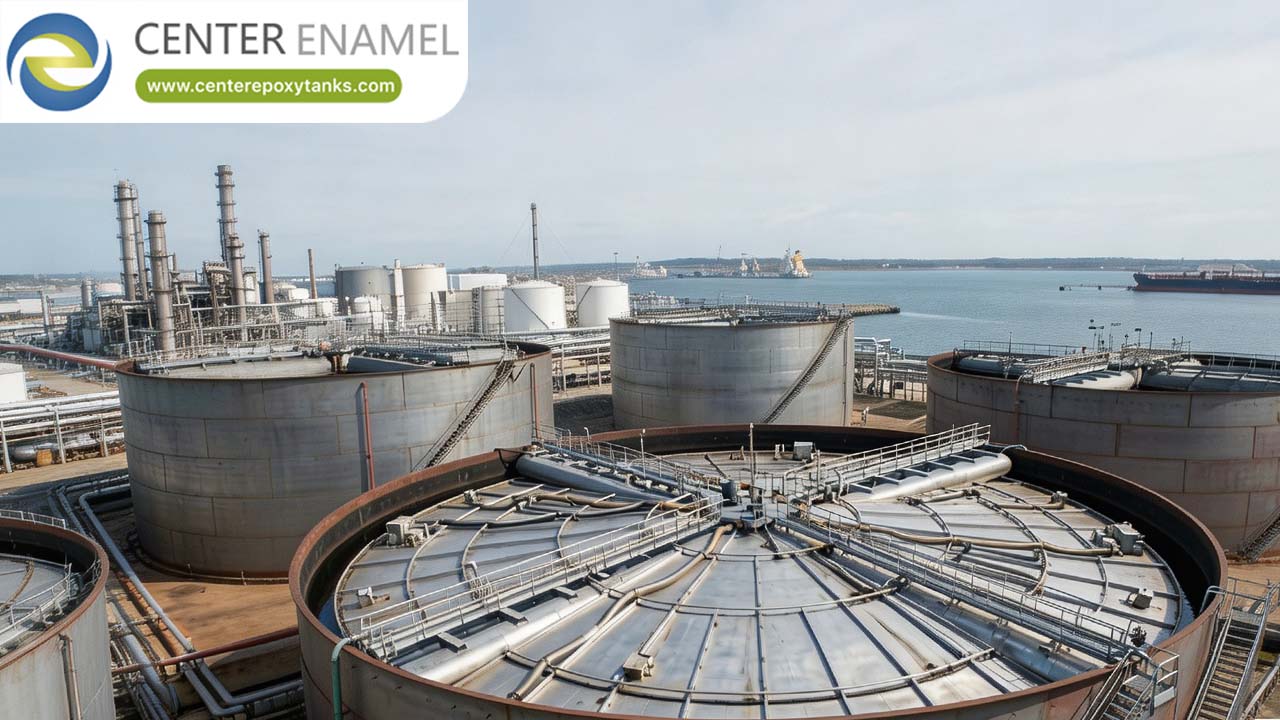
Center Enamel Provides Advanced Floating Roof Systems for Oil Tanks: Engineering Safety and Emission Control
In the high-stakes sectors of petroleum refining, crude oil transshipment, and strategic fuel reserve management, containment infrastructure must balance massive storage capacity with absolute environmental safety. Storing volatile petroleum products—such as crude oil, gasoline, aviation fuel, and volatile petrochemical solvents—presents a continuous engineering challenge: mitigating evaporative losses and preventing hazardous vapor accumulation.
When volatile organic compounds (VOCs) escape into the atmosphere, facilities face severe economic product loss, environmental penalties, and strict regulatory crackdowns. To address these challenges, global energy companies and engineering procurement construction (EPC) firms rely on cutting-edge containment upgrades. As a premier global leader in storage technology, Shijiazhuang Zhengzhong Technology Co., Ltd. (Center Enamel) provides advanced floating roof systems for oil tanks, establishing the benchmark for environmental compliance, structural buoyancy, and vapor retention across more than 95 countries.
Core Engineering and API 650 Appendix H Compliance
Center Enamel’s floating roof systems—encompassing both high-performance Internal Floating Roofs (IFRs) and External Floating Roofs (EFRs)—are engineered to meet the most rigorous international standards:
API 650 Appendix H Engineering Excellence: Designed in strict compliance with API 650 Appendix H, Center Enamel’s floating roofs ensure optimal structural integrity under complex internal hydrostatic loads, seismic shifts, and dynamic liquid fluctuations.
Advanced High-Strength Metallurgy: Fabricated using corrosion-resistant aluminum alloys (such as AA 6061-T6) or high-grade stainless steel (AISI 316L), these roofs combine lightweight buoyancy with exceptional durability, preventing galvanic corrosion and ensuring a 30+ year service life.
Achieving 99% VOC Emission Reduction: By floating directly on the liquid surface, Center Enamel’s full-contact and pontoon-type roofs eliminate the headspace (ullage) where explosive vapors accumulate, successfully cutting fugitive emissions by up to 99% and supporting rigorous ESG and BACT (Best Available Control Technology) reporting.
High-Performance Sealing Systems: Equipped with engineered mechanical shoe seals and secondary wiper gaskets, the systems maintain a tight, continuous, airtight interface against the tank shell even during thermal expansion or seismic activity.
Technical Performance Matrix: Floating Roof Solutions
Technical Parameter | Center Enamel Advanced Floating Roofs | Traditional Heavy Steel Pontoon Roofs | Legacy Fixed-Roof Tanks (No Internal Deck) |
Vapor Loss & VOC Mitigation | Virtually eliminates ullage; achieves up to 99% fugitive emission reduction | Moderate reduction, but prone to vapor leakage around complex deck fittings | High evaporation rates; continuous loss of volatile petroleum fractions |
Material Composition & Weight | Lightweight AA 6061-T6 aluminum or 316L stainless steel; reduces dead load | Heavy carbon steel construction requiring extensive structural pontoon framing | Structural carbon steel fixed roof with open vapor headspace below |
Installation & Retrofit Logic | Modular, bolt-together design passes through standard manways for rapid retrofitting | Heavy field welding required; complex and time-consuming on-site assembly | Monolithic fixed structure; difficult and hazardous to modify on-site |
Fire Safety & NFPA 11 Compliance | Minimizes flammable vapor concentrations, reducing rim-fire and explosion risks | Standard fire risk management; requires extensive foam dam infrastructure | High explosion risk due to accumulated volatile gas pockets in headspace |
The Ultimate Synergy: Aluminum Dome Roofs + Internal Floating Roofs
For maximum asset protection, Center Enamel pioneered the dual-protection concept: pairing its Internal Floating Roofs (IFRs) with high-strength Aluminum Geodesic Dome Roofs.
Weather Isolation: The external aluminum dome completely shields the internal floating roof from heavy rainfall, snow loads, and wind-induced torque, eliminating the need for complex internal drainage systems (such as rolling ladders and swivel drains).
Total Environmental Control: This combination creates a closed, weather-tight, and vapor-tight environment that guarantees maximum product retention, pristine fuel purity (critical for aviation fuels and strategic reserves), and minimal operational maintenance overhead over decades of continuous service.
Frequently Asked Questions (FAQ)
Q: What makes Center Enamel's floating roof systems ideal for oil storage tanks?
A: Center Enamel integrates over 30 years of manufacturing expertise with strict adherence to API 650 Appendix H standards. Our floating roofs utilize high-strength aluminum and stainless steel alloys, advanced mechanical shoe seals, and compartmentalized buoyancy designs that maximize vapor retention and ensure structural safety.
Q: How do floating roof systems reduce environmental emissions and product loss?
A: By floating directly on the surface of stored volatile liquids, our internal and external floating roofs eliminate the vapor headspace (ullage) inside the tank. This prevents volatile organic compounds (VOCs) from evaporating and escaping into the atmosphere, achieving up to 99% emission reduction and protecting valuable fuel products.
Q: Can Center Enamel's internal floating roofs be retrofitted into existing fixed-roof oil tanks?
A: Yes. Center Enamel’s modular, bolt-together floating roof components are specifically engineered for easy entry through standard tank manways (600mm or larger). This allows facility operators to upgrade existing fixed-roof tanks into high-efficiency floating roof systems without hazardous on-site hot work or removing the primary roof structure.
Q: How do these floating roofs handle fire safety regulations?
A: Our floating roof systems comply strictly with NFPA 11 guidelines. By maintaining a continuous, near-zero vapor space, the roof minimizes the concentration of flammable gas mixtures, significantly lowering explosion hazards and making rim-fire suppression systems far more effective.


