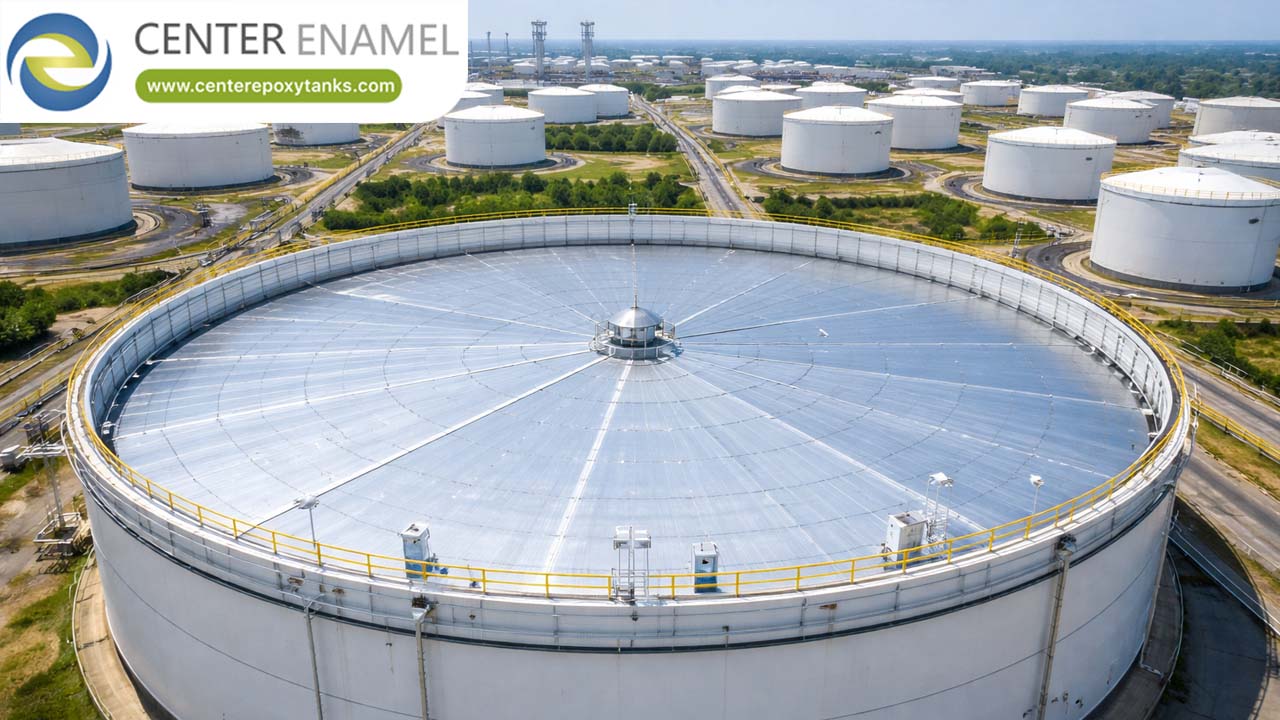
Center Enamel Floating Roofs for Vietnam Liquid Storage Tanks: Engineering Guide
As Vietnam undergoes rapid industrialization in the chemical and petroleum sectors, stringent environmental regulations regarding Volatile Organic Compound (VOC) emissions are becoming a critical compliance barrier. Center Enamel has established itself as a leading provider of aluminum internal floating roofs (IFRs) tailored for the humid, coastal operating environments common in Vietnam. These roofs are essential for modernizing liquid storage tanks, ensuring safety, and maximizing environmental sustainability.
1. The Engineering Imperative: Why Floating Roofs?
Liquid storage tanks—especially those containing gasoline, crude oil, or volatile chemicals—are prone to significant product loss due to evaporation. An Internal Floating Roof (IFR) is a critical engineered solution that rests on the surface of the liquid, physically separating the product from the vapor space.
VOC Emission Mitigation
The primary function of the floating roof is to minimize the vapor space. By reducing this space, you directly decrease the product loss ($L$) according to vapor pressure dynamics:
Center Enamel’s aluminum floating roofs are designed to achieve 99%+ efficiency in blocking VOC emissions, crucial for meeting the environmental standards increasingly enforced by Vietnam's industrial zones.
2. Technical Advantages: The Center Enamel Difference
Vietnam’s geography presents unique challenges, including high humidity and salinity in coastal industrial zones (like those in Hai Phong or Vung Tau). Center Enamel utilizes high-grade aluminum alloys that outperform traditional steel floating roofs.
Key Technical Specs
● Material Composition: Utilizing high-strength, corrosion-resistant aluminum alloys (Series 3000/5000) that provide an excellent strength-to-weight ratio.
● Modular Design: The roofs are engineered for "knock-down" shipping and assembly, which significantly lowers logistics costs for Vietnamese inland or remote coastal projects.
● Seal Technology: Advanced rim seals (wiper seals or primary/secondary foam seals) designed to maintain constant contact with the tank wall, accommodating the slight out-of-roundness inherent in field-erected tanks.
Performance Comparison Matrix
Feature | Center Enamel Aluminum IFR | Traditional Steel IFR |
Corrosion Resistance | High (Ideal for coastal Vietnam) | Low (Requires heavy coating) |
Dead Weight | Low (Minimal load on tank) | High (Structural stress) |
Installation Time | Fast (Modular Bolted) | Slow (Field Welding) |
VOC Efficiency | 99% | 90-95% |
Maintenance | Low (No painting required) | High (Periodic maintenance) |
3. Procurement & Installation in Vietnam
Procuring infrastructure from international suppliers requires careful navigation of both international codes (API) and local Vietnam standards (TCVN).
Vetting Checklist for Vietnamese Projects
1. API 650 Compliance: Ensure the design specifications meet Appendix H of API 650 (Internal Floating Roofs).
2. Seismic Resilience: Given Vietnam's seismic zoning in certain regions, verify that the roof design accounts for tank shell sloshing and potential lateral movement.
3. Local Logistics: Center Enamel roofs are modular, which is ideal for containerized shipping to Vietnam. Ensure the manufacturer provides detailed, translated assembly manuals for local site crews.
4. Third-Party Inspection: For critical chemical storage, mandate a pre-shipment inspection (e.g., by Bureau Veritas or SGS) to verify material mill certificates (MTRs) before the roof components arrive at the Vietnamese port.
Frequently Asked Questions (FAQ)
Q: Are these roofs compatible with existing steel tanks?
A: Yes. Center Enamel floating roofs are engineered to be retrofitted into existing API 650 or TCVN-compliant tanks. The design accounts for variations in shell diameter and potential shell out-of-roundness.
Q: How do they handle the high humidity in Vietnam?
A: Aluminum is naturally resistant to the oxidation caused by the high-humidity, high-salinity environment of Vietnam’s coastline. Unlike steel, which requires constant maintenance and painting, the aluminum surface remains stable, reducing lifecycle maintenance costs significantly.
Q: Can these roofs handle specific chemicals like ethanol-blended fuels (E5/E10)?
A: Yes, provided the seal materials (gaskets/wipers) are specified as compatible with the specific solvent properties of ethanol blends. When procuring, always disclose the liquid stored so the manufacturer can supply the correct chemical-resistant seal material.
Are you currently in the design phase for a new storage facility, or are you looking to retrofit an existing tank to improve VOC compliance and meet new environmental regulations?


