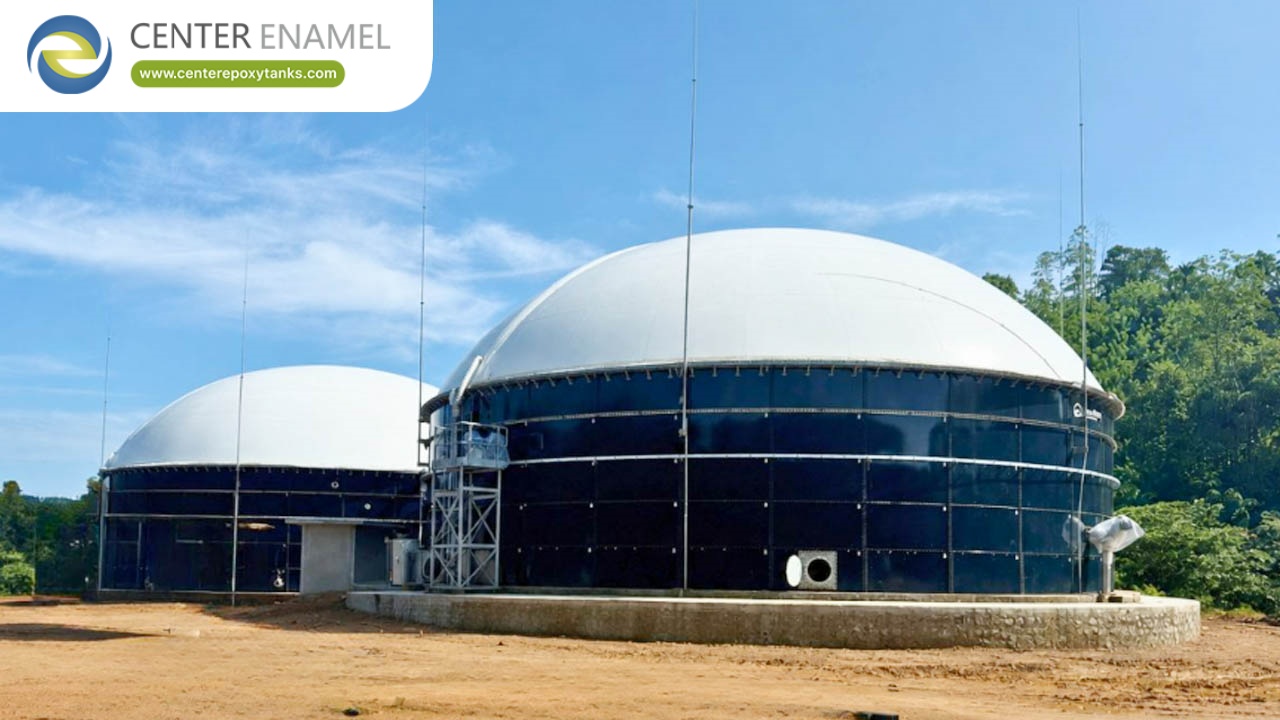
Biogas Storage Tanks with Double Membrane Roofs: Advanced Containment for Renewable Energy
As the global transition toward decarbonization and circular bioeconomies accelerates, anaerobic digestion (AD) has become a primary technology for converting agricultural waste, municipal sewage sludge, and industrial organic effluents into clean energy. Traditionally, biogas plants relied on separate structures—utilizing one tank for biological fermentation and a separate gasometer for intermediate gas storage, connected by extensive pipe networks.
Today, biogas storage tanks with double membrane roofs have revolutionized the industry. By mounting a flexible, dual-layer membrane gas holder directly onto the top of the main anaerobic digestion or post-digestion tank, these integrated systems combine biological reaction and gas buffering into a single, highly efficient containment footprint.
Structural Anatomy of Integrated Double Membrane Biogas Tanks
The structural design of a biogas storage tank with a double membrane roof requires sophisticated engineering to balance biological gas generation, internal structural pressures, and external environmental loads:
The Tank Body Foundation (GFS or Epoxy-Coated Steel): The primary liquid container is typically constructed from high-strength Glass-Fused-to-Steel (GFS) or fusion-bonded epoxy panels. This provides absolute structural stability and complete chemical immunity against corrosive liquid digestate.
The Outer Membrane (Weather & Structural Shield): Fabricated from high-tenacity polyester fabric coated with specialized PVDF (Polyvinylidene Fluoride), the outer membrane maintains constant positive air pressure via an automated blower system. It protects the inner gas bladder from extreme wind shear, UV degradation, and heavy snow loads.
The Inner Membrane (Methane Gas Retention): Suspended securely inside the outer canopy, the inner membrane expands and contracts dynamically like a "variable lung," absorbing shifts in biological gas production without inducing back-pressure on the liquid digester.
The Sealing and Clamping System: Heavy-duty aluminum or stainless steel clamping profiles, paired with specialized EPDM gas-tight sealing gaskets, lock the membrane perimeter airtight to the rim of the steel tank wall.
Technical Performance Matrix: Biogas Storage Configurations
Technical Parameter | Integrated Biogas Storage Tank with Double Membrane Roof | Separate Concrete Digester + Standalone Gas Holder | Traditional Welded Steel Tank with Fixed Roof |
Spatial Footprint & Land Use | Compact, unified footprint; highly efficient for space-constrained sites | Requires expansive acreage and extensive connecting gas pipe runs | Moderate footprint; lacks built-in gas buffering capacity |
Gas Leakage & Sealing Security | Direct tank-to-membrane seal eliminates intermediate pipe flange leaks | Multiple mechanical joints and complex piping prone to fugitive leaks | Rigid steel roofs require external gas collection bladders |
Corrosion & Chemical Defense | Superior; glass-fused-to-steel tank walls and PVDF membranes resist H2S | High risk of concrete carbonation and internal steel oxidation | Vulnerable to biogenic sulfuric acid attack without heavy coatings |
Installation Velocity & Agility | Rapid modular erection (bolted tank + prefabricated membrane dome) | Slow civil construction, formwork, and multi-week concrete curing | Labor-intensive field welding and complex rigging |
Key Advantages for Modern Biogas Facilities
1. Capital Cost and Footprint Optimization
By integrating the gas holder directly onto the top of the digestion tank, project developers eliminate the need for a separate concrete foundation slab, dedicated gasometer land area, and long runs of specialized gas piping. This significantly reduces both capital expenditure (CAPEX) and civil engineering complexity.
2. Elimination of Biogenic Corrosion Headaches
Biogas is saturated with moisture and corrosive hydrogen sulfide (H2S). Integrated systems pair GFS or epoxy-coated tank walls with chemically inert synthetic inner membranes. This ensures that every surface exposed to raw biogas is completely immune to sulfur oxidation and rust flaking.
3. Dynamic Pressure Regulation and Enhanced Safety
The continuous air-support pressure of the outer canopy ensures that the inner membrane maintains a steady, uniform delivery pressure for downstream Combined Heat and Power (CHP) engines or biogas upgrading units, preventing operational surging.
Frequently Asked Questions (FAQ)
Q: What are biogas storage tanks with double membrane roofs?
A: These are advanced industrial containment systems that combine a primary anaerobic digestion tank (such as a GFS tank) with a flexible, dual-layer membrane gas holder mounted directly on top, serving the dual purpose of liquid fermentation and gas buffering.
Q: How does the double membrane roof manage fluctuating biogas generation?
A: The inner membrane acts as a dynamic "variable lung," expanding and contracting smoothly within the protective outer air canopy to absorb peak gas production surges while maintaining stable delivery pressure for downstream generators.
Q: What materials protect the storage tank and membrane from corrosive biogas?
A: The primary tank utilizes Glass-Fused-to-Steel (GFS) or fusion-bonded epoxy to resist internal liquid acids, while the membrane roof utilizes high-tenacity polyester coated with PVDF, providing total chemical immunity against biogenic hydrogen sulfide (H2S) and moisture.
Q: Can a double membrane roof be installed on an existing anaerobic digestion tank?
A: Yes. With proper structural verification of the existing tank rim and wall load capacity, modular double membrane roofs can often be retrofitted onto existing concrete or steel digester tanks to upgrade gas storage capacity.


