

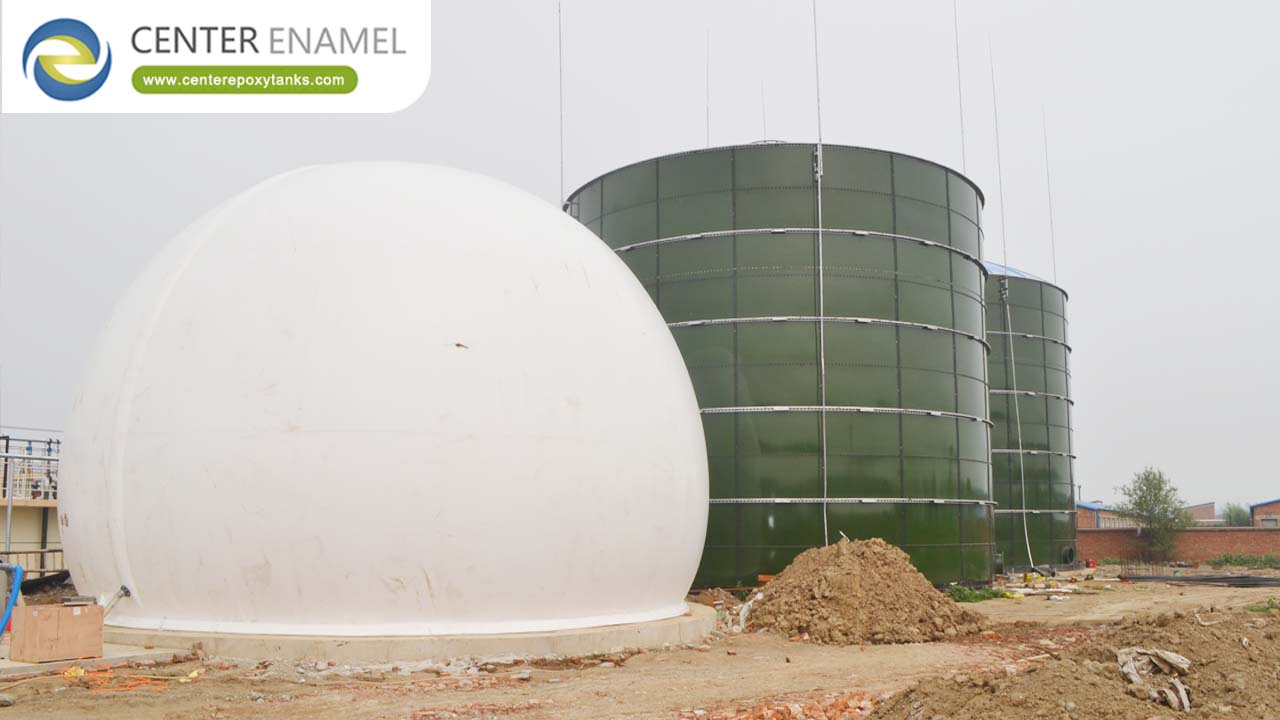
China Double Membrane Biogas Holder Manufacturer: Advanced Engineering & Storage Solutions
As a premier China double membrane biogas holder manufacturer, Center Enamel provides high-performance gas containment engineered for the global renewable energy sector. Our integrated storage systems are designed to maximize methane recovery, ensure 99.9% gas-tightness, and withstand extreme environmental loads.
Technical Engineering Summary
Metric | Specification |
Material Construction | High-tenacity polyester fabric with dual-sided PVC + PVDF coating |
Operating Pressure | 0 mbar to 20 mbar (Adjustable via blower systems) |
Safety Compliance | Flame Retardant (DIN 4102 B1), ISO 9001:2015 |
Gas Tightness | High-frequency (HF) molecular fusion welding (< 480 cm/m2 . d .bar$) |
Design Standard | AWWA D103, Eurocode (Wind & Snow Load Optimized) |
Environmental Resilience | 100% UV Stable / H2S Corrosion Immune |
Design Life | 15 – 20 Years (Minimal Maintenance) |
1. Strategic Engineering Comparison: Double Membrane vs. Steel Gas Holders
For modern Anaerobic Digestion (AD) facilities, membrane technology offers a superior Net Present Value (NPV) compared to traditional steel.
Feature | Double Membrane Gas Holder | Traditional Steel Gas Holder |
Corrosion Resistance | Immune: Inert to H2S and moisture. | Poor: High risk of acid pitting/rust. |
Operational Control | Dynamic Volume: Constant pressure feed. | Rigid: Limited pressure flexibility. |
Capital Cost | 30–50% Lower: Reduced logistics/labor. | High: Intensive material and crane costs. |
Installation | Rapid: 2–5 days total. | Slow: Weeks of welding and NDT. |
Safety | Flexible membrane absorbs seismic energy. | Brittle welds prone to fracture. |
2. Fabric Engineering & Safety Protocols
Center Enamel addresses the two primary failure points of biogas storage: Chemical Corrosion and Pressure Instability.
The PVDF Advantage
We utilize PVDF-coated polyester fabrics. Unlike standard industrial PVC, our PVDF topcoat is chemically inert, providing a barrier against the corrosive nature of H2S. This prevents the material from becoming brittle and ensures a self-cleaning surface that sheds snow and ice.
Failsafe Instrumentation
● Dual-Way Pressure Safety Valve (PVRV): Prevents structural collapse under vacuum or rupture during overpressure.
● Ultrasonic Level Sensors: Provides non-contact, real-time volume tracking for SCADA-integrated energy management.
● HF Welding: Our seams are fused at the molecular level, creating a bond stronger than the fabric itself for zero-leak performance.
3. Global Project Performance & Operational Evidence
Our engineering is proven across diverse climates, from the high seismic zones of South America to the strict environmental regulations of Singapore.
Project Location | Total Volume (m3) | Operational Impact |
Inner Mongolia | 16,760 | 15% Reduction in methane flaring via 4-unit CSTR cluster. |
Singapore Urban site | 3,458 | 99.9% Leak-Free odor control for metropolitan standards. |
Hebei Cangzhou | 3,077 | 12% Increase in biogas recovery via dynamic buffering. |
4. Technical FAQ for Renewable Energy Projects
Q: How does a double membrane biogas holder handle high wind or snow loads?
A: The outer membrane is continuously pressurized by an explosion-proof blower, creating a rigid aerodynamic shape. This structure sheds snow effectively and resists wind loads up to 120 km/h, while the PVDF coating prevents ice bonding.
Q: Can this system be integrated with existing infrastructure?
A: Absolutely. Center Enamel specialized in Integrated Storage Solutions. Our holders function as tank-top covers for Glass-Fused-to-Steel (GFS) or Epoxy Coated Tanks, functioning as both a roof and a storage vessel to minimize the project footprint.
Q: What is the maintenance requirement?
A: Extremely low. Because the material is biostatic and UV-resistant, no repainting or structural patching is required. Only periodic checks of the blower and safety valves are recommended to ensure optimal pressure.
