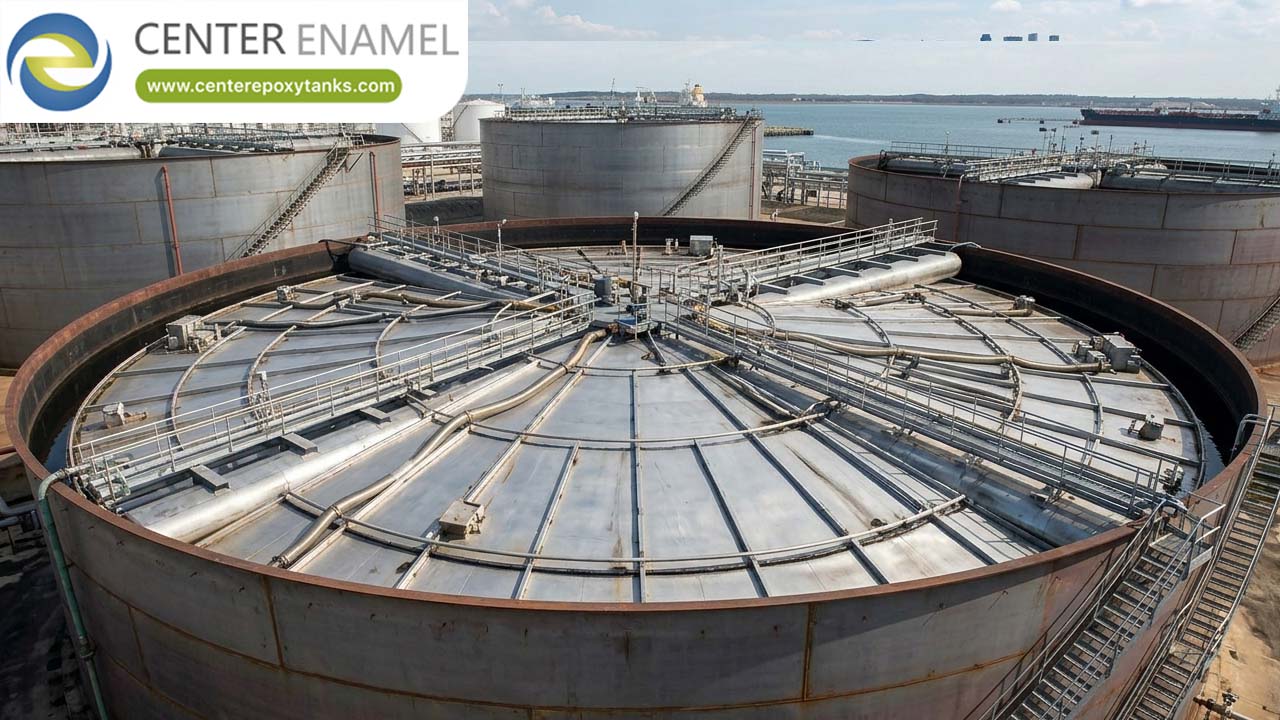
 Center Enamel Deploys High-Performance External Floating Roofs for Large-Scale Crude Oil Storage Infrastructure in Iraq
In the primary midstream hub sectors of Iraq—ranging from the massive strategic storage terminals of Basra and Al-Faw to downstream refinery hubs across the country—managing large-volume crude oil inventories requires balancing maximum storage capacity with stringent vapor control. Large-diameter open-top storage vessels (typically exceeding 40 meters in diameter) containing volatile crude oil are highly prone to massive vapor generation if left uncovered.
Unlike smaller refined product vessels that utilize internal floating blankets beneath fixed covers, massive crude oil reservoirs utilize an External Floating Roof (EFR) as the primary structural boundary.
Operating exposed to the atmosphere, an EFR floats directly on the liquid crude surface, rising and falling dynamically within the open tank shell. For international EPC contractors, state-owned oil enterprises, and terminal directors operating across Iraq, Center Enamel delivers world-class, factory-fabricated EFR engineering solutions that combine robust buoyancy safety margins with advanced weather-resistance and seal physics.
1. Vapor Thermodynamics: Suppressing Evaporative Losses at Scale
For large-diameter crude oil tanks, traditional fixed roofs are economically and structurally impractical due to the massive structural steel weight required and the immense vapor space generated. Without an EFR, an open or fixed-head space triggers extreme volatile organic compound (VOC) emissions, degrading the financial value of the crude and creating severe environmental hazards.An external floating roof alters this loop by neutralizing the liquid-air interface completely across the massive diameter.
By eliminating up to 98%+ of potential standing evaporative losses, Center Enamel EFR systems maximize product preservation, offering a rapid return on investment (ROI) for Iraqi terminal operations while strictly aligning with global environmental protection mandates.
2. Advanced Structural Typologies: Pontoon vs. Double-Deck EFRs
Center Enamel custom-tailors EFR configurations to satisfy the exact operational parameters, environmental load factors, and volumetric boundaries of Iraqi tank farms under API 650 Appendix C standards:
Pontoon External Floating Roofs
Engineered with an open center deck skin area ringed by a series of robust, closed, peripheral multi-cell pontoons.
● Engineering Advantages: The annular pontoons provide exceptional structural stability and high localized buoyancy. The center deck is designed with a calculated downward slope, allowing rainwater or ambient condensation to drain naturally to a centralized collection sump. This format provides an excellent balance of material economy and high structural safety factors for standard large-diameter applications.
Double-Deck External Floating Roofs
Consists of two continuous metal skin sheets (top and bottom decks) separated by a dense internal grid of bulkheads and structural framing, creating a multi-cell vacuum space across the entire diameter.
● Engineering Advantages: Double-deck EFRs offer maximum structural rigidity, making them highly resilient against extreme structural stresses. The dead-air space between the decks acts as a powerful thermal insulator, preventing intense solar radiation from heating the underlying crude oil, minimizing temperature-driven vapor flashing, and completely eliminating "dishing" or liquid pooling liabilities during sudden downpours.
3. Engineering for Iraq’s Severe Climate: Storm Drainage and Sand Load Dynamics
External floating roofs in Iraq operate under some of the most punishing outdoor environmental conditions in the world. Center Enamel integrates specific engineering counter-measures against these regional hazards:
● High-Capacity Roof Drainage Systems: While Iraq is generally arid, seasonal flash downpours can dump massive volumes of water onto an open EFR within hours. Center Enamel engineers heavy-duty flexible pipe joints or articulated master-drain arms that route water from the center deck screen safely through the liquid crude out of the tank base, preventing roof sinking or structural tilting.
● Abrasive Sand and Dust Load Modeling: High-velocity desert sandstorms place intense uneven weights of dust on the floating deck. Center Enamel utilizes advanced Finite Element Analysis (FEA) to simulate asymmetric sand accumulations. Structural bracing and peripheral rim bulkheads are reinforced to maintain horizontal buoyancy equilibrium even under intense wind shear and unbalanced sand loads.
4. High-Performance Rim Seals and Metallurgy
The critical boundary of an EFR is the perimeter rim gap between the floating deck and the vertical tank shell. Center Enamel utilizes specialized metallurgical selections and advanced primary/secondary seal configurations:
● Corrosion-Resistant Alloys: IFR and EFR components are fabricated using high-strength marine-grade aluminum or advanced stainless steel alloys, offering total defense against aggressive sulfur compounds (H2S) inherent in Iraqi sweet and sour crude grades.
● Primary and Secondary Seal Arrays: Center Enamel deploys a dual-containment shield. The Primary Mechanical Shoe Seal uses heavy-gauge metallic bands under spring tension to maintain constant contact along the tank shell. Positioned directly above, a Secondary Wiper Seal (fabricated from premium Viton or UV-stabilized Buna-N elastomers) scrapes away residual oil and seals any micro-gaps, providing total vapor containment and preventing desert sand from slipping down into the crude.
5. Technical Evaluation Scorecard: External Floating Roof Systems
To assist procurement managers, EPC contractors, and refinery terminal engineers during vendor qualification, this scorecard highlights the comparative performance vectors of elite EFR configurations:
Critical Engineering Parameter | Center Enamel Double-Deck EFR | Center Enamel Pontoon EFR | Conventional Low-Spec EFRs |
Structural Rigid Thickness | Maximum (Dual sheet matrix) | High (Annular rim cell core) | Low (Single layer prone to flexing) |
Thermal Insulation Performance | Superior (Blocks solar heat flash) | Moderate | Poor (Accelerates product heating) |
Asymmetric Sand Load Deflection | Excellent (High torque resistance) | High | Vulnerable to structural tilting |
Vapor Suppression Efficiency | 98.5% to 99.5%+ Suppression | 95% to 98% Vapor Blockade | Variable based on joint degradation |
Rainwater Management | Integrated heavy articulated drain | Precision center sump gravity line | Standard drain prone to clogging |
Rim Seal Integrity Architecture | Dual Shoe + Wiper Seal Array | Dual Shoe + Wiper Seal Array | Single fabric wiper seal only |
Asset Design Life | 30+ Year Verified Lifespan | 30+ Year Verified Lifespan | 10–15 years before deformation |
6. Why Center Enamel Is the Definitive Choice for Iraq's Energy Sector
Executing large-scale midstream petroleum infrastructure projects requires partnering with a manufacturer that possesses verifiable global engineering authority. Shijiazhuang Zhengzhong Technology Co., Ltd (Center Enamel) is Asia's pioneer and a leading global authority in modular containment and internal tank components.
Operating from an advanced, highly automated smart production base exceeding 150,000 m², Center Enamel has spent more than 30 years refining advanced material science, accumulating nearly 200 proprietary patents. Gold-standard quality control processes ensure our systems strictly comply with international engineering codes—including API 650 (Appendix C), AWWA D103-09, and ISO 9001.
While world-renowned for our premium, record-setting Glass-Fused-to-Steel installations (including a monumental 32,000 m³ municipal wastewater matrix successfully fabricated in 2024), Center Enamel maintains a comprehensive multi-material manufacturing portfolio. This encompasses Glass-Fused-to-Steel (GFS) tanks, Fusion Bonded Epoxy (FBE) tanks, Stainless Steel tanks, and precision-engineered External Floating Roofs (EFR), Internal Floating Roofs (IFR), and Aluminum Geodesic Domes delivered to more than 100 countries worldwide—including the USA, Australia, Canada, Malaysia, Saudi Arabia, and the UAE.
Our engineering capability ensures that your storage terminal receives a turnkey, custom-fit external floating roof engineered to handle local seismic accelerations, extreme desert sand loads, and high thermal expansions. This guarantees smooth local permitting, minimized on-site downtime during tank turnaround windows, and uncompromised structural performance for decades.
Securing Massive Liquid Crude Assets
Selecting an external floating roof configuration for large-scale crude oil infrastructure requires shifting focus away from upfront capital cost alone and analyzing dynamic sand-load capacities, drainage throughput physics, thermal insulation performance, and dual-seal containment security under API 650 standards. For Iraq's modern oil terminals, upstream production blocks, and downstream storage networks, partnering with an internationally certified leader like Center Enamel represents a vital risk-mitigation investment that prevents massive product loss, enhances terminal safety, and secures performance for over three decades.


